Amazon Almost Killed His Business — What He Built Next Is Genius | Jeff Kutas, Founder MB Sentinel
Download MP3[00:00:00] Bootstrapping changes your lens and your problem solving is a lot different than if you just give them seed money. Talk to me about bootstraping and, and the hills and valleys and how you approach problems having, especially in the beginning days, limited to no revenue. But you have this idea, I've been living with capital uncertainty for almost 20 years of my life.
But what that means though to me is if you're willing to walk that path of capital uncertainty. 'cause you just believe the money's gonna come from somewhere. Because you know you're doing the right thing. You can't, it's not a formula of success. It's a mindset of, Hey, if it's something that you think that you can develop and you're going to spend some time doing it, it, it should be the rest of your life.
If it's something you wanna do like this commit, you gotta commit. That's why it's useful and very helpful to talk to different entrepreneurs and founders, because the mentality is often the same, but the paths are a bit different. Bootstrapping changes your lens and your problem solving is a lot different than if you just give him seed money.
You just throw money at the problem. But then you know when that money runs out, you don't necessarily have something that can continue. When you start with [00:01:00] the bootstrapping, you solve things and you dial things in a lot faster
I am here today with Jeff Kutas. He is the founder, co-inventor and CEO of MB Sentinel Enterprises, which is the maker of an award-winning mailbox and box sentinel parcel safe.
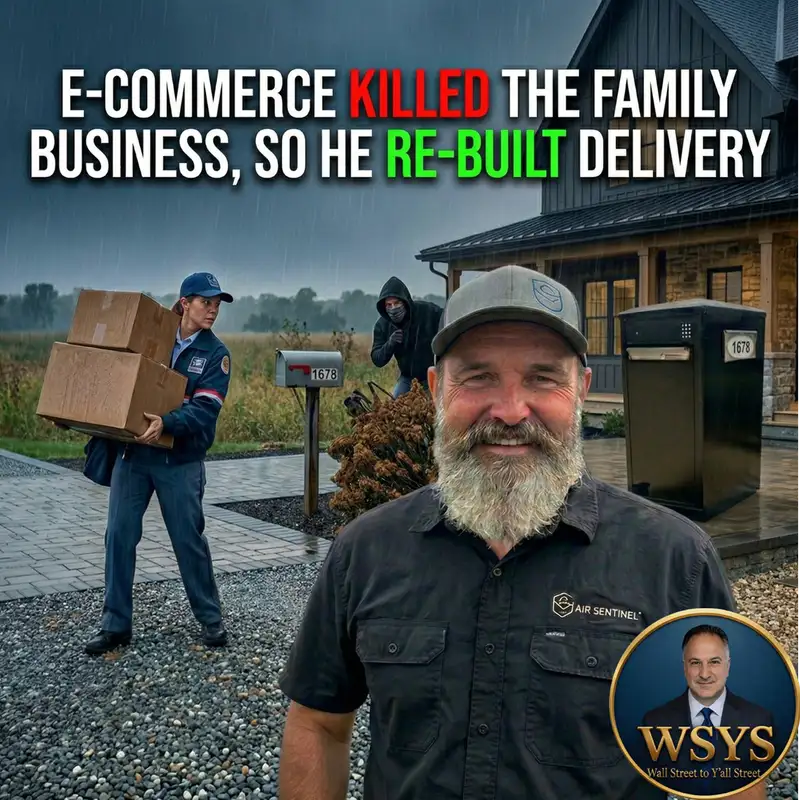
Recognized as the 2021 Texas Best Product Award winner 2022 Texas Award finalist and recipient of the Architecture Master Prize. But this company didn't start in a lab or a pitch deck. In 2017, Jeff watched his postal carrier struggle under the growing pressure of last mile delivery, and you couldn't unsee it.
That moment sparked a new direction after rebuilding a three generation family business disrupted by e-commerce. Today, MB Sentinel Designs practical, secure, and accessible parcel solutions built for a world shaped. By online commerce, porch piracy, and aging demographics, guided by empathy and shaped by collaboration with occupational therapy insights.
Jeff's approach blend innovation with lived experience. He also operates from [00:02:00] a conscious capitalist lens integrating environmental reforestation initiatives into the business model through the MB Sentinel Love Life forest. Today we're talking about hardware versus software, legacy versus disruption, purpose versus profit.
And what it really takes to scale a physical product company and a digital first economy. Jeff, welcome to Wall Street, to y'all street. We are here in your base of operations in Stephenville, Texas, which is west of Dallas. And thank you for the tour of your facility.
Before we get into the inception of MB Sentinel and what you are doing and what you plan to do, maybe you could share with us a little bit of your backstory,
thanks first for even recognizing us, for what we're doing. It's just such a pleasure to continue to get our story out there. Grew up in upstate New York and, it was just a good time. I went to a nice parochial school and then my folks, like a lot of families they split up my father was up in New York State and I moved to [00:03:00] Texas. My stepfather, he's actually a plant manager for Acme Brick. So we moved around a lot.
Every time you moved, you had to meet all the new kids again and be the new kid again. So it's, you learn to, you just learn to try to find a way to get in flow with things. That's just been a great foundation for me, just working outside my comfort zone.
was there anything in your childhood or growing up. You think made you wanna be an entrepreneur? I know you said you, you grew up around an entrepreneurial family. Yeah. Was that it? I, sure. I had nice things when we grew up, our family was doing well and divorce really changed that.
And I knew I wanted those nice things back. So you go to work, if you want those things
Once we moved, it was just a hardship, but a great lesson all at the same time. And so before you started this company about nine years ago, roughly, had you started another company before that or is this your first kind of entrepreneurial journey?
As things started to change in my life where I needed to start figuring out what I wanted to do with my career, I developed a strong liking for trades, I just wanted to be somewhere where I fit in and I could do a good job and enjoy what I did. [00:04:00] And then I knew that I wanted to do something more than work in a sheet metal fabrication shop. ' cause that didn't excite me so much. And I wasn't really into entrepreneurship then.
I was just more intodeveloping myself. So I felt I really wanted to be a C-level head guy. So I went into trades and started doing heavy construction. The guys there said, we gotta get you outta here, and they got me into public utility. So I spent nine years in public utility and developing all the sponsors.
And once I had those. I just knew it wasn't for me. So I moved back to family business. My folks developed, my mom opened a health food store. She helped build this industry. She's a pioneer for natural health products, retail. long before Central Market was even developed, and started chasing the Whole Foods.
It's like our family's been a vital and integral part of that industry. So we built that and then retail shifted, just like you look at SACS now and how they're out because maybe they didn't take care of the customer. There's a lot to talk about, It's I saw that early when Jeff Bezos started selling more than books.
I was like, what's going on here? I should have been saying where's my finance guy? Knowing now as an entrepreneur, I know a lot about [00:05:00] myself that I'm not good at, but I know where to go find that help now.
And I think that's the most important part is just discovering who you are. And then figuring out how all this goes together. But with the way the world's connected now, there's no greater time for small business people to do something amazing. So you are, you're positive on small businesses.
Changing environment, right? There is a lot of consolidation across different industries. Yeah. But you see there's a lot of upside for small businesses. If there's a positive impact that I see for anything right now. That we're all living in this period of time. We didn't think back to what we liked best about our life and when we were privileged to be here and experience this.
And how many people have you heard say that, gosh, I'm glad I was, that we're the age we are that I experienced life like I did. That's really, I never thought that I'd had that perspective to share with someone that could have to just go you're right. It's it's amazing.
Yeah, there's there's a lot of things going on that. Are gonna change that we know nothing about right now. So yeah, it's we're at the infancy of things that are [00:06:00] changing and providing tools to small businesses. And you think of even something as simple as ai, which just came out a couple of years ago.
It's amazing. But we still are at the infancy. You had cheap metal experience, you had entrepreneurial background. 2016, you have a life change, which is right around before you started this company. Sure. Let's get into, how did you come up with, first of all, let's do this. Describe your product.
We manufacture mailbox and package delivery safes. And everybody has the same problem, but not everybody requires the same solution. And that's, speaking to how they live. Do they live in suburbia? If they live in suburbia, they need more of a wall hatch on the garage 'cause things are being delivered to the front porch.
So if things are on your front porch, you need one of our products. That's our hero product. It's called the Box Scholar. And that's an amazing product that's going to actually help people in so many varieties of things for its universal qualities. But when you look at the other products, you know the cabinets that we have, if you have a gated entrance, people love our products for gated entrances.
If they need drive adjacent places. So everything, [00:07:00] it's just, it's a mail and package. It'll be safe, but it just depends on how it needs to function for you. It doesn't need to be a two door or a single door. And that's what we understand how to do well, you have, for example the one that goes in the garage that you can just insert which is essentially a flat panel that's inserted into the garage. And then you have the larger unit that we were looking at earlier that's solar powered. We're not a good, better, best company. Every product's made the same quality and standard. It just depends on the solution you need. If you need capacity, we have that. If you need something that's just gonna be a package transfer into a, an interior room, like a garage or a Amazon closet, we have that too.
So it really just depends on what the need is for capacity. talk to us about assumptions. you had this metal fabrication experience, you had experience across many different things. It sounds like you had some entrepreneurial flare in you. What was the impetus for doing this?
I moved back to my home to retreat from the business that I thought I lost. I thought I was a bad business person. In this time I thought, what did I do to screw this up?
I knew it [00:08:00] wasn't me. I knew what I was fighting because I knew what I had to do to survive in it. I just knew that I didn't likely invest the time properly if you're looking at it from a business person's perspective. Talk a little bit about that for what happened to make you think that you were a bad business person, simply when you have a business that's been longstanding for almost 30 years. And it's going away. It's sometimes it's hard to think why is that happening? And, but the people that are interested in you, in keeping that profitable, which is your family, it's your livelihood you're gonna find a way to keep that viable.
So you start doing different things and, I start diverting products, to online e-commerce companies and doing all those things that help people get these products to market. And I really got to understand when I looked how much vitamin C was being bought a month. I was almost embarrassed at how little I was selling in comparison to my store.
As opposed to, I'm like, oh my gosh, everybody's shopping there, it was like I got to watch people, start shopping on the internet for the products that I was selling that they no longer wanted to come to my store for, even though they liked me, but people just got busy.
It was [00:09:00] just a disruption. You have to pick up and go forward and I, but to move on with this piece, I started this company and my wife and I made a conscious decision, what are we gonna do? She said, see, I said, I've got an idea for this mailbox.
And it was, it happened when I moved back to home office. When I saw this potential start to bloom. And that's when our postal carrier came to our door, like three times in a week. And I thought, being a retail guy, I said to Lisa, I said, Lisa.
We don't have to have just in time inventory here at this house, we, you're killing a post-it carrier. ' I thought somebody should reinvent the mailbox. 'cause this isn't working right.
'cause when you're in business, you're just always fixing problems. You're just geared to fix them. you're just conditioned to fix them. You're there to solve problems. And I saw, and then that just kept aching, I thought, I need to look at that.
And I did that. That's interesting because it's so basic. It is something that was invented a hundred, 150 years ago. Oh yeah. Maybe even longer. Who, I don't know when the mailbox was invented, but it certainly wasn't invented for the age we're in now. With the daily, now deliveries from Amazon that we're receiving and then you have problems that we [00:10:00] never really had before, like porch piracy.
I had the idea to reinvent the mailbox. To help our postal carrier before I heard the term Porch pirate. Yeah. Before I actually, I went, wow. It wasn't a thing yet.
It wasn't a thing yet. And you know what I thought? Because I used to have these. I'd go to the early days of trade shows and things like that, trying to find out if the people really want this, how much time should I invest in this idea? And the people that would come in, they'd be like, oh my God, you stole my idea.
And it was so much fun though, was when being a retailer. When you could help people understand that, hey it's, it takes all this to live in this world, right? But we all have an effect on it one way or the other. And when we, our family, put out all that time and effort to be a great business in that community people still left.
It wasn't enough. So you have a little bit of resentment for that, right? Wow, my family did 30 years for this. And now everybody's gone. But you don't blame it on them. It's just where we're at. You're just frustrated with the moment. But when they would say so you'd have those other people that would come up and say, unbelievable that we have to have a package saved at this day and age.
I said, you know what, [00:11:00] tell me about it. I lost a brick and mortar store and all those shoplifters are coming to your neighborhood. Yeah. 'cause I'm not open anymore. Yeah. So you have this business for decades and you're contributing to community as all small businesses do through employment and taxes and other efforts and for convenience.
People leave willy-nilly. Yeah. And then you're like, ah, you do, rather than let that eat you up you're sitting there and really, I would say MB Sentinel is. a company rather that was born from empathy, your empathy for your postal carrier, right?
That's essentially where we're all carriers. Yeah. It's incredible. It's been a journey. It's something I grew into. It's, I'm not a serial entrepreneur. I'll tell you the name, the term serial, when people would say that to me. Because when I was in the natural products industry I was building different brands, trying to build a brand.
I was always fascinated with building a brand. 'Cause it took a lot of creativity. It took knowledge, it took timing. It was just one of those fun things to do. So it would really keep me captivated,
I was always working to build this brand when I had the opportunity to see what was going on with those postal carriers. And then recognize the, the piece that I did for [00:12:00] luxury, that's where it took off. So we're making a stretch now from, if we're looking at, you're standing on your porch or looking out your window and you're seeing your postal carrier struggle and you have this idea and you know how to fabricate metal, but then we're fast forwarding to where you're shipping these huge boxes and you have customers all over, but there's a lot in between that. As an entrepreneur and founder. And so how do you build that first mailbox?
What was your next step? We had to conceptualize the idea in the incubation period just to figure out if what it would be and if people even liked it, and then if they would find the price point, offensive or what were, could we find a market for this idea? Because I knew people needed it.
They weren't shopping my store, so they quit shopping my store, they were shopping somewhere and I knew where they were shopping, so I just knew where I needed to focus and it wasn't Texas. I built the company in Texas. But the Californians, God bless them, that they set our business on fire.
So you go to your garage, you get some metal, you start banging around, or how do you do that?
You have no manufacturing facility. So how do you do that? How did you [00:13:00] build your first box? It is based on Brian.
I call Brian Lang. He's my co inventor and that's why he is listed.
Brian and I started building this mailbox together. He was my engineer and I knew he could do it. Brian worked in sheet metal fabrication. He's a great engineer and he has worked with us since inception of developing the original designs that we have patented for the original utility.
He's just a great friend and a great guy. And, that's how I started I had the resource, and so I went and I, because it would've been very difficult. And challenging to just say, Hey, let's go find an accelerator, or let's go find, how do you get people to help you there?
It's one thing to go to, as an incubator with a product that's fitting into a category, but you were essentially creating a category that didn't exist, right?
And so you had access to someone with knowhow and knowledge and then, so how did you take it to the next step? Like your first run, your first batch, your first customer base?
So I was highly motivated because I just lost everything, right? So I had to figure this out quickly. And when I started to navigate that, I thought I'm going to have to get this to a position and hopefully find someone [00:14:00] that sees it as well as I do. And that ended up being, high school friends.
So our primary investors, there's two of them. they saw what I had and they knew what I had lost in my company, but they knew the experience I had. I just went out and reconnected with, friends that I had, and it wasn't intentionally to help them become business partners.
so it's, it is just about, if you do a good job of developing those relationships along this journey that we're all on, don't forget where some of those pieces are.
my great friend Jeff, who's I've duplicated myself with to help me do, to be me in this shop. And we don't have to text each other. We just almost, we see it together. Oh yeah. It's crazy. Yeah. Yeah. And it's but we've been apart for 30 years.
And that's, the alignment that is coming forward for our company, but it's all about the people. So you essentially tapped your networking. Yes. Even people you hadn't necessarily had a relationship with for decades, but it's Hey, oh yeah, let's connect. I'm doing this. Oh yeah. And then they're like, oh, actually I can fill that piece of it.
That's it. It's connected with other businesses too.
. I hear so [00:15:00] many people who say, oh, I can't, I have this idea, but I can't do it because I don't have capital, or I don't live in LA or New York or, Dallas or something like that.
But here you are, you're in Stephenville, Texas, population 20,000 no investment capital necessarily. But you found a way to create this company, start this company, yep. And start building these mailboxes out of essentially just an idea. How did you get with the powder coating company?
That's pretty funny. I story Brian Lang, my engineer at the time, I brought this idea to him and he, once we had it formalized, he said there's a powder coat over in Stephenville. That has a conveyor. He said, you need to go over there and get with Dan Malone.
He does a good job. If you need, if you have any volume he will have it. Small company, but they right outta steam build great to work with. So Brian led me here. When I got there, we probably covered the first unit and I even built the pallet, a crate to haul it back to Brian's shop in Ville, Texas, like 40 miles away.
Once we got it there. [00:16:00] I knew we were gonna have a logistic problem hauling that stuff around. I said, this is not gonna work. You're like, this is not gonna work. I said, I've gotta find a way to get inside Dan Malone shop when God rest his soil.
That man got me in there. He just passed within the last 30 days or so. Amazing gentleman. He actually opened up his a back seven square foot area for me. To start incubating the company right there. Really? Yeah. 700 square foot. Yeah. So you have this idea, but you're living a good 45 minutes away, right?
And you're like you team up with someone again through word of mouth. They give you 700 square feet and then you are like, I need to move over there. And that's what essentially brought you over this way. That's right. Okay. We started, doing the power code here and then where we are today, this is our accelerator, which is an a, a different site just across the street.
You have several bays here at this warehouse facility. we got a tour before with all the machinery And you have this process now where you are taking these essentially flat, shiny sheets of metal, right? And going through your different stages.
And then you have this [00:17:00] giant, solid piece of a locked mailbox. How long did it take you to dial in that process? The work product is impeccable. I would picture this huge manufacturing facility to do that. And so how long did it take for you to engineer this to where all of that's just dialed in because it's impeccable work?
Chase Phillips, who is our second engineer, he helped me from the first unit to the rest of the units that we have today. We were working with architectural design people.
I understand how to build things. 'cause I grew up in the trades and I could communicate to chase what we needed to build next. And chase would help me do that. But in between there, there was a company that was local to me that was helping me just fabricate and prototype the pieces that I needed preformed, they call it third party manufactured.
And that would bring them here and put them together. And then when I started. Diversifying the product models. They actually gave me the introduction to Chase
I'm just gonna say reach into your local network and there's a lot of talent there that most people probably don't even understand. Talk to me [00:18:00] about bootstrapping and the hills and valleys and How you approach problems having, especially in the beginning days, limited to no revenue but you have this idea, right? Yeah that's crazy. There's a term I learned last week. we got shared with my friend Jeff. I said, it's capital uncertainty. Say it again? Capital uncertainty. Capital. I said I've been living with capital uncertainty for almost 20 years of my life, but what that means though, to me is. If you're willing to walk that path of capital uncertainty, 'cause you just believe the money's gonna come from somewhere 'cause you know you're doing the right thing. You can't, it's not a formula of success. It's a mindset of, hey, if it's something that you think that you can develop.
And you're going to spend some time doing it. it should be the rest of your wife if it's something you wanna do like this. Commit. You gotta commit. but there's no, and some people have an exit, like Warby Parker and those guys.
Everybody has a different idea. This is how it works for me. that's why it's useful, and very helpful to talk to different entrepreneurs and founders because the mentality is often the same, but the paths are a bit different.
Bootstrapping changes your [00:19:00] lens and your problem solving is a lot different than if you just given $5 million seed money. You just throw money at the problem. But then you know when that money runs out, you don't necessarily have something that can continue.
When you start with the bootstrapping, you solve things and you dial things in a lot faster, which it looks like you've done right? We're scaling and accelerating all at the same time. The business is starting to grow so nice that it's, I feel very good about the momentum that's here.
I understand what we can do here. We can 10 x our company right here, when Jeff and I double checked what we think we understand in this facility. Yes. Wow. we were talking earlier about how you're starting at the luxury end of the market, if you will, on this kind of thing, because if I could share a price point, right?
Like the larger unit we were looking at is roughly $8,500, right? So not cheap, no. Very good quality, obviously. Higher end customer, definitely. Talk to me about customer acquisition. How did you go about getting those first customers? Were you just knocking on doors or how do you do that? Yeah, I knocked on doors, I knocked on gates, like 3000 pamphlets.
Okay. I came, I did not have this beard. [00:20:00] I was on Bethel Road and this guy comes out and his driveway went off the Neverland. I tagged this gate. 'cause I thought, this is a great place for me to develop a relationship with somebody that might wanna buy, the mailbox or the partial box.
And this guy comes out. So that's an owner or kids' owner, I could tell by the quality of vehicle they were driving. But this gentleman, he wasn't happy that I was in his right of way and he ran up behind me and.
I jumped out, I said, what's go time? I'm gonna go show this guy in my mailbox. So you had one with you? No, I had A pamphlet. I didn't even have one made. But this guy, he said, how can I help you? And I said I'm a veteran from Stevenville, Texas, and I held up this brochure and he just I make this Amazon package stuff.
He just throws his hands up no. And He's all dressed up. I said, he had his Make America Great again hat, okay, I love this guy, but he's wearing a red jumpsuit. Looks like he's out of a red, a dare movie. And he's probably about, maybe 10 years. My senior, I looked 20 years younger than this.
So he is no, I'm not gonna do that. And I said I'll tell you what you go do what you need to do to make American great again today. I'll [00:21:00] go do me. A different approach to call a customer. Yeah, my wife. I had like how many years of retail where I've been beat on by customers, right?
you're at your limit already when you go out there and do these things emotionally. My wife's said you cannot do that. I'm like. Yeah. But it may take you a while to scale up with that approach. Oh yeah. Wow. So you go out, you're in the middle of the country and you're like, I have this box that your packages can go in.
And that was the rest of Texas, like the first couple years. With the exception of the people that are builders Association, they saw it early and they thank God, love them. TAB they got they helped me.
Acme Brick has helped me. They've hung in there. They just knew I was early for this region. And that's the way it works. People don't understand the business. People really early adoption happens on the west side.
So yeah, because if you think about it, that is stereotypical, but there is truth is to it. The West coast, the Californians who were your first big customer base, they do think outside the box. They open more open and they're flushed with capital.
And there's a high population density, so maybe porch piracy was invented there, so maybe They saw the utility of it sooner than others from an individual B2C basis. But then [00:22:00] B2B is where you really started getting traction, is my understanding.
The B2B, you're correct. The people started, it took us a while and it was a journey to. Even understand people would specify our product, and it's fun. But it's not like people call us up and say, Hey, they love your stuff.
It's like a general contractor calls you up and say, Hey, you were specified It's that's a trophy every day. I get one of those and I can't wait until we're in a position to further, elevate the gratitude that we have for those people that are out there helping us develop our design sense.
Certainly love to connect with them and let them know that, we're ready to offer the added value that we understand that could help them, and simplify those and costs too, to really meet the needs, of their clientele, love it.
I've had them tell me that we're the coolest thing since the outdoor kitchen. That was amazing, because who doesn't love their outdoor kitchen? It's wow, I'm up there. To think that we've done more for the industry since anyone than anyone else, as a building materials manufacturer, since the outdoor kitchen.
it's just, it's a lot to. Fathom. it just emphasizes the value of the product. And so how does [00:23:00] sometimes in some industries, they have these awards or companies will win awards and it's eh, did that move the needle? I got an award. You've won several awards for this recognition.
Do you think that moves the needle in getting the word out? No. Those awards, each one of them, we have to make application for those awards. And it's when you have to make an application for, even if it's a $400 application fee or whatever it is. They're also it's a lot.
It's also your time. But you have to value what your time's worth now. And you have to get that out there and you're not gonna be able to magnify your voice like you need to, you need others to help you magnify it. And if they're not willing to do that. Then you might think better about where you're spending your time.
I think those awards were vital. We actually went and looked at all of them, which ones we wanted to, thought we could likely, do something with and hopefully it would bring us some visibility. I would encourage everyone to see what's applicable to what they do and just make good decisions.
I think visibility, definitely, you get visibility from it. And just as importantly, in my opinion, you get credibility, right? [00:24:00] Because you're getting recognition from an outside source. 'cause you're not the only one applying and multiple companies who apply for these things and they do look at them.
And an award, it's an award. You earned it. Hey, we stand out. Though we've had, I think one USA today piece That we did, but that's that. Just to ignite the interest for the other people to see us.
So I ignited the USA today piece first, just to get the interest of the people that would have interest in possibly looking at helping us. So think about that, and how beneficial that could be to create the visibility that you want for the right people.
most of the people out there that are very specialized in what they do, they can pick and choose who they wanna work with as they should. So you've gotta make yourself visible to them. There's a complete sea change now and I think for the better of the country, there's a sea change to finally getting back to making things with our hands.
For so long we've imported so much and there's a huge shift back to manufacturing. What is the hardest part of scaling a manufacturing company like this? The hardest part to [00:25:00] me is is not making the product. It's, like you said, the scaling part. It's like a puzzle, it has four sides to it.
you start with the priorities, especially when you're bootstrapping We figure out, okay, we want to, we will take on more risk. We'll buy a piece of equipment and we've actually built a a great relationship over a couple years with AADA this company that actually leased this.
they actually sold this piece of equipment to me, but I didn't have a profit in the business. Wow. That was crazy. Amada. Wow. Yeah, they're amazing manufacturing. Company for press breaks and they great people to work with. I encourage anyone to call ada, so if they have interest in developing a relationship with someone that could help 'em with the equipment piece.
so that's just specifically to like a manufacturing business. And then taking a step back because you do have business experience on the retail side, obviously, which is a different animal than this because B2B is right now where it's at. What are the, is it capital constraints?
Is it doesn't sound like physical constraints so much. Is it capital? Is it customer acquisition? Is it [00:26:00] like what? What do you think would unlock that 10 x you were talking about earlier? What would make that happen? Honestly, right now all it would be is, the more I feed it, the faster it goes.
So it's a Capital constraint. Yeah. I need to increase my burn rate. I need more people that can help me elevate what we've already accomplished to share with others. And it's as simple as, whether there's someone that can actually help me with the social media, I can create the content.
We've got a great team of people already, but it takes a, our service attainable market's measured at $50 million. And that was 2023. You don't do that by yourself. Yeah, I know. And it's gotten to where social media marketing and all that, it's just gotten so expensive.
Yeah. And if it's not done correctly, you can just throw away hundreds of thousands of dollars easily. Yeah. Oh yeah. it can happen Like that. Yeah. I'd rather have people that are investing in our company. It depends on what you wanna build, yeah. It's not everybody wants to build a luxury mailbox company.
They just wanna build maybe a smaller business, but still they're all the same, they're just different economies of scale. What you wanna do with your time and everything else, what do you want from it? but I can't think to this point how to do it differently based on what I had to work with. I didn't know [00:27:00] until probably about a year and a half ago why I felt at my other business really show that, that was like, what was the reason people quit shopping in my stores.
So that just came in a year and a half ago. I was like, my gosh, it really is what happened. What did you think it was before? Or you just still trying to figure it out? I was just trying to figure out how to crack the nut and make it work. 'cause I love the industry so much. I said there's no way, this is not, this can't go away.
I've worked so hard for it to stay there. Anyway it's, but that industry, I learned so much in it and there's so much more I still plan, still working with it now and capital obviously, that's an easy, that fuel on the fire like you said.
But you had also shared with me, I think you have figured it out because you were sharing with me earlier, you are new partnership with ace. And I think that's priceless because they have reach, Talk a little bit about that partnership. I can't say that Ace and I have a partnership yet.
But we've got the beginning of a, I think a great opportunity and privilege to do something awesome. Together. And I think what we can help people understand is that ACE Handyman services are available through [00:28:00] ACE Hardware. It depends on what region they live in, but it's been a handyman service company for more than five years that they acquired that was built long before that they called handyman services, I believe.
I know that great revenue people, so they went out and they bought a franchise to help create visibility for the hardware stores and bring the communities together. And I love all that. So a Handman Services has offered us an opportunity to develop pilot programs with a handyman service franchisees that have interest in working with us.
So we're just working to develop those relationships with those that like to work with us or have interest in working with us, and us come together very nicely and it's so much fun to, connect with people
Yeah. And so instead of Jeff, it's someone's driveway with a pamphlet screaming at the guy. It's someone who's actually been invited, an ace handyman service guy, and he says, Hey, by the way, we have this, that, that's the idea, right? There's this absolutely. So where Ace specifically fits in, we've worked since 21, is a supporter for St.
Jude Children's Research Hospital with the Dream Home Program. And we're actually working to develop our sustainable fundraising program. Nationally, which we already have had this partnership operational [00:29:00] since gosh, April 1st of last year. So we'll almost be at a year. It's it's not like we ran outta the box like Ryan Trehan and raised $11 million in 50 days, which is amazing.
It's truly amazing what they did. And they were at a million dollars on the goal when they started. Wow. And people calculated that.
Long before I knew who Ryan Reon was, I used to have mostly dads that would come to my store when their moms would be down there at St. Jude Children's Research Hospital. They asked me, things to help them with integrative health and what could they do for their kids.
If I could ever do anything for those families, I would. So it, it is pretty easy to find a purpose once I understood the scalability of this company exactly where I wanted to go. And we've already have, I think just a, an amazing privilege to develop a fundraising program, for profit.
They, they don't partner with just anybody. Even a and St. Jude, it's, it almost is an award when you get a partner like that. They vet you. And so that, that's an award in of itself. Build your ecosystems, build your brand ecosystems. And that's where you'll find the longevity, in my opinion, if that's what you're looking to build.
Something, that has, longevity, [00:30:00] but it depends on what you wanna do. If you were to get, a VC firm came in and said, Jeff, we wanna give you X number of dollars and you can 10 x you can blow up, is the idea to stay at the luxury side or do you have an idea to go down?
We talked a little bit about this earlier. What is MB Sentinel, post investment? Yeah. No, really, I've been working hard to not have to take venture capital. What I believe we're at a point right now since we're at revenue. if VC wanted to help me, it should have helped me sooner.
Okay. And right now the ship has sailed. Okay. For a minute. I see most. Publicly traded company's trying to go private. So that's true. So I'm like, what do I, what am I doing? So all I know is I've ripped my ass off and everybody else has helped me build.
This company has too, and we just wanna see it go down the track. So what I'd love to, we just wanna have fun. How much money do you need to have to have a good time? You know what I mean? I see, you know what I've come to understand with everything. Wealth is t-shirt to t-shirt for most families that wanna make them generational and others have done better, I think it'd be more fun to give the money to some of the people that are helping you grow the business first. So I see partial esop. [00:31:00] I'm looking for family fund money. Okay. How do you build a sustainable fundraiser that has such potential, like we do that has a $750 million sum?
And we're donating a hundred dollars a unit to St. Jude Children's Research Hospital. So I have somebody that just wants to donate straight away and not invest it in a company like this. They could, It's like that's the potential of that is they give us five years to figure that out.
It's interesting for those that don't know. And ESOP is an employee stock stock owned plan, basically where the employees own the company and whenever those. transfers happen. It's always a big deal in the news. And so I think back, even to like the famous fish market in Pikes Place, they did it.
And some billionaire every now and then will do it, but it is a rarity for that to happen. but those companies tend to thrive and survive. Because there's total buy-in. It isn't some PE firm on the East coast. There's buy-in. it's fun with as much information as there is out there for entrepreneurs, if you just start looking at esop.
And you're gonna find there's not a lot out there, but a lot of people that are out there at this point. Like you remember the A track and the CD and cassettes and how all [00:32:00] that transition. Right now I see podcasts, people who are experts, they're really there and there's just a few of them for certain things you wanna look for.
But because how many people are looking for that, right? So you only found like maybe two, three, it's not a lot. So you have to find the real leaders for that. And it helps you understand there's enough technology out there for me to understand that I don't want a CPA. That's specifically designed to do nothing but ESOPs.
I'd rather have somebody that helps me measure that better, that's just not married to it, because I think a partial ESOP is what my family needs. Because we've spent eight years building this company and it's taking all the resources that we have to bootstrap it. So to make it bigger, we could either do two things.
We need to sell the company, and have a nice payday and everybody's good. Or we can move forward and do something that's purpose driven, which is what we would feel disappointed about. Two days on the beach having not done it. That's my wife and I talk to a lot of founders and they say that, they're like, yeah, I could sell, but then what?
Yeah. I actually like what I'm doing. Is it challenging? Do I don't have a second life to do this again? Yeah. You know what I mean? Yeah. And you also, you wanna see it through what can I do with this? [00:33:00] What can it become? Absolutely. There's something to that. Oh yeah. I believe with what we have.
It just continues to elevate and magnify when we develop the right parallel partnerships with people. It's St. Jude Children's Research Hospital. You can imagine how many people don't know about Ace Handyman's services in their area but they know about St. Jude.
90% of the population does. They understand there's St. Jude Dream Home local to them. So if they have a St. Jude Dream home local to them and St. Jude Dream Home starts creating visibility for MB sent on the box scholar, which people love, and Fox Affiliate News Networks help. Create visibility for that too.
Then we offer immediate access to consumers that have existing home with Ace and you get them aligned with the piece, like St. Jude, and they're already doing such a great job with Children's Miracle Network. I see putting those Miracle networks and all those pieces together.
And ultimately as our business thrives and grows, provided we have the privilege to do it and we're supposed to, you start with the next level foundations like Thomas the Towers operation, founding Home, that's where the nationals and everyone hangs out. I start at the top to build my company.
I didn't start at the [00:34:00] top, in the quality of things that we built. I didn't start at the top of people I thought would buy it in volume. I couldn't have, I couldn't do that anyway. But don't you think that could feed it? So for example, if you were to team up with a large home builder, like a Lennar or a deal?
For sure. So that's the volume. They're putting it out. Thousands and thousands of homes. We're not even in the housing boom, and they're still building thousands and thousands of homes. They're trying to catch up. We have a huge growth of homes. But, so maybe you don't want to go that route but if you were to, it could feed Yeah.
More for St. Jude's. Anything that would feed the Jude. Yeah. And I could do it without losing quality of what we're doing, but we already have partnerships lined up with like best manufacturing in Arkansas. we've been looking at this, waiting for this to happen for three, four years.
So when things happen, I know how to accelerate and hold the line and pick up local support to keep this working well, we're figuring out how best needs to build there for us. And so best would be, they'd be a third party manufacturer for you. And if I had the resources, I'd be there now.
So that's the scalability to So you, so this space can take you to a certain, but then you're lining a partner. Yeah, that's right. So you're doing something a lot of founders don't do. You're thinking down the [00:35:00] road. I'm not trying to build a mega factory.
I wanna accelerate my business through third party manufacturing for one product, which is the hero product at Box Call. 'cause it's the easiest thing to make. And they can make it really well, they can make it to the quality standard that we want them to. When you start working it with other products that become a little bit more sophisticated in their design and functionality, it's a lot to ask someone to do So we're gonna focus on the luxury piece always. That's gonna be our bread and. This is our baby. we're gonna have the world's first luxury mailbox company. The world's what? First luxury mailbox company.
Okay. So what about a way a lot of founders can scale or have scaled in the past is that they invent something like what you've done and then images license it to someone. Is that something you would ever consider, or do you want to be more involved in the manufacturing process?
Even if you had a 3:00 PM you're still involved. The licensing parts would likely be if I were to consider them, and I would say that I would be for international opportunities. Okay. Here in the states, licensing doesn't interest me so much for anything. I don't even want the licensing, distraction of an idea, someone else's idea.
I, I just, we're just gonna work on what we do. Our core businesses with [00:36:00] architectural landscape design people we know we can do a great job for the middle market. We're just gonna just keep riding with the Jude to keep things going. Your passion for St. Jude, it just comes through because you bring it up often and that, that's wonderful.
I think that's great. And as you grow, it's clear you intend, I think you have a multi-year thing going on with them right now you said, right? Yeah. That's. It's such a privilege. Yeah. That's wild. It's since 21 two's, while to get that one. But it'll be fun to see, you know what we conquer where you can take, yeah.
So you wanna be like the world's first luxury mailbox. What about a lower end of the market? Even at a lower end? It's still going to be a couple thousand. Oh, that's just one thing. I just wanna build those types of products and I know that we can, but they're the middle market.
There's several different markets for all this. I don't want, we're not gonna go below the middle. everything we ever make, it'll be something of quality. And that's the floor. so long as we can get a price point that allows us to make some profit to give back and have a little for ourselves, but the quality level is there.
So that MB Sentinel Is known as a solid brand share with a premium product company. There's real dollars to [00:37:00] share and, there's customer, cost per acquisitions too. To relate with other partners and have, lateral business opportunities with people that just have the same customer.
I see that build local piece doing really well to get us out there. 'cause once you have all the pieces together, it should work. We'll see though. So let's talk a little bit about competition. how have you seen that? How do you see. Is it an issue in something like this? Because manufacturing, I think that can be copied.
Yeah. I don't think about that as much as I think about, who's moving to get out front. I think about, our products are, they're necessity now, but. When won't they be, you notice when, you know they have a drone delivery garage that's also your golf cart garage or something that meets the delivery truck up in your neighborhood.
Then what's the lifecycle, of your company? Oh, it's there's so many things to think about, right? I just, with anybody, I would just tell 'em, look back to, look forward sometimes a little bit. Wherever you're at with some of this stuff.
So regardless of how the market evolves, you should be able to fit somewhere in it, even if they have a robot that goes to get, that's it. To meet the delivery truck, to get the package. [00:38:00] There's still some people who will say, no, I just need a box. yeah. Smart box. Yeah. I think the hills and valleys are so much similar between this and a lot of even service-based businesses. There there's definitely a lot of overlap, but then you do have unique challenges.
I think, you should be saluted for. Giving back to St. Jude and the things that you're doing with them and certainly the awards you won and teaming up potentially with Ace and others is definitely a salute. I love what we're doing with the universities.
So you your essential labor is from an intern basis. Oh, yeah. Again, startup mentality. Bootstrapping. We, that we both, we've got when I started the business is myself and my son and Brandon's, Brandon still works with our company.
My son is, he's 30. He's been worked with me his whole life. That's a whole story in itself, but he's taking a little bit of a break 'cause it's a good time for him too. But he'll be back as soon as my role here is done and Jeff's in a position, he's having an arrest right now.
He'll be able to come back in and take this piece on and I'll move out to further elevate the relationships with our customers and all the other things we do. But, and these interns, everything that we have different jobs that would be ongoing for [00:39:00] interns. So young guy that was showing up when we were filming, he was coming into, help us develop some things that we use for material handling. Whether it's these carts or things like that. So we love to have engagement with the interns. That have a vocational interest and something similar. 'Cause that's where you really get to cultivate them. 'cause then they come in and they, maybe they get to go somewhere and who knows for the type of company we're looking to do, they may stay.
Or maybe they come back in 10 years after they know how awesome it is or who knows. Or they tell their buddy about it or something. You never know where that goes. Or they write it up to partial ESOP and then they cash out and they go start their own. Or whatever, Karma giving it back and whatnot. So you, this all. Probably came from the impetus of being a bootstrapping and how can I need this to happen. I have that resource. How can I do this with this limited resource? And so you approached universities to get on their interim program?
I needed the help anyway, I needed it fractionally, so I just did a, I got with gosh, it was I forget what do you call it? Anyway there's a whole. Piece that can go out there. If you wanna buy, find kids that wanna do internships nationally for sales. They're all there.
Okay. It's just a matter of connecting, I think. [00:40:00] But to keep it simple, for anybody that's a small business person now that's just working hard to maybe make their business better, I would encourage 'em, the easy piece are to go out there and network with, whoever it is that they think they may have in their own brand ecosystem or their remote ecosystem to further elevate.
They're businesses together. IE the guy that does the windows here, local to us, the window washing guy. What's a window washing guy and a mailbox guy have to do together? The $6,000 houses that he's washing windows for might need a mailbox. Okay. And then they might need a free window washing with the mailbox.
Yeah. You get some synergy there by connecting with someone you wouldn't even think has any application. They're already doing the windows anyway. Yeah. And again, they're not out at the gate yelling with the pamphlet. No. Yeah. So it's just about, I think it's really fun to get to build local movement going.
It's gonna be fun to see if we can get that up and bumping, but it looks like we've got great hope for that. I've got the plant people in Fort Worth. They're an architectural landscape design firm. Sarah Jet, she just purchased that company after being an operations manager for 15 years.
[00:41:00] And she actually worked with me at my health food store and did our book then. It's just so amazing. Oh, full circle. So we've got. Full access to developing placements with anyone here locally with great help, and we'll do a good job for them. But Sarah I see great opportunity for her to elevate her business in architectural landscape design, with the package delivery solutions that we offer folks.
Okay? And that'll give back to the same community here locally. We get that up and running and then it'll just be ongoing. Okay. And then last thing I wanna talk about is, yeah, you just talked about how you have this plan for your son to come in and take position when he's finished and then you elevate, and then you're essentially out of the warehouse and you are literally just focusing laser focused on customer acquisition.
Is that correct? Yeah. That's elevating. Just the purpose driven brand, I think is all we have to do. The acquisition helps. It just it just comes with it. We've, the customer acquisition piece was part of the design of what we do and everything that we've put together in our go-to-market formula.
It's just fun to be able to employ all that and it should just [00:42:00] come. and especially if you have, the head of the company focusing on just that aspect of it, that just feeds everything else. And you've got it dialed in here, so you know, the quality is there, it's being kicked out.
Having a wife that's an occupational therapist that's worked in geriatric care for over 30 years, she'll be a great figurehead. it's actually, if it wasn't for Lisa, we wouldn't have the quality that we have in the universal designs, she's just such a great person when it comes to understanding those pieces. So it really it's just a fun place to be. And so what you're getting to with that is the aging demographic and your customer base aging place. The older customers who may have issues opening a door or getting a package.
We've already got our assets together for that. And it's a campaign like Imagine Ace when they put it out there as, slips and falls, what happen with age, but the front porch doesn't have to be the stage. And boom, it's the box gobbler. And a hundred dollars goes to St.
People love that already now available through Ace Handyman services. In your area. And it's just like that. We're hoping does very well. It all ties in. Or even someone who can't necessarily easily get outside to the front of their house. They can go into their [00:43:00] garage and retrieve a package.
Yep. I think there's strong, like for for folks that have interest in Paralympic sports and things like that, whether those are the types of people that we'll align with, as influencers likely to help us create visibility for those universal qualities, that we offer.
To further elevate what we wanna do with the industry, with the CEU trainings to help create visibility, in an entertaining way for cool products. They're gonna help everyone and themselves as a business. So it's gonna be a good time. It's just so much work to do, just all about finding the right people, yeah. Always so much work to do as a founder. So if people want more information on the product, the company, how to order the website is. MB sentinel.com. Yep. Okay. Or just look me up on LinkedIn, Jeff Kudi. I'll include that link. Yeah, that sounds great.