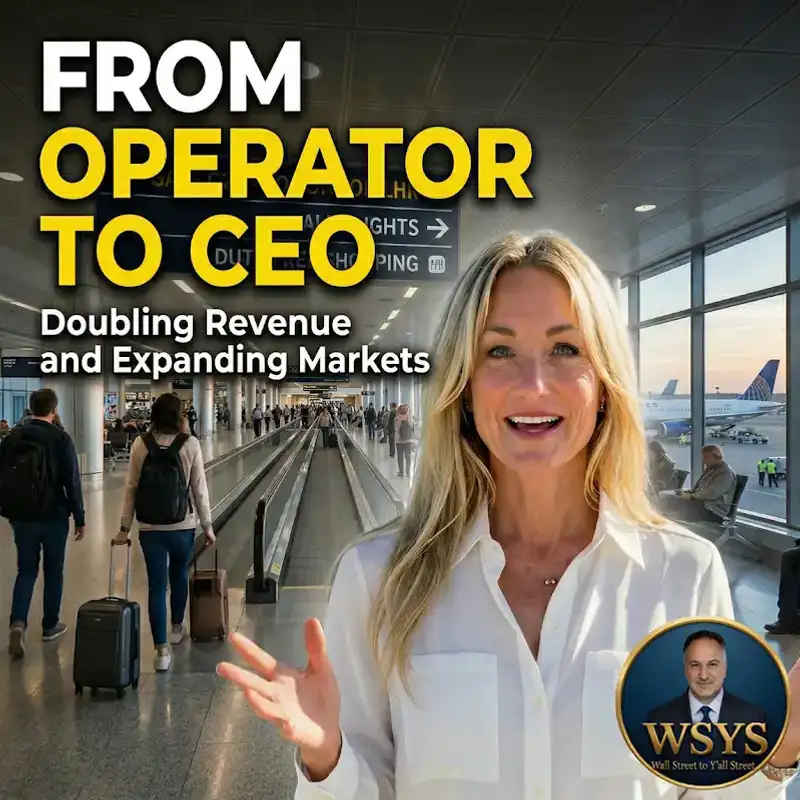
The Moment She Stopped Being the Operator and Became the CEO | Kris Klein, CEO Pollen Sense
Download MP3[00:00:00] All right, so we are recording. Wonderful. I am here today with Chris Klein. CEO of pollen sense. Thank you, for being with me today. and you're building something that people rarely think about, but that affects billions of us every day.
You're building something that senses what's in our air, right? so your CEO and founder of Pollen Sense, which is a deep tech health data company, and I'm just generalizing here. You can correct me, but you're transforming how we understand airborne health threats. pollen sensors patented AI sensors.
Continuously identify airborne particles, whether it's pollens, mold, dust, other bio aerosols in real time, replacing how this used to happen in a manual count. my understanding is pollens is now deployed in about two dozen countries. Is that right? Yeah. And building what many believe is that missing data layer between environmental exposure and clinical outcomes.
Helping like hospitals, factories, public agencies, governments determine what's in the air [00:01:00] and causing, maybe asthma spikes or loss of product or something like that. And, but you did not start in a lab, right? You have over 25 years in experience of strategic growth, business development, healthcare consulting, live media, national event leadership, and before becoming CEO recently. Paul and sense you served as VP of Global Sales and strategy, helping expand the company's reach worldwide. You're also a founder of a senior health, living space. You've worked directly with hospitals and healthcare systems long before entering this. Paul itself sense itself was recently named in a Health Wildcatters 2025 cohort.
We want to hear about that as well as recognized by Startup Grind, Frisco Startup of the year, which is validation not only beyond the 25 countries, but also getting, traction, from, an investor standpoint. so today we're talking about AI in healthcare, public health, blind spots, founder pressures.
And why the air we breathe may be the next frontier in medical [00:02:00] data. Chris, welcomebefore we get to Pollen Sense and how you became CEO and the great things your company is doing under your leadership. Let's step back and talk to us a bit about how you ended up in business in general, because you have a very storied background, right?
Yeah, Joe, I'm definitely, I laugh and say I'm a wild card. so I grew up traveling. and just moving around a lot as a kid. so I learned to fit into different groups and grew up in theater, and being on stage as a dancer.
So after high school, I made a deal with my parents, that I would get a job dancing in that first year after high school. and I did. I don't think they believed me 'cause I wasn't always the best, but I loved to perform. And I was, everything that I set out to do, which was really interesting, this was like the start of it.
Whenever I would say I'm gonna do this, I would always pull it off. And so I said, I really, I wanna get a job dancing, somebody's gonna pay me to do that. I went up to an audition and I actually got the job. So after [00:03:00] high school, I went off and was a professional dancer for a few years. And got into, real estate and new development and property management and learned new business development instead of just managing established business. And then from that it it snowballed into physician recruiting and healthcare marketing and a slew of things. But really where when I look back over 25 years. of, third, 25 to 30 years of career. it really, it had a theme of new development, new markets, new business, and growing business in a big way for a lot of other people. Interesting. so if I were to sum that up, you were a theme park dancer, a morning show personality, a senior living.
Business development and now naturally morphed into CEO of a deep tech health data company, AI data company, not your traditional path. And what do you think carried over, for example, from event [00:04:00] marketing to being CEO of this company? give that as an example. I'd say that I have a degree in people.
Okay. Really, it's being able to see the lay of the land, see the strategy. And I say, see, because it is very intuitive. but being able to see the path to go forward, being able to work really closely with a team and have everybody be passionate and have everybody just get the big vision. it was a process of that and pulling all those different pieces together, and seeing, what if we pull our resources and we've got this great little team, then what we could do is we're gonna double revenue. And we're gonna bring in the biggest customers that we could possibly bring in enterprise globally into this company and put ourselves in the right place.
And everybody trusted me and they jumped on board with it. And after we doubled revenue, and we literally landed some of the biggest enterprise customers. As first time pilot customers, we know that the company saw that. Maybe I should go ahead and just be at the helm of what we're doing because you started out right in the other [00:05:00] positions and so it sounds like charisma is probably just as important or maybe more important then competence.
Would you say that? Yeah, I would definitely couple. a very strong resiliency. Through life because when you grow up on stage, you get turned down a lot. You are auditioning, you get cut a lot. You constantly hear no. And you said, that's okay. It's not gonna beat me down. I'm gonna get up and I'm gonna try again.
So resiliency and tenacity I think have been really, big parts in my success so far in life, even though, that wasn't always the favorite. To all of my bosses. With those two, that's typical of, the founder entrepreneurial mindset, though, they don't make the best employees necessarily.
No. Because they have ideas. Yeah. And, they see things from a different lens. So what do you think people most misunderstand about what skillset is necessary to be a good CEO, a good leader? [00:06:00] I've, for me it's a lot of positivity. Not being ignorant of the, the fires that could be around, but honestly, it's being authentic and genuine and having a positive outlook that, okay, even if we do have something that goes down, how are we gonna make it better?
How are we moving forward? I think that's been a big part of my success too. I'm hearing a lot of team building. So you are a big team builder. So it's finding the right people to do a job. Obviously any business has to do that, but maybe once you get 'em in the door, continuing that effort. So it's not just a six round interview or whatever it is to hire someone, but then there are steps beyond that. To bring the team together. So talk to us a little bit just so we have an understanding, because I certainly didn't, when I looked at it from the outside and saw what you were doing, I was like, wow, what is pollen sense? And so you think about, we track our steps, our calories, our heart rate, but we don't necessarily track what we're breathing. Talk to us about what Paul and sense. Does and [00:07:00] the how. It's on the advent of AI, if you will. So Poland Sense is patented physical AI data infrastructure.
And what that is that instead of using a chat or an LLM to predict. Things. We use a different form of AI and we use vision machine learning. So to be all technical about it really it's because, and it was formed because we're breathing 20,000 times a day. 20,000 times a day. And the current technology can't tell you what you're breathing right now. it could be that there's stuff in the air. And that stuff might be a PM 2.5 like you hear on the news or PM 10, and we know that could be bad for our health. But why? What's it made of? And there are so many more indicators for health and for our environment and for industrial use of what, and knowing what is act actually in the air that could be hurting us or costing us millions of dollars in operational [00:08:00] expenses. Talk to us about that because before when I was setting up, you were talking a little bit about the industrial applications and I was like, oh, this is good stuff. Save this. don't forget, we have to talk to him about this again. Give us an insight into how pollen incense can be used, say from an industrial perspective.
Yeah. So get the name pollen outta your mind. Because really what we do is we've got an optical sensor that will collect airborne particles. And then we take about a thousand pictures of these particles that are trapped on a tape. And then we generate with that thousand pictures, we compress it into one and we generate one of those every one to three minutes.
So what this means, and that's continuous monitoring and continuous identification, first detecting, and then classifying what those particles are. So what this means in any setting, whether it be outdoors for aero allergens. Indoors for even pet dander or asbestos in a space or mold. This could also be in industrial spaces.
So with this whole [00:09:00] platform that we have the training infrastructure to be able to take a particle sample and build that data set to then be identified by the sensor. So then I can put it in your manufacturing, in your facility, and for whatever you want to monitor for. Or just say it's something in general, there's dust particles or mold, then we could put that in there and then it can detect it round the clock.
So then, if you have a leak, then you know, if one of your crews maybe overnight isn't following with their compliance. it just has a lot of different data that's really useful that could save a lot of money. just to break it down, which is very technical. And so to try to break it down in, into a layman's perspective, essentially, a client who has, because I think everyone understands the importance of detecting dust, for example, in a semiconductor facility that could obviously cause issues, Processing something, they give you an ingredient. You train your AI to detect that. It takes these pictures, you give them real time data, every one to three minutes. And then they know, for example, [00:10:00] is there a leakage of this in our process? That is right. And then you've got hourly reporting.
So you can see really quickly from anywhere. You don't even have to wait on the lab result. Which could be really timely and expensive. You could be watching on your laptop or looking on your phone from anywhere in the world, checking in on that data to see is there a spike? Wow. Now what's that spike attributed to?
Was there an event that happened? Did our HVAC did some filter system fail? what are we looking at? So you could mitigate that risk almost immediately. And the way this was done prior to this AI technology, it was literally just counted on. They'll go in with a single air sample. And they'll monitor 75 liters of the air, for example, depending on the situation. And then they'll take that sample, they'll ship it to a lab. The lab goes through their process. They're gonna give, they're gonna update you in a few days at best. Here's what we've got, but what's happened before, after, and during that time.
Yeah. So you're getting trailing [00:11:00] data, right? it's days old. It's a snapshot in time. And who knows during that three to five day period how much money you've lost, How off your production could be. So there's real utility to this. the other application would be, I think we had talked about like hospitals. Is that right? So talk a little bit about that. It would be excellent for hospitals looking in monitoring their patient rooms or the in, in an or. As well. if you have contaminants, we know that, sometimes when we go to the hospital, sometimes we get a little sicker. they clean the heck out of the space. But if you are in there and you're sick and you're, immune compromised, or you've got wounds or something And something happens, a lot of hospitals are doing construction. Something gets in, if it's a big enough biological or big enough particle, then we can identify that.
So if there's an outbreak in something and it's a big enough, then we can see that. so it's really helpful when it comes to that layer of air quality monitoring. So it's particulate, it's not necessarily virus or bacteria. Correct. Okay. Yeah. So if it would have to be a big [00:12:00] enough. bacteria or virus, most of them are gonna be too small. but even we can even see red blood cells, that's a big enough. Micron size. Yeah. Okay. Interesting. Okay, so there are some biologicals that, defense contractors. Want to see, whenever they ask me about them. 'cause we've had a lot of conversations for public spaces and interior spaces like anti-terrorism.
Yes. So they'll want to see certain things. even though they tell me it might be pollen and mold, I tell them that they've got a sample of it. You could go and get a train it. but there are other biologicals out there that we don't know about. that there are other applications.
So our technology, even though it's. Deep tech. Also has a dual tech capability. So let's talk about, you came into the company from a sales and marketing perspective, and the idea, I think, in that role was to grow the company. I don't think you necessarily came in saying, I'm gonna be CEO one day.
Is that right? Correct. So you come in and talk to us about your progression, like how many countries was the company in when you came in? we [00:13:00] were in, when I came in. Full-time consulting. a few years ago, I think we were at about 20. Okay. Roughly. Okay. So we've added six other countries.
Talk about that. How have you grown this? How have you added on six? 'cause to me that sounds huge. Like how do you add on and break into another market with regional differences, cultural differences? How do you explain what this technology is? How do you do that? People find us. Okay. It's amazing. We do what nobody else in the world can do at a portable, timely, and scalable level. so when you look at competition, so to speak, and other countries in Europe, they've been really concerned about particulate matter in the air for a lot longer than we have in North America. so when the, air quality monitoring group in Kazakhstan. Reaches out, they're looking online for a solution or on a chat and they find us, or through the world Abiology community.
And because we're so research driven, we enter it in [00:14:00] research and to be able to change the world, you've gotta have validation. And a lot of the, chatter and a lot of different events. That word gets around for what we can do. And we do it at an affordable rate too. When you're looking at.
Some of the competition in Europe is the size of a camping refrigerator, and it's 150,000 US dollars. Plus it could be 30 to $40,000 a year after that for that one machine. And you're not gonna bring it around where we could be in a 5,000 range and it's portable. It's the size of an old bunch box. and it works immediately.
Like it's just plug. We can deliver something that's a lot more useful. And is, that's largely because you are leveraging ai. Where they're leveraging kind of old school technology. Is that the reason some of them are leveraging? they're, let me back up. They're leveraging, more spectroscopy and lasers.
Okay. Except we, we are definitely using AI in a different manner. Okay. Absolutely. Because it's all photo based. Yeah. What about, okay, [00:15:00] not a lot of businesses say, our customers are coming to us. it's just, yeah. and it's not that easy. I know It's not just falling in your lap.
You still have to explain it and sell it and the utility and the price point obviously helps, and we put ourselves out there. Don't get me wrong, I'm not kicked back just waiting on an email to come through the phone to ring. we're at the right events. when you're a small team, you've gotta be capital efficient and you've gotta be able to grow.
But when you are the person leading the sales, leading the strategy, looking at all of those pieces and making sure fulfillment's lined up and all that stuff, it's a lot. So with me, I would go to events. And I would set up there and I would meet the right people like meeting Proctor and Gamble at an industrial event, just getting to build those relationships, which you are working with, right? Can you get set up? can you share that they let me say their name. So share what you're doing with them if you can. So we're working on a paid pilot right now at Proctor and Gamble. it took a couple years to get here. So it's not an overnight, not so easy success, even though it sounds like it. and what we do is they will, send us some ingredients, let's say. And we will [00:16:00] teach our AI to detect that ingredient and to identify that, and we're about to launch in one of their manufacturing facilities to go and see, all right, like, how exciting is this? Is it gonna go where we really think it's gonna go? and the plan is to be able to go across all their manufacturing. That was their idea, by the way. And it could be the thing where nothing is sensed for years, but that one instance where there's leakage or breakage in the system. It's Hey, we have to plug this gap and it completely pays for itself, right?
Or avoiding an industrial accident because who knows what the ingredient is? What about, so in talking about these, going back to these other countries, coming to you and finding you at conferences or through word of mouth or the internet. How do you deal with regional and cultural differences? 'cause I would imagine negotiating with someone in Ireland would be different than Kazakhstan. how do you deal with that? sometimes I look it up and I educate myself. So when we went and did, a partnership launch, a distribution channel partnership launch in Singapore. it was helpful beforehand to [00:17:00] study up on some of the culture before actually being in the middle of it. so I'll do that before I have a call with someone from another country. I'll look some things up so I know whenever I'm dealing, with the country of France, we have a lot of business with France. I try not to be too excited and, Hey, how are you doing today? interesting, because they, it's not their culture.
So they can get annoyed by, it's such a small nuance thing, right? Small. Yeah. It's so small and nuanced that, if you don't do that, you could potentially kill the deal. Yeah, Image offending them and maybe they have another option. Interesting. And so do you go on chat? Do you go on Google?
Do you go on YouTube? Like how does a CEO. Research that if they're not, I use everything, all the above. you'll see me at five or six in the morning listening to YouTube lectures and stuff. That's. my morning, boring time with a cup of coffee. I do that and then I utilize a lot of different LLM platforms, so chat platforms. I like different ones. Sometimes I'll create a room [00:18:00] of like agents or a group or a fake board, or a group of people in the chat. I will tell it, okay, these are the personality types that I want. Here's my intention with this deal.
What could be a possible outcome and then utilize research from what you know about that country and how their government works. and then their data usage and playing all these different parts in there. Like I definitely do, I guess what I would call like my homework. To be able to hopefully make it a win.
You're essentially building a focus group, right? Yeah. But doing it at such a team of one, if a team of one, and it's such. Quick turnaround, right? Like you said, you're having your copy at 5:00 AM and you're doing this, whereas in the past you would have to confer with executives, bring in a consultant and, yeah.
Pitch. And how do I do this and refine it and record yourself and watch it. And you're able to do this with AI just because you know how to prompt it. It's, it's amazing that the tools, that could be a whole episode itself, right? I do travel around too. Sure. Yeah. So in [00:19:00] 2024, so I came on as a consultant.
In 2023, I was watching the company for a couple of years and I was invited to do a presentation for a national group for them. They needed some help. So I, with for Paulin Senses. and whenever I saw that, I saw, there's this huge other market. I started to see some of the strategy and so I said, just let me.
Just let me, and I as like you said, like a true entrepreneur. I had a line of credit and I didn't make any money and I worked for free for that year. I said, just let me look at this other industry. I said, I'll pay for all my conferences. I will, I got it. Just let me. So I went and I started working that and it wasn't always the smoothest. but I started to see a lot, And with that, being able to do more of the development, so how to explain, I can't imagine you've done this before. I can't imagine Chris going to so companies over the last 20 years and saying, Hey, I'm gonna work for free, Yes. and the guise of I want to be CEO. And I know that wasn't necessarily. What you were gunning for, right? it happened [00:20:00] because you proved yourself. What made you see something in this company to do that's a huge risk. It was going around. So whenever I worked for free in 2024, I went around.
Whenever I got vp, whenever I was brought in to be VP of sales and strategy and everything, lead all that. I said, we need to go meet with some of these top researchers and these early customers. We need to go get in front of 'em. So I booked a one-way ticket to Europe. Flew into Greece and started getting in front of some of these customers, doing these research projects. that helped with learning some of the culture and getting to build those relationships whenever you make that effort to go be in front of them. Yes, it's expensive. Yes, I have debt, but that was really part of the success of it, was saying, we gotta do this. I'm not gonna sit in the office and say, oh, we've gotta raise money before we can do that.
I thought. I'm gonna get out there and I'm gonna do it because I see the potential in this and we're gonna grow it. But first we've gotta go get in front of everybody. That helped to learn more of the culture, [00:21:00] more of the ways. Did different parts of Europe for a few weeks. Went around, ended up at the end of that year going to Southeast Asia, went to a couple of countries there, worked in the launch of it with 19 other countries with the distribution channel partners there. started to network and then just started to build this global network of communication with everyone. So that was in my first, full year onboard, technically not as a consultant. and then being able to move from that. We, I more than doubled revenue. Oh my goodness. In 2025 from all the previous years, it was just the same in the validation kind of product market fit testing stage.
And then I was able to double the revenue because I spent the time and the money, but spent the time to go around and say, okay, let me hear you. And we're not just a research project, we're gonna grow this. So let me hear you from a an NGO perspective or a government or, a private business. So now I'm working with allergy clinics and news [00:22:00] stations and stuff.
So that's been a big part of it. And I think through that, whenever the board started to see. The changes. I nudge my way through quite a bit, get outta my way. And they said, alright, let's just get outta her way, because they're brilliant scientists that really started the company. brilliant scientists and engineers. but they're not the people person. And then it's me. And so finally they shifted and said, okay, we're gonna support you. And you go and take us there. You almost gave them no choice. I really gave them no choice Numbers don't lie. Yeah. and when they saw the fruits of what you were doing Yeah. you put an equity, you're an investor and so they elevated you in quick order, To this position as CEO. wow. that's amazing.
so Noah, I started to put out there, Hey, we've got a layer of forecast data that nobody else can do because we have this network of ground juice sensors, providing hourly data. So we've got this layer of data and I wanted to [00:23:00] expand our data market. So I talked to Noah that I connected with through some.
Big NGO organizations, and now Noah's getting ready to publish on data that they've been actually using our data to validate their, against their model, to improve their model. They've been able to license a layer of our, forecast outdoor air data. it's been a really great partnership. So I'm working closely with Noah. On expanding that and then hopefully working more with federal funds and stuff. But with bringing all these big partners in, it was, it made a lot of sense to let me be the front man. sure. Yeah. you developed the relationships and it's just a natural progression. What changed when you moved from being, sales and marketing and going out and building the business and now you're CEO, what changed? Hi. I work longer hours maybe. Okay. so I took on some more responsibilities. Okay. For sure. But with the right [00:24:00] support, it's really helpful because I'm still leading all the sales and marketing and everything right now.
I'm still leading that development until we have the rockstar team. and I'm gonna be really picky about that. Whenever we can duplicate me in that space, then we'll bring on more support. And we do have customer success team that we've started to implement, so that's been really helpful. but really what changed was that I, I took on some more work. So you're still doing the role. Of, growing into new accounts, new countries While you are managing from a CEO perspective, and the goal is to move more into that CEO role, when you get someone to take on the travel and the relationship building, is that Yes. I think we'll balance that.
Yeah. So I really, it's important, I believe, at this growth stage. until we're 50, 75, a hundred million, until we're in that space. I think having that face time is really crucial right now for all of our big partnerships. and then being able to grow the [00:25:00] sales and the revenue with someone that's got an enterprise background.
Will be really important too. But right now I've got those relationships and I think it is really important that we continue that for a while. So you talked to me prior about, some decisions you had to make and where you are with respect to, for example, capital raising. And I know you've been in this role, CEO for a shorter period of time VP and sales and growth, but what are some of the hardest decisions you've already had to make in this short period of time? it's been, one, we grew up as a company, so we became a C Corp. Okay. in my time as CEO, my short time so far as CEO, and then pushing to say, look, we really need to do a capital raise if we are gonna scale this to, a multi a hundred million dollar exit. then we are, we're gonna have to raise funding. So I pushed really tough, with the board, to be able to go into the cohort with Health Wildcatters, which has really beneficial to be able to tap into the [00:26:00] network and explain what is Health Wildcatters.
So Health Wildcatters is a life sciences accelerator program. So they invest in you some and then you have. It was a second full-time job, but we had mentors that would come in multiple days a week, so it was like being in school. Multiple days a week while also running sales and a business. but it was this great network in my own backyard in Dallas and the venture space and in the growing life sciences hub and tech hub.
That is the state of Texas. Yeah. Especially with y'all street coming in the backyard. Yeah. There's just so much money that's already moved in, but there's so much more that's coming. It's an exciting time in Texas. that's for sure. The migration is definitely real. What surprised you most about stepping into role as CEO that you just didn't see coming? there's a lot of pressure. now I put all the pressure on myself, I'm the breadwinner for everybody in the company. I look at it that way. So if we're not, if we're not on target to where we [00:27:00] need to be, then I potentially. I bomb for everybody and their families. There's a lot of pressure with that.
Yeah. I definitely started to sleep less. but at the same time there was relief that finally instead of trying to bust through these walls. To say, let me, I have the opportunity and now I have the support that I really needed, from the start. But I just proved myself to be able to get there.
And now going into capital raise, now it's learning. Okay, how are we gonna structure. Everything. I can't just pick up the phone yet and call a gc, a general counsel and say, oh, cool. This is what we wanna do now. Make it happen. That'll be beautiful. So talk a little bit about that. you hear so much about companies who are in the capital raising stage and then all of a sudden, the next thing you hear, they're a unicorn. Talk to us a little about, at this stage, peek behind the scenes about. Fundraising realities, capital raising. What are you facing? What are the frustration or the friction? I [00:28:00] pitch and I pitch and I pitch, all the time. and it started. That I didn't have the right story, because people weren't getting it. They would say, the investors, a VC or somebody would say, I don't get it. I don't see the full go to market, or I don't see how this really scales, or I don't understand the tech, or they just didn't get it and that's my fault.
That's because they didn't, it's not their fault that they didn't get it. It's because I didn't tell the story. So I had to work really hard on practicing and trying to get my story better. So now everyone gets it, which is great. And now it's okay. Let's look at the financials and projections. How wide did it take so long to get to where we are? there are different hurdles that you have to start to overcome with being, five, six years in the market. And your product market fit testing and everything. So educating on that and then looking ahead with the projections of it, how much money are we gonna need? And then where are we gonna go with that?
And the team is looking at me, you are the [00:29:00] strategy person, you're the growth person. How are we gonna do this? So just visualizing that and getting the numbers and. Getting that all out. personally, that's been one of the, and continues to be lesson after lesson for me. Yeah, it's an iterative process and over my 20 plus years, I've raised over a hundred billion dollars.
Some of which have been companies that have no revenue. And then you have other companies that have a tremendous amount of revenue and track record and they can't raise capital sometimes. It's just where the market is at that time. Yeah. Sometimes your offering is so new that people can't wrap their head around it.
Sometimes it is that the story needs to be told just a little different. And so it's like a tube of toothpaste and you fix it, and then you get it right, and then all of a sudden it happens. And then you are onto the next thing, and then two years later, maybe you're doing another round or a year and a half later and you're almost starting that process over again.
Because your story's different and it has to be told different to a different market. And so it's not something necessarily that you figure out and [00:30:00] then you're good forever. a specific skillset that you have to build on. So we've raised, with Paul and Sense we had, a lead angel, in 2019, I believe. and we've raised between friends and family, a strategic partner, and our lead angel about $2.2 million. before we really became a C Corp. and that was a lot simpler, but then being a, Delaware Incorporated, there are different rules that come along with that. And that's fine and understandable, but now we're looking at institutional investors and starting with, angels.
And then we have some, starting with, going into VC rounds. And looking at, okay, how are we gonna structure this? That the speak the lingo and talking to and presenting to the angels is different. Definitely from talking to some of my venture capital firms too. that's a big difference.
And then somebody's over here going, do you wanna consider going into an IPO and. I can't even get my head around that right now. It's like I'm just focused on this right now. Yeah. Lemme get past this hurdle. So for the founder [00:31:00] out there, or the entrepreneur who's thinking about raising capital, what advice would you give them after this?
Going through this process and tweaking your story and still at a stage where you know you're on the cusp of raising capital. what advice would you give someone thinking about I wanna start raising capital? Everyone said to do it before you need it. And I remember talking about it a year and a half ago. So start early when my strategy got started to say, you are gonna need this. And that was a year and a half ago and now we need it. We are in some due diligence, which is great. And we've got the eyes of people and now we're like, the engine is really starting to churn. but if I would have been ready a year and a half ago, then we could have started those conversations, and we weren't ready yet.
So I would say get ready as soon as you can, even if you're not gonna raise yet, learn. That's spot on. Get your, your house in order. All the boring stuff in the background. All the corporate docs. Clean up [00:32:00] your cap table. Clean up all your equity and start working on that pitch deck well before you need to start sending it around.
Interesting. And lean on people get mentors. I have a ton of mentors now. I have a personal advisor that, I consider, a good friend and stuff, but I can pick up the phone and say, this deal is gonna delay. I feel like a failure, and they can remind me of like where I'm at, and also speak to it from an investor perspective. So it's stuff like that, being able to have mentors. And then the other day, I had pitched to an angel group here in Texas, a month or so ago, and then the other day, one of the doctors in that group reached out on LinkedIn and said, Hey, I know that like you can really do sales and you get this kind of growth again.
I'm building a product. can I call you this weekend? And they're like, yeah, of course. And so here I am also getting to, mentor back because of my business development background. and it was just in conversation. It was like, oh, I didn't see something that way. So I think [00:33:00] mentorship, learning all you can, being open, being coachable, that's a big one. is that I am, I'm used to standing in a space and facing rejection, so I think that makes me coachable too. And I've had to check my ego a lot. And to be able to keep learning and then to be able to pick up the phone with a mentor or someone and say Hey, this is the problem that I'm facing. What would you consider?
It's such an undervalued, I don't wanna call it a skill trait, right? Because in order to ask for help, you have to admit you don't know what you're doing in some respect. Yeah. And, yeah, check your ego is probably a good way to sum that up. so now you are the mentor to this thing and you never know where relationships.
Go, right? it could be that down the road that doctor knows someone and, says, Hey, these guys are raising capital. And just things that, the way they play out. So from a capital raising perspective, what are some of the harder questions you're getting from potential investors, that aren't industry [00:34:00] specific, just generally? the financials, having your financials really set up. So we have a fractional CFO with M and a background, and he's been fantastic, so I can lean on him because that's not my skillset, so I can lean on him for the financial projection sheet, which is. Very detailed and he just gives me the availability to not totally break the sheet. I've got like little boxes I'm allowed to manipulate. They're my test boxes. Sandbox. so I've been, working with that, and looking at, the financials, I think have been because that has always made my head spin. that's probably to be real and authentic here. one of the places that I struggle with because I can sit there and tell you about my customers and my pipeline and I can sell that all day and be really blunt with it. but the financial piece I've spent more days and hours. manipulating the projections and then learning and teaching myself so that I can have those conversations and I know that I'm still gonna get to that next [00:35:00] wall where I am gonna go. I don't know the answer to that. so personally, I think it's been just being able to learn and speak to the financial. talk about EBITDA and what it all means. again, tube of toothpaste, right? you fix this and then something else pops up. So I almost get the sense, you're an entrepreneur at heart. You didn't start out that way, right? and you found yourself and elbowed your way in and earned it as CEO now. But I almost feel this is a great company. we want great companies to succeed, but I almost get the sense that you could have gone into anything and so long as you have passion for it, done very well. And so if this company were to go under tomorrow, what would you build next?
What would you go onto next? Do you think? it's so hard because you're so into this. But what would you do? I would. Continue to support advanced technology that helps people for the greater good with a big impact. Now, what that looks like, I'm not sure. but that's where, my heart is I grew up, in a space [00:36:00] around, worker safety and my dad worked for big industrial people like Bechtel, and nuclear power and stuff as an engineer. so growing up in that space, I was really passionate about it. so I see it as lobbying for our rights as individuals to be able to live the healthiest that we can, and have a big impact on people and to be able to utilize honest technology for that. to where it truly has an impact on your health.
Or your worker health? I think that would be, I would love to stay in that realm. In that field. So say you get 5 million, $10 million, in the next month or whatever, and use of proceeds is dictated. You know what you're going to do with that capital. What's the next big challenge as CEO?
You see the next hurdle that you would face? Oh, we're gonna go into your house. in a good way, Joe. In a good way. Okay. Okay. the next challenge is gonna be getting through the industrial redesign of the sensor so that I can deliver it into your house. Okay. and [00:37:00] scaling that. So having the right marketing team, because again, I know my strengths and weaknesses and that's not my strengths.
In knowing the, advertising space to be able to reach you. but so that we can deliver it to the people who are really suffering. So just with asthma and allergies alone, there's over a 80, depending on where you check, 80 to a hundred million people in the US suffer from allergies and asthma.
And I, one of 'em, yeah. Cedar gets me and it can be debilitating. I'm allergic to Cedar too. Yeah. and that, that makes you sick. So having this kind of real information, helps reduce. healthcare costs. It reduces ER visits for asthma. related injuries. It improves quality of life generally as well.
It does, yeah. Just, it absolutely does. So how do you do that? do you license the technology to Alexa or Amazon or Samsung or? So being able to, integrate into a smart home system, is where we're gonna go. So right now we've got, we have the capability to. To go pretty quickly [00:38:00] into one smart home platform. With someone new that's coming on our board right now. so they've, had an exit, a huge exit with a smart home innovation platform. And they said, whenever you're ready to go high volume, we'll get you into our product line. and we can patch into that system.
And it would also be to. Patch into like your Nest, your Alexa, and say, Hey, what are my pet dander levels right now? That would be amazing. And I think that's gonna be such a big hurdle. I think it'll be really exciting. But I think that will be one of my next big challenges as CEO is bringing it more to everyday people.
So the technology, if I remember correctly, on the pictures, the boxes about, it's about the size of those old bunch boxes. how do you get that, is it in the works to shrink this technology down already or is. Part of the use of proceeds or maybe a second round to shrink it down.
We'll get it as small as we can. and then we might, we've talked about possibly having a second option that didn't collect as much [00:39:00] data And maybe collects it in a different way, so that we could have something that's even more affordable. because right now on a professional level, you're paying 5,000 roughly a year for the license to get all the data and use the sensor.
And obviously we're not gonna charge you that. Yeah. in your house consumer, we wanna get it into a certain price point range so that it makes sense. And then have a second option that could be, just a different design to be able to support for even, a more affordable option. But really the idea is to bring this scientifically validated, real, real identified data into your hands. there are a lot of people that are suffering from mast cell disease, and it's supposed to be rare, but the percentage of people that come to us with it. They're begging for an answer and they're begging for information that's triggering their bodies to respond in this awful way. I've never heard of that mast.
Yeah. there's a mom in, in the Midwest, upper Midwest. She called several times this summer. She's I want Lisa Sensor. And I'm like, I, [00:40:00] we don't really do that. And it's expensive. And she's no, you don't understandshe's she tells me about her son. He's an elementary school kid. And she's there's this nature area behind our house. She's the kids are sick. She's my son has mast cell disease, which he has environmentally triggered response. For his body, and he gets like welts and a behavioral problem and all this stuff. and she's every time we walk to school, we go outside, he gets sick. She's I know there's something in our air. 12 doctors Including children's, so nobody can help her. So she gets a sensor. I rent her a sensor for a few months. I said, okay, fine.
Alicia, sensor. So I sent her a sensor in a week and a half. She's texting me on a Sunday. She's crying, I'm crying, and she's like sending me screenshots. She's are these levels of mold? She's is this real? is this right? I go into my system and I look around the country, different sensors located in high mold areas, and I said, yeah, I'm looking around and your levels are like double.
They're like exponentially high. And we identify the type of mold [00:41:00] that's in the air, not just that there's mold, the type. So she also says, these are the types that my son tests allergic to. But nobody monitors for this because nobody can, 'cause they don't have the technology that we developed.
So now she's saying This spike happened in the exact hour that my son had a behavioral trigger that triggers his immune response. And so then she's calling the doctors and she's what are your mold levels? And they said, we don't monitor for this.
We can't 'cause we don't have the technology to. So she's I have the technology. So I said, keep it. So then they started talk to the city. Long story short, the trees in the nature preserve behind their house have these giant canker lesions. The trees are sick. Oh my goodness. because it's a nature preserve, it's not like they go and clear out the area. Or it doesn't have fire or anything. One's checking on it. It's now, there's a preserve. it's just rotting. in that air, it's making all the kids in the neighborhood sick. Oh my goodness. And her son has these high dollar treatments that they have to pay out of pocket.
So now, she's just I can't believe we have this kind of [00:42:00] information. So now they're working with the city, clearing out the trees. This was only in the first couple of weeks of arriving the sensor. Amazing. And so I finally said, you know what? just keep it for the year. Monitor the different seasons, bring it in the house because it, we operate indoors outdoors too.
And then I talked to the Asthma and Allergy Foundation of America. So we are the data source for the top 100 allergy capitals. And it's a big report, gets 4 billion hits a year. So it's community impact information, And I talked to them and they want to start talking about mold and the deep effects that mold has on our health and different types of exposure. I think I'm gonna link the two of them together. Maybe they're gonna do a story on it. I'll keep working with the family, and Hopefully we'll be able to do some more PR with them too. And there are so many, you hear every year, every couple of years, this family died because of black mold or something like that. But you don't hear about the ones who just get sick and stay sick for years They think, oh, I'm just a sickly person. It's no, it's the air you're breathing. And the doctors were able [00:43:00] to change his medication. Because of exactly what he's being exposed to that makes him sick now.
So we have this information. Within a couple weeks they changed the medication and he is already got better quality of life. Amazing.being in this impactful space of where we utilize technology to really help people.
That's what I would continue to do. That's amazing. I don't know how you couldn't, you get on the phone with the mother. Yeah. And she's crying and sharing this story with you. And I don't know how you couldn't, you're staying up at night now, not because you're worried so much.
You're staying up at night now because you're like, how do I get this into more communities? Exactly. And impact more people. In a really heartfelt, genuine way. Yeah, absolutely. No, because all businesses, wanna make a profit, but a business that can also do good like that.
Yeah. That just, what a driver, it comes back around. If you do the right thing, it's always gonna come back. Karma. So you shared with me earlier, you're changing the company name or rebranding in a certain way. It will Pollen Sense, continue a different name. Pollens will continue. Okay. Yeah. So [00:44:00] Pollen Sense for certain applications, but the, yeah, the main meme will be Arrivo. A-I-R-E-V-O. Air Evolution. Evolution of Air E arrivo. Anything else you wanna share from someone in the sales and marketing place? Who wants to be CEO? Talk about sharp elbows. You got more stories you wanna share? Oh my God, there's so many stories again.
Maybe with over a beer or something. Oh my gosh. no, I just, I don't know. don't we? When somebody tells you no, it's, you say, okay, it's not always. No, it could be just not right now. somebody might look at you one day and tell 'em that you disrupted their company and maybe that's a good thing. it was all for the good. It is all really good. Yeah. It sounds like it's all for the good. Keep trying. And, it's funny, your early life lessons. I've heard this from so many founders, a common theme. One of the common things is. No, doesn't necessarily mean no, it means not right now.
Yeah, And you just keep trying and eventually something breaks, right? Yeah. I love it. I love it. It's amazing. I'm so [00:45:00] grateful And that's, I've got a gratitude journal. I have a lot of founders who journal as well. it's gratitude. It's seeing like being so thankful for the opportunities and the failures.
And then being thankful for tomorrow what I want to make happen. Yeah. Wonderful. I'm really grateful. This was wonderful. This was very good. Thank you. Thanks Joe for sharing all of that.