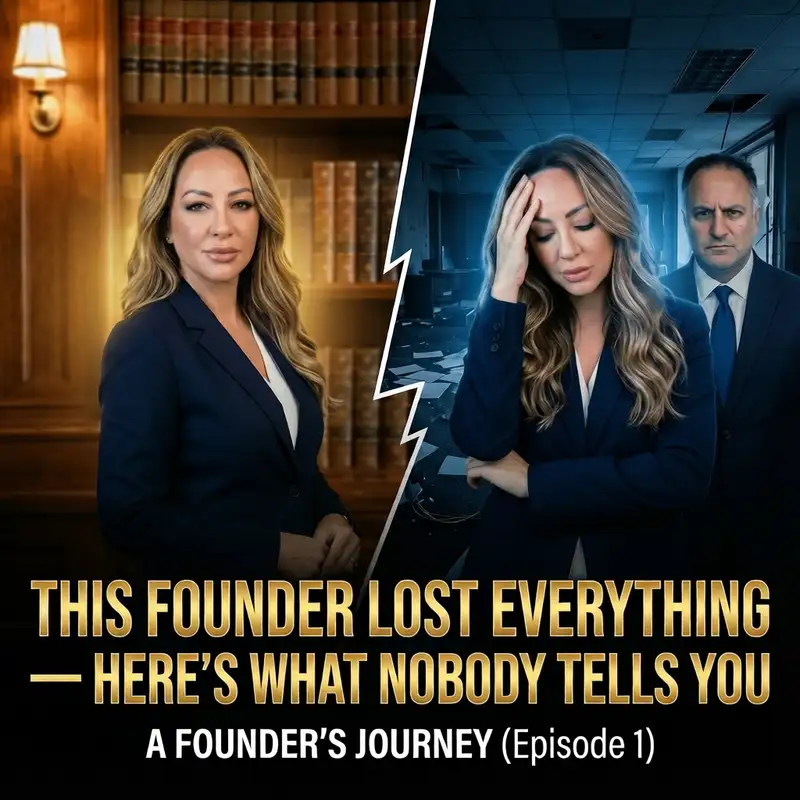
This Founder Lost Everything — Here's What Nobody Tells You
Download MP3From Wealth to Wipeout to Comeback: Andrea’s Journey
[00:00:00]
And within that first month, I made $32,000.
It doesn't matter what you're selling, it's more important who the operators are.
I don't know what no means. I just don't, that is not a word in my vocabulary.
Had we had a business plan with that business, we would've never been able to be so nimble because we bolted on and tried so many different facets
when you're given a task, do it and it better be right, because there were 200 other people waiting that could take your place.
So I learned a lot of those sort of skills from Gucci
That dreaded day that I handed in my resignation. I got set up and I said bye. And I remember them saying, where are you going? And I said, I'm going to watch sex in the city. It's playing in Midtown.
worse and worse. And then you have the big losses. We were given [00:01:00] 48 hours . And that was like a loss of $75,000 .
Hello friends. Welcome to episode one, wall Street to y'all street, Wealth to Wipe Out and wanted to give a quick intro to our first guest, Andrea Rader. I chose Andrea as my first guest for two reasons. First, I can't expect my guests to be transparent with their triumphs, but also with their failures.
To share with fellow business people so we can all learn from it without sharing my family's, uh, triumphs and failures, which are, with Andrea's case just as much my triumphs and failures as they are hers. But this is given from her perspective. So in order to be fully transparent, you're going to see the highs and lows.
The second reason I wanted Andrea to be my first guest is. She's by far the most amazing person I've ever met. , Small town girl, wall Street success, [00:02:00] entrepreneur, wife, mother of three children, and, through the highs and the lows. Took it all with. Grace
so, uh, you'll see from the episode , why I chose Andrea and I was so grateful, so, so grateful to her when I asked her to be my first guest, because she is a very private person. These are very intimate things that. She's about to share with you. And she didn't bat an eye. She said, absolutely, I'll be your first guest.
And so she was generous with her time to sit down with me for this lengthy interview. All of my interviews are long form podcast unscripted. I do have notes to make sure I don't miss anything key points, but all of my interviews will be unscripted. Authentic content from, , founders, executives, CEOs, seasoned operators that you can learn business lessons from.
So I hope you get a lot from it. Uh, shameless book plug. This book reminded me of a lot of my experience with Andrea. This is a shoe dog by Phil Knight. It's an older book, a couple of years, but [00:03:00] really one of mo my, my most favorite books. There is a, an affiliate link in the description that supports, that helps support the channel.
Um, never thought I'd be doing that. I never thought I'd have my own podcast, but here we are. I love the, the quote at the top of the book says, the best book I read last year. Phil is a gifted storyteller, and that quote's by Warren Buffett. So Warren knows a few things. Um, seriously, this guy Phil Knight, if you don't know, started Nike, started selling shoes out of the trunk of his car at, running meetups.
Didn't own a factory, imported the shoes, the story goes from there, the hills and valleys of Phil Knight and Shoe Dog. Excellent. Read, please, click to subscribe with the channel. It supports the channel. Never thought I'd be saying that either. It really does. It makes a difference.
Please DM me on LinkedIn if you have any suggestions or guests, uh, or better yet, put something in the comments and I will read it and reply, uh, in due course.
Thank you so much. Please enjoy episode one from Wealth to Comeback. Andrea Raetzer [00:04:00] enjoy.
Episode one, Wealth to Wipe Out , and my guest is Andrea Raetzer. Thank you for being here. Yeah. And thank you for sharing, uh, some of which I know is difficult to discuss, but we learned from mistakes, uh, as well as others triumphs. So sharing everything that you can is very much appreciated.
, Your story includes starting out in a very, very small town in Texas fast forwarding to Wall Street Success, luxury, , real estate rentals in Manhattan, working for Gucci corporate after befriending the president of Gucci North America. Starting your own business, a seven figure exit, rolling it into another business, losing everything, including bankruptcy due to the pandemic and, and riots and all the effects that happened and.
Most people don't even live one of these chapters, let alone all the successive chapters. And you've since come back and you're doing more and have further ambitions. And just to acknowledge [00:05:00] during all that time, you were a mother of three children and my wife for my best friend for 30 years, and my wife for the past 28.
, before we get into the hills and valleys of being an entrepreneur, please share a little bit about your upbringing as a small town girl. And what, if anything, gave you the itch to leave that and go out and do something. Different.
Sure. First of all, thank you. I see the list of your heavy hitters for interviews, so I'm honored to be the first 'cause I know who you could have chosen. So thank you. Um. So I never grew up thinking I was going to be an entrepreneur. I can definitely tell you that my life's trajectory, my journey was crazy and nothing I could have ever predicted.
I grew up in a very tiny town. I like to joke with people, population cattle and horses greater than people. I never really had developed those really good social [00:06:00] interpersonal skills. I was more that awkward young person. I can genuinely say this, and I've had people from my youth say, oh, you were in a perpetual, awkward phase.
And I think that's kind of how I carried myself all the time, just knowing that I always felt like an awkward person, but knowing that if I just worked really, really hard at anything that I set my mind on doing any goals that I had that I could achieve. So I will tell you, I was extremely good at a few things when I was young and it wasn't math.
So, it was, I was a vocalist, I was an equestrian, and that was about what I was good at and it was never the academics, but I worked really, really hard at those academics. So it was my vocals and my experience in that [00:07:00] world where somebody had kind of thrown out the idea. They'd said, you know, you could probably audition for Julliard the summer program to try and go to New York.
And I thought, New York, whoa. I, I've heard that place is dangerous, and because I was a small town girl, right? I went from Bele, Texas to San Antonio, Texas, not so small anymore. But quite frankly, I worked my way in different jobs in my youth and then in college is when I met yours truly.
And I realized what true and I really do mean this as a huge compliment. I was never academically brilliant, right? I was just a really gosh darn hard worker. And when I met you, I was faced with somebody that was so incredibly bright and so talented academically. And I remember joking [00:08:00] with you and saying, you make studying look like an art because there is such a thing for people that are incredibly academically gifted.
And I think, I think having said that though, I think we both learned over our three decades together, um. Academics only get you so far, or book smarts and that without street smarts, it's not going to happen and vice versa, right? Yeah. So I really don't know that I got the itch to go to New York, whereas I remember when I was completing college, getting an invitation to a master's program because it was going to be a new master's that was being offered at the university that we attended together.
And we were married at that point. 'cause we were married our, my last year in college and your junior year in college. And then we found out we were pregnant. And so I remember in that moment thinking, [00:09:00] okay, I don't know that two people going into a master's program while I'm pregnant and having children.
Was going to be the best use of our resources because, you know, that's what kind of happens in a marriage or some marriages where you wanna work more as a, a team. And that's what I wanted. I wanted a a, I wanted a team playing, sort of, let's, let's work as a partnership, what will be best? And I knew with how driven you were with where you wanted to go with your career, that I needed to pull back and sit out for a little bit so that I could make sure that I was more of the support system within the family to get you where you needed to go.
And so I kind of took a role of, I like to say strategist because I do feel like if I had to say there's something I'm really, really good at, it's that I am quite the gifted strategist. Oh, absolutely. Um, so what I did [00:10:00] is, you know. Hooking, getting to know who's who, hooking people up together, being a connector.
And, and that's honestly where I started to trust what I thought were lacking social skills. Well, and I think, we'll, we'll get into the importance of that and the millions of dollars you generated just by making connections. The connections you've made for us have been pivotal in, in every regard, um, all the way from which law school I got into and, and whatnot.
And I don't wanna get into details about me or, or, or as much as you, um, but I do wanna salute you for the sacrifice you made, which so many partners make. Particularly, it falls upon women's shoulders often more often than not between motherhood and just being there. You know, and then making that sacrifice and, and putting everything you, you have in, into the family.
And so thank you. So, okay. Small town girl.
Fast forward, [00:11:00] we're, we're moving to Manhattan. Right. And so and so, this is 2005 when we moved to Manhattan for permanence and day one, you had to hit the ground running in luxury real estate rentals. Mm-hmm. And just to put this into context, this is pre iPhone, right?
If you're lucky, you printed a map out of MapQuest. We didn't live midtown or uptown where the grid is and things made sense. No. We decided to live in the financial district, old New York City where it's, uh, whiny roads and they're, they're by names. And so talk to us about how that was and what you did to start to make o out the gate tens of thousands of dollars a month.
Sure. How did you do that?
So we had had a discussion, what was I going to do once we got to New York because we, our kids were still little and you were embarking on what was going to be. The, a career on Wall Street with a world renowned law firm. [00:12:00] And I thought, you know what? I think I wanna do real estate now, I'd like to say in, in, in deciding that I never knew the type of real estate I would do in New York until I got, kind of like a smack in the face as to what the ins and outs and, you know, the hierarchy of who's who in New York.
But it is true what they say. If you can make it in New York, you can make it anywhere. So I decided I would schedule a real, my real estate classes to start the day after we got into New York City. Because there was just no time to waste. There was no time just to sit around and say. I just want a sight.
See, you're, no, we have to make money. We had nobody, we had no money. We had been in school. Go ahead. We, we had sunk every penny that we had into deposits for the apartment. The movers, the, so we, we didn't have money to wash [00:13:00] our clothes in the washing machine. 'cause the, we lived at two Gold, which is still there in Manhattan in the financial district.
And I remember thinking, we, we don't have the extra funds to go use the, the communal laundry mat. So we were washing our clothes in the bathtub. And so I went to my classes, started them. I remember thinking, I am getting on the subway alone. I am gonna have to just figure out how to get around, how to do this.
I did, and I remember going into the real estate classes and then they said they dropped that big bomb and they said, who's your sponsor for when you go to take your exam, you're gonna need a sponsor. I thought A sponsor. Okay. And of course, anybody that knows who's a real estate agent or knows about that license, you have to have a broker that is willing to sponsor your license.
[00:14:00] You can take the exam. So I remember going home that after that first class and thinking, what I, how am I gonna find one? So the next day or so, I remember taking a break and I thought, I, I'm gonna go to Corcoran group. And I was like, oh my God, so embarrassing. Um, like, is Barbara here? I'm here. God.
So I walk in. And, um, and I, they looked at me and they said, well, how can we help you? And I said, well, I, I need a sponsor. I'm here. And I will say, whoever you were that I spoke to was probably one of the most gracious people I'd spoken to. I don't know who you are. But you did not make me feel bad. You, I was perplexed, but I could have been made to feel like garbage.
And whoever it was that spoke to me didn't do that. But they said here we need a book of business to join our group. And I thought, A book of business, how am I [00:15:00] gonna get one of those chicken and egg? What's, what's that? Yeah. You know? Um, so I was very naive and the very gracious individual explained to me what exactly that was.
And I just felt, so for Lauren, I just thought, what am I gonna do? And. I dunno, maybe it was a higher power of God watching out for me. I don't know. But as I was walking home, uh, and I'd gotten off the subway, I actually got off a stop too early and I thought, oh, well, you know, I'll use this as a chance to walk and kind of maybe learn a few of the streets.
And I happened to see a shingle that was hanging for a real estate brokerage house, and it was a pitiful hole in the wall and in the financial district. And it was run by two young Israeli young guys. I can't even say men, because they were young. They were young. And I walk in. It was like, sort of [00:16:00] like set up, like those places where you see those trading little, like hole in the wall trading floors where like just computer by computer, by computer and just like a big open like a boiler room they call it, right?
Yeah, yeah. And I looked in and I thought, and of course I was greeted. They're like, hi, do you need a job? Do you, are you looking for a job? So needless to say, I found my sponsor and I was just thrilled to be able to have a sponsor. And, and here was the gig, and this is where I learn, realized what it was that I had stumbled into.
There's a pecking order in the city when it comes to real estate, and that was, you had people that did multimillion dollar sales, real estate, and then you had million dollar sales in real estate. Then you had the outer boroughs. Not Manhattan but still better than where I was, which was rentals.
But all I [00:17:00] knew was that I could make money getting people to rent apartments. So I was all in, I was like, I, I don't, I don't care about, a pecking mortar, I don't care how people see me. I just wanna make money. And I went back, finished my class, and then I was off to take my exam. And the day that I took my exam, I remember walking into what was a gigantic, huge auditorium room.
And the first thing they asked me was, which language did you wanna take the exam? And I thought, which language? And she said, there are 26 languages. Wow. And I thought, oh my goodness. Yeah. And I. Still remember to this day, looking in and seeing all these different people, all these different cultures, taking this exam.
Was that a Jacob Javits Convention center? I can't remember. I wish I remembered. Yeah. Okay. I don't remember. I wonder. But there were hundreds of people taking the exam. Wow. Took the exam, [00:18:00] passed it, and then went to my first day of work at this hole in the wall real estate company. Remind me, was this like a week after we moved to Manhattan, or was it I got my license after a week.
It was a week, right? It was a week. Wow. It was fast. I, we were hardcore. Yeah. We we're like, ride or die, let's do this. Right. Well, 'cause we drove in and then the next morning you started your classes, right? Yeah, if I remember. Yes. Wow. Gosh. Okay. Thank you. Yeah. Yeah. I, I didn't know where I was going. I didn't know where I was.
Like I just was, I was off, and, um, I sat down for the first time and then started getting handed clients, and that's when the real like fear began because there were handing me people that were interested in moving to the city and we were all assigned districts, and I chose the financial district because the kids were so little.
Mm-hmm. I wanted to make sure that I could get home if [00:19:00] I needed to get home. So I started meeting people and going to these buildings. And the way that it worked at that time was you took a client to the city, to the building and showed them any number of apartments. I think at that time, I think a one bedroom apartment in the city was like 2,500 a month.
Mm-hmm. And if you happened to have a client sign on to rent an apartment. You got that one month, but then of course that was split 50 50 with the brokerage. Mm-hmm. So real fast, I got to understand how that money could add up if I was quick, if I was, you know, hardworking, if I just beat the street. And within that first month I made I think $32,000.
Yeah. Wow. That is, and I thought I remember that. Yeah. We, we thought, I mean, I [00:20:00] was like, is this your cut? And you're like, this is our money. And it almost felt illegal because it was so much for going from literally zero to 30 K in, in our checking account. That was transformative. So luxury real estate in Manhattan, obviously very high pressure.
Right. And so you talked a little bit about how you were able to have clients fed to you. The internet was a new thing back then. But the Israelis, they, they knew what they were doing. Those two young guys certainly knew what they were doing in marketing, and so they were able to get clients in, and you weren't dealing with the highest end luxury, rather, where they were buying multimillion dollar, condos.
Um, but you were still, you were still dealing with people who were well to do and could afford, you know, I mean, $2,500 for a one bedroom apartment in 2005, it's a significant amount. How was it dealing, going from, again, small town dealing with, with these people? Were these largely people coming from outside of New York City?
Were these largely, [00:21:00] uh, people who were, you know, moving around or how was that, how did you deal with it? Sure. I lied. Okay. Nobody knew I was a small town girl. Um, look I'm not. I like to tell. I'm not proud of it, but I kind of am because growing up nobody ever thought I was from South Texas. Everybody always asked me this, are you from the east coast?
I swear to God. And I thought, that is so strange. So it was not difficult for me to lie my way through when I would meet people that were looking to rent because they'd ask you, how long have you lived in the city? My whole life? Uh, like what do you mean? I'm a New Yorker. I've lived here forever. We're not condoning this behavior.
No, but it is, it is kind of fake it until you make it. You make it till you make it, man. I needed money. Sure. I needed to make money for my family, and so I would stay out late in the [00:22:00] evenings as soon as the kids would go to bed. And I checked in on you and I was learning those streets. I was learning my directions because like you said before, the financial district wasn't set up like.
The rest of the city on a grid. It was like cobblestone streets that kind of jetted off in different directions, very easy to get turned around. And the last thing you want when you tell a client that you've lived there your whole life, that you don't know where you're going. The majority of people that I was dealing with were students that were coming in to live in the city, people that were throwing caution to the wind and deciding to follow their dreams.
People that wanted to move from one apartment to another apartment. And then you'd pick up people on the way. So it was kind of interesting because you'd go to a building and you were showing people and then somebody would see you and say, Hey, can you show me an apartment? Two? It was kind of, at that time it was kind of a free for all because you have to remember the year that this was, New York was in a heyday, so New York City [00:23:00] and there was money everywhere.
Yeah. And people were happy and the economy was great and people were like, I feel privileged that I got to experience New York City at that time, right? And it was when I was in one of these luxury buildings that I kind of got my next gig without even knowing it. So I slowly but surely, um, continued to make that money that that I was making able to talk my way into getting our son into one of the most prestigious Montessori in Tribeca, Washington market.
How I did that, I'll never understand how I got that pulled off, but I did. But I was, well let, let's stop there and talk about that because I think it's a lesson in persistence. And so, uh, it's not per se business, but it shows how you can open doors that have been closed for a long time. And breakthrough, right?
Mm-hmm. I don't wanna say glass ceiling because it wasn't like a feminine thing, but [00:24:00] feminist thing. But you were able to pry open a door and as soon as there was a small opening, you got through. So for context, for people who aren't familiar with Manhattan, this there's very exclusive schools throughout that are private.
And they are populated by extremely wealthy people, right? Largely, you know, at that time it was largely investment bankers and partners in law firms. Very, very large law firms, independently wealthy people as well. So talk to us about how you were able to break into ex basically an exclusive club.
That the tuition for that was over $30,000 a year. It was. And we're talking about someone pre, this is pre-K, this is Montessori, right? Yeah. So in Iowa, Montessori for McKayla was like $1,200 a year. Yeah. And then we're going into this context. So we knew the power of Montessori, but talk to us about how you opened that door and you were able to get in.
So I'm sure they were thinking I was a crazy person because I didn't, so first of all, I think in, [00:25:00] in discussing my personality, given the fact that I was not as academically strong and my entire childhood upbringing, young adult, was a lesson in persistence and working hard, which meant I don't know what no means, I just don't, that is not a word in my vocabulary.
I just know that if somebody tells me no, it just means, okay, well we're gonna try again later. And so what ended up happening was I started doing some research about schools, you know, on schools in the city and started dialing and nobody would call me back, but Washington Market had called me back to say, you know, you'd left a message, oh, well there's a wait list for this school, but you know, you can always, um, send in an application.
So I did. And I had sent that application in when we were still in Iowa, before we had even moved to the city. And I hadn't heard back. And I thought, well, that's odd, so I marched [00:26:00] myself right over to the school and I just said, hi, you know, again, you know, like, I'm Andrea and I want my son to go to school here.
And they were the, I I, I kid you not, the look on their face was sort of like. Who are you? And I just said, you, I'm here. Like I, my son would do great. I love your school. This is so awesome. And little did I know that several, models sent their kids there. The, there was Corcoran's grandmother or something was, had their grandson there.
Like I, this was a heavy hitting school with some very high level individuals. I, I even think like the CEO of this company, that company, I you can't even imagine the names. I mean, there were executives from, I remember HBO Yes. ESPN. It was insane. I mean, at the, the top level CEOs and, you know, these guys making wonderful money.
And then all the, the nonna [00:27:00] people that no one ever knows about the investment, the managing directors at the investment banks, the private equity guys, the quants, you know, at that time that was huge with hedge funds. They, they were all there and, and no one knows who they are. No. Unless you're in that world.
Um, I I, I've come to realize later in my later years that I, we I say I, 'cause we're talking about rere me right now, but this was more us. I think that they let us in because we were like the real people. Like we were like the poor people that were like, you know, because even though you're making six figures in New York City, you're kind of poor.
Right, right. Or not in the bubble. Right. And so I brought with me just a level of realism that was probably refreshing and they were like, you know, this chick's going to keep us humble. Right. And so I kept coming back and finally I think after a couple weeks I said, don't you guys have a summer program?
And I think I wore them down and they finally were like, okay, we'll let you in the summer program. And so what I ended up doing was volunteering every which way I [00:28:00] could. And I had very little time because I was doing the real estate as well. And trying to, be a, a good wife and handle everything else.
But I did, I was volunteering, I was helping, I was making sure that there were no issues and we ended up getting a full-time slot. You know, our middle son got a full-time slot in that school, which was fantastic for him. But again it was just, no, we don't have a slot. No, we don't. Okay, I'll come back next week.
Okay. I'll come back a few days later because I was absolutely determined to get into that school. Yeah. I mean, and that was over the period of, of remember months. And you were extremely frustrated because they kept telling you no. And you know, it's, it's something that. You're not used to, you don't like hearing No e even even to dating me.
But we'll leave that, we'll leave that out of it. We'll leave the stalker stories. We'll leave the stalker stories out of it because Yeah, I did. I don't even know if it'd be legal. Okay. Okay. Okay. [00:29:00] Um, okay, so that was a bit of a segue. So you are doing the luxury real estate rentals. You know, you get picked up by a developer, you develop a building, the Octagon and Roosevelt Island, and that was just pure recruitment because you were so doing such a great job and leasing out so many of his units.
So just doing more of what you were doing. Excellence, right. Operational excellence. But from there, a natural progression. You end up on Fifth Avenue working in Gucci corporate at their US headquarters, right? Yep. Of course.
So talk about how did you end up at G Gucci corporate? I, again, had been refining that social part of me that had been so lacking in my youth.
And even to this day, I can say that I'm probably not the social butterfly that I should be. I'm, I definitely am the more quiet, reserved one. I, I guess I'm that creepy watcher. You know, I like to think of myself as a [00:30:00] cat. Like I'm the one that kind of sits in the corner of the room watching what's going on.
But I ended up at a birthday party and in Manhattan at that time, birthday parties were not just a party for the kids, right? If you had a party for just the kids without some adult beverages or things like that for the adults, then you were lame. And so I remember having a couple of drinks and seeing this extremely beautiful woman that was six foot tall.
Dressed to the nines, just gorgeous. She was a modelesque. She looked like she walked off her runway and, um, decided to chat with her and said, well, where do you work? And she was very reserved. And she said, well, I, I work on, um, at Gucci. And I said, oh my God, I always wanted to work [00:31:00] for like a fashion house, you know, that would be so cool.
And she said, well, where do you work now? And I said, well, I'm a real estate agent for real estate rentals. Okay. Um, and what was her reaction? She was very gracious. She was always extremely gracious and in interacting with her. And I, just was just bubbly and just excited to learn about her.
And I just said, boy, I would just, I would love a chance to. To see if I could apply there. Right. You know, I was talking to her as if we were equal and we were not equal. Okay. And I'm not saying as in, I'm saying as career wise. Sure, sure. We were not equal and I didn't know that at that time. So right before leaving that party, she hands me, she didn't forget because we'd already kind of separated and we were talking to different people and she handed me her business card.
But I had always [00:32:00] been taught, you know, you learn a lot of things in New York. You don't sit there and google somebody's business card in front of them. Yeah. You put it, oh, thank you very much. And discreet, you discreetly put it away. So real, real quick, that level of professionalism did you find, because that is professionalism, right?
A lot of people are like, oh, we should get together. Oh, we should do this, and then they don't follow up. That level of professionalism and etiquette did you find that to be commonplace among. This kind of crowd or, or like how, how it was commonplace for them. It wasn't for me. I learned I had to learn fast.
I, I, I just feel like the moment I hit the ground in New York, I was thrust into the deep end of you learn how to conduct yourself appropriately or you're not gonna find yourself in the social circles where you can meet the right kind of people or meet the people that would be willing to help. Because, you know, look, let's be real, and a lot of people don't understand this New York [00:33:00] City, Manhattan, there is a level of discrimination, but it's not the kind of discrimination you think it is, or at the time was very financially based, but it's for a reason, right?
Because you don't want to be at one level trying to hang with this level. And then you just can't keep up and then you end up getting into trouble. Right. You end up getting into financial trouble. Yeah. Because you got the keeping up with the Jones' thing, right. And then you're in debt and everything else.
So they're almost doing you a favor. They're almost doing you a favor. And, and you'll find, I did find that a lot, like there were people that would, the ham, the Hampton people and, and everything else that they, one of the first questions that you'll be asked in New York City is, well, what do you do?
Mm-hmm. And I used to get offended by that until I realized why, why they were asking that. And it was, okay, look, I'm pressed for time. [00:34:00] I have very limited social vacancies in my calendar. I need to make sure that the people that I am interacting with can either help me or do something, do something for me or abuse.
That's just the way it is, and I found that. Saying, my husband was a lawyer, opened a lot of doors and we maybe could not run with the Hamptons crowd, but somehow we always got that invitation. 'cause it's always great to have a lawyer around. Right? Yeah. People were very gracious and, and open and, um, you know, I'm grateful for, for all that we learned.
But I interrupted you, so going back to That's okay. Being handed a business card by this person. Yes. So I took, I went home that evening and I did the very discreet, thank you so much. Put the card in my pocket and went home and I. It was just talking and talking, talking. 'cause you happen to be home and I rarely got to talk to you.
You were always so busy. And so I was talking your ear off [00:35:00] and I remember saying, oh my gosh, you'll never believe I met this beautiful woman. She was six feet tall. She looked like a model. And Oh, and I told her she worked for Gucci. And then I was just talking to a million miles a minute. And and you said, who was she?
And I said, oh my gosh, you know what? I have her business card. Hold on one second. And I grabbed the business card and I gave it directly to you because I was cleaning the kitchen. I don't know what I was doing. And I heard you gasp and you said, oh my God. And I said, what? And you said, do you know who this is?
And I said, yeah, she's this beautiful woman that was at Washington Market and her kids go to school there. And you said, Andrea, this card is for the president of Gucci, north America. And I was like. Oh, what? Like, you, you didn't believe me. He said, gimme that. I was like, what are you talking about? Yeah. And I looked at it and immediately I felt so small because I remembered the conversation with her.
And [00:36:00] then you really realized just how gracious she had been. Mm-hmm. And but I didn't, I I, I was like, okay, well she gave me the card, that means she wants me to contact her. So the next day I contacted her and um, and I said, hi, this is Andrea. I like to take you up on coming, like reaching out to you, coming in, seeing if you know there's anything that Gucci I might be able to be a part of.
And she said, okay. A week later, I walked in there, I walked into Gucci on Fifth Avenue in nine West shoes that cost me the horror. Oh my gosh. What were you thinking? I'm, I'm telling you I, I think my shoes at that time, my nine west shoes, like 49 99, and everybody dressed in that building was like dressed to the nines in Gucci.
And I was just excited to be there. And so they placed me in a position as a store planning [00:37:00] department assistant, and I really kind of, again, hit the jackpot with the timing because they were working on moving the Gucci from the flagship Gucci on Fifth Avenue from the location it had been at, into Trump Tower and.
They desperately needed an assistant. As the assistant I was in charge of, like the punch list in the building. And, um, if anything went wrong in any of the Gucci North America stores, an earthquake kit, you know, somebody that I would help coordinate different things to be done. But I was really lucky because I was on the Trump team and I got to see that incredible store built from concrete to the gorgeousness that it is today.
And that's also where I met and Mr. Trump, Mr. [00:38:00] Trump, uh, now our President Trump. And that was an incredible experience. I was able to go to Madonna's Malawi party at the un. You know, I actually washed my hands with Demi Moore in the bathroom. I just don't, not many people can say that. Yeah. You know, so that, that, that's special.
Yeah. Um, so got to do a lot of fun things. But again, never losing sight of the fact that everything that I did, I did it as strategically as possible and with intent and, um, and always kind of thinking forward motion, like, what, you know, what, how could I use this to, to springboard to something else? So Daniella Vital, saw promising you, gave you an opportunity, placed you, and placed you in a position where you would have a tremendous amount of experience.
So what did you learn from w You know, Gucci is built on excellence, right? [00:39:00] Everything. From the door handles, you had to order and import from Italy to the light fixtures, to everything. I mean, it was amazing the work that you had to do and the level of detail that goes into just one store, something has to be fixed or built out, let alone the flagship, the North American flagship and this skyscraper right on Fifth Avenue.
What did you learn about operational excellence from Gucci That you can share
when you're given a task?
Do it and it better be right, because there were 200 other people waiting that could take your place. Mm-hmm. And I remember being given tasks and the tasks needed to be done immediately. And, okay, so the task, so the tasks needed to be done immediately and correctly, and there it was.
Everything was timed. So there was no sort of [00:40:00] like, oh, I'll get to that tomorrow. No, it was, they give you a task, you take care of it immediately, and you learn how to manage your time. And I learned a lot. I also learned just about managing email and managing those sort of lists of what needed to be done first, second, what, what was sort of emergent, what was non-emergent?
So I learned a lot of those sort of skills from Gucci, because believe me, everything was timing there. Everything had a deadline. Everything had a budget that had to be met. So it was it taught me a lot about that. I recall the reason the timing was so critical, first of all was, you know, you have a lease starting and you only get so much time.
And I don't care what REIT or real estate owner it is, landlords want rent. The other factor is you had some really tough contractors you dealt with. I remember the stories.
You would come home and tell me, what did you learn about negotiations from [00:41:00] watching? I think it was Doug and, and, and the other, you know, your bosses, essentially how they negotiated with these tough contractors and these tough real estate owners, landlords.
Yeah, that was amazing. So I was in rooms with the Trump team, the lawyers Gucci's lawyer, the contractors from Italy, the contractors from New York City, the directors from the, and I remember that the director that was in charge was so calm and eloquent, and I think that was one of the most amazing things that I witnessed.
You know, I remember one meeting, there were over budget in the millions and that, you know, the director at one point looked at the contractors and said. There is no more money. There's no more money. So you're gonna have to fix whatever this problem is and we're gonna have to move on. And so I think that was [00:42:00] amazing to get to witness that sort of negotiation in which, you have millions of dollars on the line and what it took to say, no, you're not getting any more money like it was.
So I think I, I learned some of my edge from that and not being afraid to sort of put my foot down with, when in the future, when I had my own business. Yeah. No, I think a word people often don't use enough in business and I've seen this even in my law practice, is no. Mm-hmm. No, walking away sometimes is the most powerful tool and you never wanna not do a deal.
Right. If it's a good deal. A good deal can be a bad deal if the economics don't work. And so being able to say no and mean it right. That's very powerful. Thank you. That's very, very powerful.
So just finishing up, you know, kind of the theme here is, you know, you've been recruited several [00:43:00] times you were recruited multiple times.
You had just come off of, I mean, this happened in the short span of a couple of years. What do you think people saw in you that you didn't see in yourself? Oh gosh. That's an interesting question. What's always perplexed me, because it's been a very common theme with some things that I would hear about myself.
I remember people saying to me, you don't see what I see when you walk into a room, or you tend to draw attention. People look at you when they walk into the room when you walk into the room. And I always thought, well, that's kind of creepy. And then some people would tell me, you just have a presence about you that's strong.
And I think what it is, is that there's a possible quiet strength that I have that, and you know what, I'm just gonna pick up our dog. 'cause our dog is [00:44:00] like pining away for attention here. Let's just, let's just one, one of two. Let's just give her attention. Okay. You know, poor thing. By the way, we are, we are in our house right now.
We are filming this in our house. So this little girl's just gonna sit here. Maybe Fred will join us later. Yeah. But okay. Sorry. Um, that's okay. Yeah. So I think that I think what I didn't know then was that I do have sort of that quiet strength that when I, when. People are around me when they're with me.
They just sort of feel like I'm strong enough to get the job done. That I am, I am savvy enough to solve problems that, and, but I think that's something I never saw in myself when I was younger. I just, again, I was always that awkward person. I always felt awkward. It wasn't until I embraced that quiet strength that I had and I said, maybe I should lean on this a little bit more.
[00:45:00] That I started to sort of feel more confident in my ability to direct to team build, to, um, negotiate. But I had, I had to start embracing that part of myself. Yeah. It is interesting because it's, one of the things our educational system doesn't teach is, is confidence. You know, maybe you get it a little from sports and stuff, but.
Largely risk taking is told to be avoided. And so I feel like you were put in several situations where it was almost like a pressure cooker making a diamond right? From, from us having no limited to no resources. And of course Fred's here, hi Fred, limited to no resources, um, to where you literally were generating 30 grand a month and, and networking for us.
And I'm toiling away at the firm after I pass the bar and whatnot. And so there's a lot to be said about navigating these obstacles and, and knowing inside you that you can get it done. Really, [00:46:00] there's no difference between a multimillionaire, a billionaire, right? And just some regular guy except they took the risk.
They, they maybe had a little more knowledge, but a lot of times the guys I met, the guys and gal I met who were even the, mainly the billionaires. They figured stuff out on their own. It wasn't handed to them, you know, and, and that was my, my kind of experience. So, okay, so Gucci, um, you got fed up because, they had these corporate parameters and we're gonna promote you.
I don't wanna go into all that, but you were, you were basically like, I'm out. I'm going to watch Sex in the City, you know, send me my last paycheck. Yeah. Sex in the City had opened that day. That the, the day, that dreaded day that I handed in my resignation, um, and I did, I got fed up and I said bye.
And I remember them saying, where are you going? And I said, I'm going to watch such sex in the city. It's playing in Midtown. And they were like, [00:47:00] oh yeah. And I said, yeah, and, and I walked out again in one of those not so proud moments. But I'm going, I'm going to say this with all honesty and transparency, you.
Typical entrepreneurs are not good employees. And I just didn't know that at the time. And when you think about it, having been the, a real estate agent for rentals, I wasn't an employee. I was my own business person. I chose when I got up, up and out to work. Mm-hmm. I chose my, the people that I wanted to work with.
I chose how many buildings I wanted to go to. I chose how late I worked. I chose whether or not I took a lunch. I, so in all of that, you take that and then I decide, oh, I'm gonna, I'm gonna go work for Gucci now, which was a corporate entity, and now I'm under somebody else's thumb. You can't do this, you can't do that.
You can maybe do this. Don't talk to that person. Don't go to that, that [00:48:00] office floor don't get, and it was kind of like a disaster in the making. I just didn't know it. Yeah. And in all fairness, and, and, and you know. Understanding what you, what you did. You didn't just flippantly quit and say, I'm out and abandon them.
Your boss loved you so much. He didn't want you to get promoted to go to a different department and he blocked you because of some stupid corporate rule. It was, yeah. On, on, on timing. So, um, interesting. It was what it was, it was, it was an experience. And I, just didn't know that I was well on my way back into an entrepreneur world.
So just kind of want to fast forward. So from Gucci corporate, you know, you left you know, occupy Wall Street happened. We lived on Wall and Broad. It was right in front of us. We didn't like walking the kids to school in Tribeca with all of that going on. So we decided to move outta the city. And the financial crisis came upon us and there was a lot of turmoil during that time.
And from that though, was the growth of your first [00:49:00] business. That you started with, I think it was $7,000 the first month that was on the amex for supplies and, and whatnot. Yeah. And you were able to, well, you tell the story what happened. Sure. So we at that time had bought a home out in the country and a hurricane had come through and had knocked out power and everything else.
And I think that we had gotten trapped in the house for like two weeks. And obviously the mail hadn't been getting delivered. So you were home and a knock, we hear a knock at the door and it was the mail lady, the carrier, the mail carrier, and she had in her possession, unbeknownst to me because you answered the door, about 12 of my 20.
Subscription box services that I had become addicted to. And for anybody that doesn't [00:50:00] know what the subscription box is, it was sort of like that big craze that happened for a number of years in which companies would curate these packages and then charge you a monthly fee. And then you got this like recurring box every month.
And so for example, Birchbox was one of them. Glam box there. You know, there were ones that were for home goods, there were ones that were for food, there were ones that were for, and so I remember you saying, Andrea, what is all this? And I had been sitting at the table knitting because that was another one of my hobbies and passions was knitting.
And I said, well, those are all my subscription box service. And you were like and I remember you sitting there looking at them and. You started to open 'em, which I was very upset about because I was like, Hey, those are my surprises, you know, every month and how dare you? And you [00:51:00] said, I don't see anything here for yarn.
And I, well, and just for context, your yarn, it wasn't $3 ball, Walmart yarn, we're talking about $30 balls of of of high-end YA yarn that you would use. Yes. And so I said, there isn't one for yarn and you didn't respond very quickly at that time. And I just kind of went along my own business. And I remember waking up at two in the morning and you were downstairs still looking through these boxes and I thought, what the heck is going on?
You know? And I thought, so I. Got some tea, went back up to bed because I, I, learned that about you just kinda let you be. I, I didn't know if you were, were you upset? 'cause I'd gotten some beautiful boxes. How much money did you spend on them? I don't know. But I remember by the morning time I came down and you had this idea and you pitched it to me [00:52:00] and you said, would you want to open your business?
But, 'cause I remember telling you I wanted to go into business, I wanted to be my own boss. I was frustrated with the whole experience I'd had going from real estate to a corporate job and then back to stay at home mom. And I wanted to do something, but I didn't know what to do. And so you said, why don't you do this subscription box service, but with yarn?
And I thought, well, that's kind of brilliant. I thought I. Yeah. And so I think that for 48 hours we kind of had like a jam session and we were like, what would we call it? What would we do and what would it be? And so what ended up happening is, is we named it Nick, right? K-N-I-T-C-R-A-T-E. And we decided that we were going to curate these by contacting yarn either Indie yarn [00:53:00] Dyers, which are independent yarn dyers, not corporate or luxury yarn vendors, and pair them with knitwear designers that we would contact for unique core proprietary knitting designs.
And, um, and so, you know, we were working through that and kind of trying to figure that whole thing out and. We had to pitch it though, and we didn't really know how to do that. And so in all the research we realized that unlike today, and this was what was very unique about this industry, is that this particular industry, the fiber arts industry, had its own crazy bubble of a world which was named Ravelry.
And it's sort of like the Facebook for yarn. And did And did you know about this platform before you started getting into this? Or was this part of [00:54:00] the research? No, I didn't know. I didn't know about it. This was part of the research. And how many knitting projects had you completed at this point?
You're talking me to the bus? Well that was one of the things that when we were talking about it, you said, we, you could, we could do this, you could do this. Like I'll, you know, you of course were like, I'll help you this, that, and the other. And I said. I remember looking at you and saying, but Joe, I haven't ever completed one knitting project.
And you're like, what are you talking about? And I said, I think I've had a perpetual scarf for like years, you know? And, and I You said, I remember you saying, well, then learn finished something. And I thought, wow. So I ended up actually going and getting certified at the New York Fashion Institute.
Yeah. Knitwear and I, fashion Institute of Technology. I think it was the Fashion Institute of New York. So yeah. And I went and bought every knitwear book there [00:55:00] was, and learned and voraciously just learned everything I could about the knitting world. And you know, just as an example, at the time that I started knitting, I maybe could sit for 30 minutes in knit by the end of it.
I could sit in a clinic for three days straight, 12 hours a day and knit and have a finished project at the end of that . And so that is how voracious I was about inhaling this because I thought, okay, if this is going to be a business, you can't have an owner that doesn't know what the hell they're doing.
And I, it was an industry I loved, so I didn't mind like learning. I thought, okay, well, you know, and I literally poured myself into this world. Everything I could, I figured out everything I could deciphered, because if you've ever looked at a knitting pattern, it's a different language altogether.
It's a different language [00:56:00] and it's, um, complicated and, but I had the right temperament because anybody that knows any knitters. They're Type A, I don't care who you are out there, you're type A and you have to have a level of patience and persistence that is almost, you know, masochistic in nature.
So how do you take $7,000 and you have no manufacturing capability, you have no design team, you have no social media team, yet you create a business that you literally pull millions of dollars out of over three years and then have a seven figure exit.
How do you do that? I, and I, I'm gonna be very honest about this. Um, I, we we're just shooting from our hip, moving, uh, moving into whatever part of that industry we could, partnering with whoever we could, could, and your typical [00:57:00] person is gonna say, well, you better have a business plan for that. Had I had a business plan.
For that company. I never would've grown, ever. Because I had to be so nimble. And I will tell you that I, the first sort of like post that I put out there into the Ravelry universe was met was so much hate. And that post, just to be clear, was the idea for the business. It was the idea, Hey guys, what do you think about this?
Yeah. And so we thought, oh, okay, well, we need to post something somewhere. And I, and I do say we, because you are my like sounding board and you know, we needed a focus group and we didn't know any editor. We didn't, we didn't know any editor, you know, and any I you did know, they were super opinionated.
You know, you got more opinions than you wanted, right? And so I remember thinking, okay, let, let me just post something on Ravelry and I'll say, oh, I'm interested in doing [00:58:00] this. What do you guys think? The level of hate that I got was insane. And I'm talking about hundreds of posts of people saying, you're stupid, you're crazy.
Nobody will ever buy that. Why would I do that? I'd just rather go to my local, you know, knitting store, blah, blah, blah, blah, blah, blah, blah. And I remember being so sad about it because I thought, wow I really thought it was a good idea. So I remember thinking, okay, I'm going to start pitching to vendors that own yarn, that import yarn.
And I started picking up the phone and calling them, and I got a lot of rejection people. What are you talking about? That's not anything I wanna be a part of. That'll never work that. So I think it was like number 13 or 14 that I called and I. [00:59:00] Finally got some positive feedback, which was Nadine Curtis, who was the owner of a yarn company that imported mohair yarn from South Africa.
Right, okay. And she was very much an out of the box thinker. California Californian. Yeah. And very creative, very open to trying different things. And I remember the spiel. I keep saying I feel bad. I keep saying I remember, but I do, I remember that. It's going back. It's going back, you know, and I'm thinking about this that I remember her saying, I think this is brilliant.
And I thought you do validation. Oh my God. And she honestly helped me refine the strategy a little bit because she knew. A knitwear designer that worked exclusively [01:00:00] with her yarn and his name was Steven or Steven Stevie. B or Steven B. Steven B. Right. Steven B. Right. Very brilliant knitwear designer.
And he had all these beautiful patterns that he would do up with her yarn. Very, very kind man. And she said, you know what, let me pull Steven in and see if he would be willing to come up with a pattern that would be exclusive with whatever you decide you want to use with her yarn. And so at the end of that project, 'cause these were gonna be monthly boxes that were gonna go out, how we pulled this off, I have no clue.
Because the level of work that went into curating these projects was insane. Yeah. But what we decided in the end was that she was going to have exclusive colors dyed for this particular project, and Steven was going to come up with an [01:01:00] exclusive project using only those exclusive colors. And we were going to actually buy everything wholesale and then we were going to put those in a package and ship them off to anybody that subscribed.
And that was the very first package that we sent out. And what's really amazing is that the first month of projects, I believe 67 people signed up to receive these projects and. If you looked at the last month that we had that company where we were sending out projects, I think that we were sending like 5,000 of those out per month.
Like it is just an insane it was insane. And, and the, the inception of, um, what Nadine Curtis did for us with Steven, um, because of their reputation in the industry, I [01:02:00] recall, I remember they validated the idea and because they worked with us, we had the ability to have other designers and approached them.
And um, and you're right, I mean, I think our last 12 months of owning that company, we shipped 7.2 tons of yarn to a customer base in 19 countries. That is correct. So that business you sold for seven figures or We sold for seven figures and it was, barely three and a half years that we owned it.
Last question on Nick Crate. What do you think that you did right from the outset?
That maybe other founders don't do something I did right from the outset? Yes. I tried to create something very much proprietary. Okay. And that was because I didn't want it to be easily replicated. However, it did not take long before somebody came out of the [01:03:00] woodwork.
And I think this is an interesting, part of the story for anybody that is developing a business because. I hear it over and over again. People that say, well, I don't wanna do this business because somebody could just, you know, they could just copy it. Yeah. That's pretty much every a a lot of businesses, if you can't have some form of a proprietary nature to your business, that's gonna happen.
And even when you do have a proprietary nature of the business, conceptually, it can be copied. And that's something that happened to me was that it took maybe three months, three months in for somebody to come out of the woodwork to copy the entire concept. And I'll tell you exactly how it happened, which was crazy, is that we had been, we had gotten traction and every month it seemed like in the beginning, the number of packages we were sending out would double.
So like the first month was [01:04:00] 67, the next month was, you know, double that. The next month was double that. And what we realized was that there were a number of yarn store owners that were signing onto this project because it was giving them creative juice for things that they could do in their store. So sure enough, there was a yarn owner that had subscribed to the package and it just so happened that the day that that pa her package arrived at the store, her yarn sort of distributor guy that would, that worked for yarn rep, I think the yarn rep.
Yeah, thank you. It was kind of, her yarn rep happened to be coming in for, um, an appointment with her that day to show her all the latest yarns and was like, what is that? And she said, oh, you know, it's this new company in. They curate these packages? Well, it took him [01:05:00] like he a hot second, I think within a week.
I found out he'd quit his job, took out his life savings and created an alternatively named subscription box service and then went head to head and we literally competed with him until the day we sold that company. He eventually, um, went out of business because he handed that business over to a family member or something, but it, we had very little time.
You know, they talk about those businesses that have that like upward trajectory where they just, there, there's Rev, rev, rev, rev and they get like this, head start with the business. We had very little Head start before somebody copied it, but we were, we were successful nonetheless. Yes. No.
One more question kind of fast forwarding to the exit of Nick Crane. So seven Figure exit money hits the account, A lot of money hits the account. Did that [01:06:00] feel like freedom to you or did it feel like pressure to do it again? What was Yeah, what, what, what happens? Like, you know, you, you, you get an exit, what happens?
Well, I think, so I think before I kind of talk about that, in order to really understand it, in that last year that I had the business, we talk about had I never followed a business plan, had I followed a business plan, I wouldn't have been as successful. We were always. Bolting different things on, right.
Always trying to make more, how can we make more money out of the business? How can we make the business grow? And so as the business was growing, being featured in Vogue Knitting International, which we were, um, entrepreneur magazine. Entrepreneur magazine, yeah. Bolting on a store, an internet store.
Mm-hmm. Did that bolted on, oh, hey, maybe I can dye my own yarn and have my own yarn company did that. Yep. Yep. Maybe I could have so bolted on. [01:07:00] So I don't think there was ever a second that I wasn't working on this business. It, it consumed me. And I think until the very last day, I lived and breathed this company and it was all I knew every second of the day was tied up to it.
So in selling the business, I thought it was gonna feel like freedom, but it didn't. It felt like this money came in. And then you really realize okay, what am I gonna do next? What am I gonna do? Again, an entrepreneur mindset. I can't go work for somebody else. I just, I know that's not gonna work.
I, I, I will fail at that. So taking a break and kind of trying to, well, we, we took a break for I think seven days. I think it was seven days. But I do wanna add context. Something that we glossed over, or I glossed over [01:08:00] is when Nick Creek was started, when you started working on it full time. And when I was helping a little bit in that period was the financial crisis.
A couple of years post-financial crisis. I had survived 14 rounds of layoffs at my law firm, and my number came up. Mm-hmm. I was let go and we had an $8,000 mortgage. We had, our property taxes were like 26,000 a year. We had three children, you know, we had obligations and so this business was born out of necessity.
Mm-hmm. It was at a time when no one was looking for m and a corporate capital markets attorneys. Right. No one was hiring, the train stations were empty, literally. And it was either make this work or I don't know, right. We would've lost, lost everything. So I think we took seven days off.
We did, and I wanna get into the next business.
The business that ultimately became a national retail [01:09:00] company doing several million dollars in sales a year, was pre COVID set up for tremendous partnerships with some of the biggest companies in the world. We had some really serious stuff in the fire. Walk us through. The birth and the rise in the fall and the ultimate bankruptcy of Steveology.
So I, we were sitting and thinking, what are we gonna do? This money isn't going to last forever. Although it was a hefty amount of money. You don't, you can't stop there. Not at the age that we were at. And we were too rambunctious. I was bored. You were bored. Yeah. And so we started to think about what interested us in all of that, in all of our experiences.
And we used to put tea in some of the packages with Nick Crate, and you had asked me, you [01:10:00] said, if you had to choose another industry to go into, what would it be now at that time? A number of interesting things. Were kind of coming to a head. When our youngest was born, I was diagnosed with rheumatoid arthritis, and it was a battle for me because, you have all these symptoms and these issues that are happening to you and you don't quite know that it's real.
And all the medications that they're giving you are so poisonous. And you know, there are honestly some of the lighter cancer drugs, some of the ones that, that they give. And I had gone into this sort of like holistic part of jour, part of my journey with that, with the autoimmune disease that I have. And tea became a big part of my life.
And I remember feeling very disappointed when I'd walked into a Tiana. Because I'd walked in and, and just for [01:11:00] context, because Tiana, is no longer with us, right? They were a, a lar large, several hundred stores, I think it was four or 500 stores. Yeah. National, international, ultimately purchased by Starbucks and so, mm-hmm. Very, very large, well established tea chain that was in business while we, when we started it. But you, you're, you're doing before that, so just so people know what Tiana is. Sure. Or was I remember wanting to go and get some tea. Just, you know, some anti-inflammatory teas, something very, you know, holistic.
And I went to a Tiana in the mall. Warren, our youngest, was in a stroller, very little. And it was one of those quiet moments when he was napping. And I walk in and right away, you know, they had the samples at the entrance. Here, drink this, try this, try that. Do you wanna buy the, and I remember really getting sucked into this immediate buying process when I was there, right?
It was like, [01:12:00] and you should get this and you should get this, and we'll mix it with that and we can mix it with this. And this is our exclusive. And I mean, you have to buy it in a pound. I had no idea what a pound of tea yielded. I had no idea anything about what I was buying. All I knew is that Warren was waking up, he was screaming I was just trying to figure out what I wanted to buy, and I just kept saying yes, right?
I was like, yes. Okay, sure. Yeah. Yes. Because in my mind I thought, well, how can it be any more expensive than the grocery store, right? Mm-hmm. And I remember going up into the register and they said, okay, well that'll be, you know, $275. And I was like, what? I thought maybe, I don't know, I thought maybe like.
The person next to me is Bill got combined with my bill and I thought, what in the hell did I just buy? And they said to me, we've already mixed these tees and if you don't purchase 'em, we'll have to call security. And I was like, what? [01:13:00] What are you talking about? And Warren was having a full unfit at this point.
So I handed over my American Express and I, I just said, well, I hope here, we'll see if it just kind of goes through. Because you know, even though we had the money, we had, we were still on a budget. And and so you saw that charge and you immediately called me and you were like, what is this charge? Like what did you buy?
And I got home and I laid everything out and I said, I don't know what I bought, but I bought a bunch of tea. And so that was sort of like one of my experiences with tea. So I sort of connected that when you had asked me what was one of the things that would interest you in doing next. I remembered that experience and I remembered that experience being so awful.
So I said to you, I would love to like open a tea store, but it be done in more of an educational fashion. And so we [01:14:00] tore apart the study in our house at the time and created a mock store, like what would we want our tea store to look like? And I think we changed it up like 6, 7, 8 times. And we went and we got canisters and how would we package it?
And what would the labels look like, and what would the scoops be like? And what would we scoop it into and what would we weigh it with and what would we, on and on and on and on. And again, this is like another one of those, well, we don't know that much about tea, went and bought every book I could on tea learning and absorbing everything.
Now, talk about a world that was just like the knitting world, except on steroids, right? With their, with the snobbery and the like. You know, if you do, you be intelligent about what tea is this? Tea Snu. Tea connoisseurs. Tea snubs. Tea connoisseurs. And, and the tea processes. And the, but also again, for [01:15:00] context it was done in a manner with heavy research because in looking at it, tea is the second most consumed beverage in the world.
Only behind water. Right. And so, and then when you look at the billions of dollars Tiana was making and the market growth, and at the time we lived in, in Issaquah, right outside of Seattle. And it's like, what better place to open a tea company, right? Yeah. Than Starbucks backyard. Yeah. So we created, the perfect Tea store and started pitching.
To different landlords. And there was this one store empty space that was in downtown Seattle. And I remember we made an appointment, went pitched the idea and thinking it was so strange because the development group that we were pitching to really didn't ask a whole lot about the business and was more interested in us as a couple and what our history was, which I thought was really odd.
And I [01:16:00] remember after the third meeting thinking when are they gonna actually ask about the business? And what I didn't realize at the time was that there is a philosophy and a school of thought that it doesn't matter what you're selling, it's more important who the operators are and. You can have the crappiest thing to sell, but if you have savvy operators, they're gonna find a way to sell it.
So that was sort of like a little nugget of information that I learned along the way. And then I realized, ah, that's why they don't care. They care. Like they just wanna know that we can sell. Well. And this was a storied institution in as far as real estate went in the Seattle area. KLE had been around for 150 years or something like that.
It was a family owned company, very much tight knit. You know, they rented all the office space in Nordstrom and, and sold almost all the buildings to Amazon in that whole area [01:17:00] in downtown Seattle. And the building that we were renting in was an old, one of the oldest skyscrapers in Seattle and their first property.
And so they saw it as their baby. And so that space, it's had empty for I think 12 years. They wouldn't rent it to anybody. I think it was 12 years. And you're right, they kept met meeting with us and asking these questions. Why did you, why did we have to pitch it? Why do you say that? Why can't you just go to a landlord and get a space?
Yeah, I know. Well, you know what? I think it depends. So it depends on the type of landlord you're going to, right? You have your mom and pop landlords that they're just looking to get somebody in there and they're, they're more, um, excited about what your concept is and what are you selling?
And, and then there are the bigger landlords that are developers. And so they're more interested in, can you pay? And so being a good operator [01:18:00] is what they're more concerned about because you're not talking about a rent that's. $1,200 a month. We're talking about rents that are anywhere from 5,000 a month to 14,000 a month on up.
You know, if you're a bigger retailer, like, well, and a couple of our stores at the end did have those rent rates because we were in high end malls. Yeah. Really good spaces. But I think also it comes down to what we wanted. And so we had, we had started a business with very little money and grown it.
We were very cost conscious. We didn't wanna Sure. And so we would go to the mom and pops and we'd be like, this is what we wanna do, and we want you to build it. Right. I see where you're, what you're asking me. Yeah. So as the, as going into a developer, we pitched it and then, we said, look, you know, we're willing to sign a lease for.
Five years, seven years, 10 years. Those are typ. The typical be, the [01:19:00] benchmarks are like 3, 5, 7, 10. Okay. And depending on how long you're getting it and how many months will dictate what kind of tenant allowance you get. And that was huge because we didn't wanna sink what was our living money like.
We were a money that we had profited from the previous business into this building that wasn't even ours. We didn't own the building. So because it was a raw space, it was a raw space, didn't even have a bathroom in it. And what was even more interesting about the space that we got was that it was literally a foot and a half beyond what was allowed to get to a public restroom.
Mm-hmm.
So that we didn't have to build the restroom in the store. Mm-hmm. And we were a foot and a half off. So we had to have full plumbing, the bathroom the everything, everything. So we negotiated with these developers to do the [01:20:00] build out, and it, that saved us an incredible amount of money that saved us six figures on that store.
And we carbon copied that with every single store after that and negotiating against some of the biggest REITs in the world. And we, we'll talk about that.
So we start this tea company, we wanna scale it. We did the math. We're like, if we're going to do this, it needs to be, you know, this kind of build out by the developer because we're not gonna put money into that.
We put money into packaging and marketing and all the stuff that, that you worked on. We didn't open our second store for a long time, right? Mm-hmm. Um, but then we opened the second through the fourth. We're talking to different partners. How do you think scaling a business at a time when social media, you know, was in its infancy?
How did you, how did we scale the business to quickly go up to seven figures and beyond? How did that happen? So it happened [01:21:00] very differently from the first business, which I can't even say I, I couldn't predict it. I wasn't aware of it.
It sort of slapped me in the face because with Nick Crate, this was at a time when you could do the like it like my post, follow me, tag a friend, you'll be entered into a raffle to win something, right?
That was something you could do on Facebook in its infancy for free. You could, you could, you could post for free, right? For free. No boosting. There was no ads. It's crazy how wild that kind of stuff would go. And so we were able to grow Nick Crates Facebook presence. To hundreds of thousands of people. It was insane.
And then when we found ourselves just a few years later in trying to do the same thing with Steveology, which was the name of the tea company, [01:22:00] everything had changed. All the marketing, marketing structures had changed everything. So it cost money to post, you had to have a separate business page to post.
You had to have like all these different rules. And it, it became like this very complicated web and world of, um, advertising. And when you're tight with your budget, that can get very expensive, very fast.
So what was interesting about Steveology is that our location really dictated our success in the beginning because unbeknownst to us, we were going to become.
A cult following. And we, and this is like what they say, location, location, location. Right. Um, we weren't on the prime corner. But we were on the edge of the prime corner and we were a hop, skip, and a jump from Amazon's headquarters and I'll ne [01:23:00] And Nordstrom. And Nordstrom and Pike Place Market.
That's right. Yeah. So we all of a sudden had this slew of groups of Amazonians that would come in. And there was one, there was two, there were seven, there were 10, there were 12. And the groups would get bigger and bigger and bigger. And then all of a sudden the different companies, all of them would talk to each other.
And we started to maintain this following. Was there a product that Yes. Yes. Built that following? I was about to talk about that. And it was. Uh, the, it was the steep the endless steep. The endless steep. Mm-hmm. And what it was, was that we decided to import, this was our first sort of, um, attempt at importing, and it was to import a beautiful glass Tumblr.
We had a wood one, a bamboo one, and a, and a glass one. And we had them laser [01:24:00] etched with our name. And the idea was the T infuser. And the idea was that they would buy the Tumblr. And we harkened back to our subscription, our subscription based platform history. And we said, if you sign up for a monthly fee, you'll, you get to come in once a day every single day and choose a different tee to steep.
And that took off like wildfire. You would walk down the streets of downtown Seattle mm-hmm. And see people walking around with our endless steep tumblers. They did bring their friends back in. Yes. Yeah. And at the time that we instituted the endless steep, you could not get that Tumblr unless you joined the endless steep so people would join it just to get the Tumblr.
Yeah. Which was crazy. I will say again, we had no business plan with that business. Had we had a business plan with that business, we would've never been able to be so nimble because we bolted on and tried so many different facets [01:25:00] of tranches, call it what you will in that business. To try and figure out like what would make it tick, what would make it grow?
And so we, bolted on iced tea, excuse me, to the, to, to the menu we bolted on in that particular store, the downtown Seattle store. Everything from small food empanadas to waffles, to yogurt cups, to everything. We could try to figure out what would make it flow better. And so it was sort of interesting seeing that sort of grow and, and how we how we kind of took that concept and then tried to, you know, replicate it in other stores.
Interesting.
so we have currently five stores. We also have an online, presence as well as in wholesale, our first store in downtown Seattle. Our second store is in Honolulu, Hawaii, in Alamo [01:26:00] Moana mall .
Our third store, is over in South Center Mall, uh, fourth store, Alderwood Mall, and then our newest is in Fremont (Seattle). We have more stuff in the works.
So a lot less like your typical more commercial tea shops that we've all heard of before, , that only have like 60 or 70 and everything's behind the counter and you have to ask somebody to reach something or smell. We've created something where people come in, you can roam our store. It's categorized by tea type.
You can smell what you want to smell. Nobody's gonna bother you unless you want a little bit of tea education, which all of our people are very well versed in the tea education, and we'd like to see ourselves that way. More like a tea education. We're here to help. We're here to guide you. We don't care if you even buy anything that day.
Come in, grab a cup of tea. You can choose anything you like.
They fly off the shelves and, uh, we were very shorthanded during the holidays of those, but we're working on that. So there we go. Yeah. Alright. Thank you so much. Yeah. Thank you for having me. That's Andrea Raetzer and from Steepologie. [01:27:00] Go out and check out their shops
Galleria and Houston. We had a store in Austin, Indianapolis. And it's, it's honestly in opening the other stores in different regional locations, it's where you really earn your brownie points because you don't understand as an operator how different regions are going to dictate the success and failure of different products, same product in every store.
Interesting. Right. Way different reception. Right. From region to region. For example, um, when we were making iced tea in, in, in the states, we used half the amount of Belgian beet sugar in them that we used in Hawaii. Because they like their drinks way sweeter. So we had really planned for the amount of Belgian beet sugar, which came.
50 pound bags that had to be [01:28:00] shipped. Yes. We had not planned for the shipping cost to ship, I think even three times the amount that we sent to other stores. Yeah. Over there. Because that's in Hawaii, right? Yeah. So little things like that, you know, in certain regions one tea wouldn't do so great, but another region it did.
And taste profiles are different. And so getting a, one of the greatest challenges in having multiple locations is understanding sort of that flow, that supply chain management system and okay we've gotta funnel this amount to that region, but we're gonna funnel this amount to that region and that sort of ebb and flow in order to continue the level of profitability and,
I think that had to have been one of the biggest challenges before. Of course, COVID hit. Yes. Well, I remember that. And it was interesting because we would open stores and it would take a while, about two years to get to that top level of [01:29:00] sales. And so our Seattle store, we negotiated very low and I think it was 4,000 and we got it up to 40,000 a month in sales.
But then our store in Hawaii, I think the rent was 16,000. And sales were in the beginning, barely that if that. And then on top of that, you had all the shipping costs, you have your product costs, you have marketing. There's just a different, it's a regional, you have to be ready. There are certain locations.
Nobody warns you. Nobody warns you. And it's, if you go into regional areas that are culturally very, I guess I could use the word bubble again, that are very, sort of like bubble in nature. The Hawaii is one of 'em where it's you better have product labeled Hawaii. You better have product re from that region.
You better have product packaged to look like it's giftable because most people that come in and out of there are traveling. You better have it in travel bowl sizing so they can be [01:30:00] on a plane and survive custom, or not customs, but going through the airport and not being seized because you know, it's a food product or this, that, there's so many things that you have to think about when going to different regions that nobody really prepares you for.
And you know what a lot of people would say that's common knowledge. Not really, right? Not really. When you're opening stores and you're excited and you're just thinking, okay, well it's. It's a state, like it's a, you just don't, well, yeah. You think it's a state. We're at Al Mall, the largest open air mall in the world.
Yeah. With a lot of tours. How much of a difference can it make? But it did, and we did all those, those things we did, we sourced the Monica honey. We sourced the, um, the Manuka honey. The Manuka honey. We sourced that, uh, that specialty. Yeah, the specialty. That was, that was really tough to get from the big island.
Um, we did the unique thing with the turtles on the Tumblr, but, but again, all of that is the cost. You're just not prepared for at the time. Right. It's like, oh, wait a minute. Like, I, I, this is the [01:31:00] budget for this store. Holy cow. Uh, I need to budget X, Y, and Z for that. It's just the little things that go into business like that, that you just don't, you're not prepared for.
So that's the retail side. We also had online, uh, which did very well. We used our X online experience and our warehouse to distribute online orders as well as to the stores. First in Seattle, and then we moved the warehouse to Texas. Talk to me, we're still pre COVID, VID. What were the plans to grow the business from a partnership perspective?
What kind of companies were coming at us with partnership and what did that look like pre COVID? Well, I think there were a number of facets of people coming to us. So about a year into opening our business, Teavana Starbucks decided to close all the Teavana down. And so that freed up a lot of empty spaces in the malls that there were previously tea operators.
So we had [01:32:00] other REITs coming to us with all these package deals for stores that, you know, they, and that's a wine and dine game. That could be a whole nother segment. That is a whole nother issue that. That turned out to be a, a nightmare. But that being said, we had Nordstrom mm-hmm.
That was coming at us for a deal in their, some of their flagship locations, possibly in their deli. You know, we had a deal with Amazon, an exclusive deal with, for their corporate office to serve their employees.
we cut off all of our wholesale offering. Andrea's driving. I look tired. I'm so tired. We, yeah. Yeah, we had with Amazon thing, huh? Yeah, we've exhausted, we've, we've had. We've had some long days lately.
The reason we're doing this with Amazon, we cut off all of our wholesale because we wanted to make sure our, our stores were stocked. We were having issues with all the wholesale orders coming in and not being able to stock the stores, , and our online and app offering. And, but we wanted to partner with [01:33:00] Amazon, partly because it's Amazon, but also they were the only, , people, company, whatever you think Amazon is.
It is people, who supported us during COVID, right? So our first door was downtown Seattle, just a couple of blocks from the Amazon spheres and from Amazon's headquarters and all their first buildings. And, the city of Seattle didn't support us, didn't do anything, um, except charge just taxes and, and fees as usual during the shutdown.
And the federal government was kind enough to give us a little bit of debt, but Amazon stepped up and gave. They had two rounds of grants and so they gave small businesses down in that corridor, um, money, right? To pay our rent to pay our employees. And so we applied twice and I think the total, they gave us what was like $10,000.
Actually I think it was closer to 15. It was a 15, $15,000. Which in the big scheme of thing isn't a lot, but it meant a lot at the time. We were completely shut [01:34:00] down for almost three months and um, you know, we didn't know what. What was in store. So Amazon stepped up to the plate.
So we were honored when they came to us to do it, and we were more honored to do it after COVD. Knowing that they stepped up and cut checks when they didn't have to. Thank you very much, Amazon. And we're hopeful to get some good analytics out of this so that we can see, , you know. Whether we do this, Steepologie Teas Cafe offering. Thanks guys.
All right. Always day one in Jeff's world. Let's see what we got. Thank you sir. Ah, this is beautiful. I love this thing. And how's I light it up? Look at that. So cool. That's a good hint. We've got a little ladder in the back too. Perfect. Alright guys, we are here at Karma Cup Cafe. [01:35:00] Inside Amazon's new Bellevue, Washington building.
You can't get what? Look at that. That is so cool. We watched them put this thing up. Beautiful. So there's gonna be like light food here. This is gonna be have all our tees or the 57 tees, Amazon selected, and uh, over here as well. So people can smell the s sniffer jars. Pick the tees.
Beautiful. Okay.
Snapchat as well as a partnership we had Bumble. Mm-hmm. As a partnership.
We had, I mean, it, it was just, we had some heavy hitters that were coming our way. Yeah. We had Google, we had Convoy, we had Microsoft. We went to the Redmond campus. Yeah. Uh, there was a lot that we were doing. And then the world, the world stopped over, over overnight. Yes. So I, um, it is such [01:36:00] an incredible, incredible.
Memory and experience because it's like seared into my mind when all of a sudden the world stopped. So talk, talk us through this.
So when COVID hit, what was the moment you thought, this may take us down?
The first shocker was, of course, the news that we were under a curfew in the city and that all non-essential stores would needed to be shuttered. And I just re remember thinking how are we gonna pay the bills? How are we going? Because when I found out that landlord still wanted payment for the leases, regardless of the stores being shut down.
We didn't have that capital [01:37:00] in reserves to float that. And I mean, it's six figures a month. It's six figures A and then all of a sudden your sales stop 'cause everything stops. Yeah. And then what compounded the trauma of the issue was that you had your big entities coming out and saying we're, you know, furloughing and still paying our employees and we're giving 'em benefits and we're doing all this.
Well, we couldn't do that. We weren't big enough. We looked big. But because we were, we had a very polished look, but nobody really understood that we were still very small. And so we had to close all but I two, all but two of the stores, which our revenue came to a grinding. Grinding, halt and like fell off a cliff.
And for context, all of the stores, but two were in malls. Yeah. High-end [01:38:00] malls. And so the, the downtown Seattle and then the Fremont Seattle. And we lived in, in Queen Anne in Seattle. Those were the only two stores that we could keep open. Yeah. But the Seattle store was next to Amazon and Nordstrom.
Were they coming in? No. And then the Fremont store was next to Google. Oh yeah. So it just got worse and worse and worse.
All right. Seattle's police, chief resigns and her department defunded with law enforcement seemingly in shambles. It's no surprise, months of unrest have made for bad business. Now a local tea shop is closing its doors since they simply no longer feel safe in the Emerald City. Joining me live with what drove them for that decision, owners of Steveology Tees, Andrea and Joe Reer, thank you very much for being here.
We appreciate it. Sorry, under these circumstances, so much. Thanks for having us. Thank you for having us. Good morning. So good morning. Um, why don't you guys start by telling me what ultimately brought you to this decision, Joe, I'll start with you. Um, it was, you know, it was a decision made after a lot of [01:39:00] deliberation.
We'd been there for three and a half years. Um, that was our first store. We've grown it to several stores and, um, we saw over the past several years, uh, despite SPD officers' best efforts to stem the tide of growing, homelessness and violence. Open air drug use, including shooting up heroin right in front of our store.
Um, city Hall or Seattle City Hall seemed to continue to hobble their efforts to make change. And it got so bad that in January of this year, uh, there was, there were multiple shootings, uh, a block away from our store in which mul, several people were murdered, and, uh, several people were injured. And so at that point, uh, safety, you know, became paramount.
Um, and then when, when the Seattle City Hall started talking about defunding the police, um, we had to start thinking about closing the store instead of pressing forward. Wow. Let's go ahead and take a listen to, um, Carmen Best on why she decided to make this decision to resign. Uh. This is not about the [01:40:00] money, and it certainly isn't about, you know, the demonstrators.
I mean, be real. I have a lot thicker skin than that. It really is about the overarching lack of respect for the officers, the men and women who work so hard day in and day out. Andrea, do you see that lack of respect for the officers that she's talking about? Oh, absolutely. Um, we have seen nothing but uh, the Seattle Police Department's best efforts to help aid the business owners in the downtown corridor, um, only to see them basically being spit on and being treated very poorly, basically being crucified for the absolute horrific wrongdoings of some.
And what that does is it hurts all of us. It makes it very difficult for us to function in our everyday business lives to keep our team members safe. Our own daughter was assaulted in our store in broad daylight. Um, [01:41:00] SPD at that time was swift to arrive and to help us, uh, with that situation. Uh, but it's our other team members that are now telling us they will not work in the downtown corridor.
You can't keep your doors open if you can't. Keep team members there that feel safe. It's an absolute liability and it's ethically wrong. I know you have a couple of other locations and uh, another one that was set to open this fall. Joe, what is your plan from here and those employees who are no longer gonna be working at this location, will they go to other locations?
Yeah, so we've been fortunate enough to transfer those employees to other stores, uh, in the, in the surrounding area. So fortunate for that, as well as our online platform, our online orders at our warehouse. So, so we're using them there as well. We were set to open two more stores actually in Seattle, one in Capitol Hill.
Um, and you know what happened there with Chop and Seattle City Hall allowing that to happen. And then also on Pioneer Square, which is another area in Seattle that is just. Slowly [01:42:00] declined, and in the past couple of months, it's just been a complete falling off the cliff. Wow. Well, we're, we're sorry. Yeah.
Not, not, not as of now. We will not be opening in the downtown area at all. Yeah. Um, also other businesses have affected us in that they fled as well. Um, we're not alone. Safety, safety being one of those concerns. Bed, we lost Bed, bath and Beyond on our block. We lost Macy's on the other side and countless other large businesses that helped with the foot traffic to drive people and forest.
Yeah, to our store. Well, we're sorry to talk to you under these circumstances, but for those interested, if they wanna support your business, you offer over 300 fine loose leaf tees and accessories, which sounds fantastic. Andrea and Joe, thank you very much for joining us and telling your story. We appreciate it.
Thank you very much. Thank you.
Unrested violence continues in cities like Seattle as the pandemic continues to squeeze hardworking people who are just trying to make a living. So what do small business owners need to hear and see from their elected officials? We are [01:43:00] asking Joey Rodolfo, co-founder and designer of Buki and Andrea and Joe Reer, owners of Ology Tees.
Thank you all for being here. We appreciate it. Thank you. Good morning, Jillian. Good morning. So we've had you all on before. We've heard your stories, you know, it's been a couple weeks since we've spoken, so I'm curious,
Andrea and Joe, I know you have a number of locations for your business.
I know last time we spoke one of them, you were just closing down your employees. You were gonna take over to work at some of your other stores. Have you heard anything from your leaders since then? No, we haven't. There is a complete lack of communication between small business owners in the downtown Seattle area and our city council and our mayor's office.
Uh, it seems like they're more interested in hearing and making the rioters, the protestors more comfortable, um, yet they're not interested in speaking with us. It doesn't take a whole lot to reach out to those small business owners that are downtown and they know are [01:44:00] suffering and contribute to the economy.
In Seattle. We invest time and efforts into our businesses, yet we hear nothing. Joe, Joe Brazer, I'll stick with you here for a second. Is there anything that if you did hear from your leaders, they could say or do right now that would help the situation? Um, they could resign immediately and we could have an election for new leaders who actually care about the Seattle residents and small businesses that have built a vibrant city, that they have done nothing but work to destroy short of resigning, there's nothing they can do.
Have you heard from any, um, businesses nearby where your shop was located? Any neighbors who say they're thinking of moving and getting out? Yes, we have, we, we've heard from a lot of people that are absolutely devastated.
They're devastated by the fact that some of these small business owners aren't as lucky as we are to have the multiple locations, and they have one location that they put their heart and soul into. So it's very difficult to make that decision to just. Up [01:45:00] and closed were to actually be forced to remain closed because of the discourse going on downtown.
What we need is we need new leadership and we need new leadership fast, and that comes in the form of us voting for the right side. Okay. Andrea, Joe and Joey, thank you very much for joining us. Unfortunately, under these circumstances, we're hoping that at some point we'll talk to you and things will be better, but for now, we appreciate you sharing your stories.
Thank you, Julie. Of course.
And then you have the big losses. So the Ala Moana store, we were given 48 hours to throw away all of our tea. That, that was in that store. And that was like a loss of 75,000 just in tea.
Yeah. And then I, I remember thinking, we're not gonna come back from this one. We're not gonna be able to reopen that store. And so I, I started giving away all, everything. I, I think I gave the computer to a young girl starting college. I gave the big screen TVs to each of the girls' families, so they had an extra tv.
I [01:46:00] actually told the girls, take the T and c if you can sell it and earn a little extra money, because I knew we were we couldn't pay them. Well, and and to be clear also, we didn't do this. We watched on the security cameras as our employees and their family members came in to help. Yeah, to help, which was incredible.
Clear everything out. I couldn't even say goodbye to 'em in person, which was heartbreaking because you couldn't, but they actually had their family members come help. Yeah, they all did. They volunteered. And that's really, that's Hawaii in general, right? Yeah. They're a very tight knit community and they believe in helping helping each other in that fashion, which was just.
Incredible. Um, which was Ohana, Ohana. Yeah. Ohana family. We struggled really just to keep afloat during that entire period. I think, again, that whole period of our business could be a whole episode. But to run through just some of a few of the challenges we faced. Yes, we did get [01:47:00] some of the COVID help, but that went right back to landlords.
A hundred percent. And the landlords were also dipping. Yep. We later found out they double dipped. Yeah. Millions. Millions. And, and that took its toll. We dealt with the port wars. Yeah. Which was not being able to really get our product in on time, on, for the season because we were small fry. Um, well, our iced tea pictures that we ordered in.
January arrived the following January. Yeah. Because, and it was like, we just spent $70,000 on this and then they charged us an extra 40,000 Yes. For idle fees and all this stuff. Ill fee all these weird things. Yeah. And that was during the time, I think there was a meme that was going on at the time that said, where's my product?
It's here. And it was like an arrow pointing to like a cargo ship in the ocean. And I remember also, you know, being asked, how are you gonna pay for that 40,000 or extra? 'cause the fees kept coming in to get our things released from the port. And I was looking out of the window and I [01:48:00] had a fully paid off Tesla vehicle.
Mm-hmm. And we had very little capital left at that time. It just wasn't coming in. No, the recovery wasn't happening as COVID went on. So I sold that vehicle to help get those products out. Well, and you have no choice because the customs officials. Have a list and if you have a black mark on you, you can't import.
Exactly. And we were a tea company. Yeah. So what are you going to do? Yeah. So let, let me ask you, people talk casually about failure. Like, oh, I did this. I felt like that. But what does it really feel like to see something you built just completely deteriorate through no fault of your own? Mm-hmm. You can't make payroll, you can't pay rent.
You've got the government screaming at you, you've got lawsuits coming because we have those as well. Again, through no fault of your own, how does that feel and how do you handle that?
So I think this kind of moves us into what one [01:49:00] of the darkest periods of our life and our business. And I don't know that a whole lot of people come back from it.
In fact, I know a lot of people don't come back from it. And I felt like I was drowning. I felt like a failure. I felt like my entire world was crumbling before my very eyes. I didn't know how we were going to survive it. I didn't know how we were gonna pay our bills. Um, everything that we had had been wrapped up in this business and, you know, we both jumped in head first because we had to, the business was growing at such a rate pre COVID that both of us had to be on it, otherwise it wasn't gonna do anything.
And the fateful day where I think is all like this part of my life where it was an [01:50:00] epiphany happened really, is that I ended up having a mini stroke and I would've never thought that would be me. I had that mini-stroke at the age of 48. I think 40, yeah, 48 ish. And that was just three years ago.
Yeah. And it landed me in the hospital for four days. And I remember it being one of the scariest moments of my life. I just couldn't get a handle on everything that was happening to us because the business, you know, we just, the business couldn't survive. All the bills and the, the calls on from the landlords for all the back rent from COVID and, and everything.
It just, it just wasn't surviving. It wasn't and the retail hadn't come back. You know, a lot of the landlords when you were in these spaces are like, no, [01:51:00] don't worry. Traffic's back in the malls, traffic's great. No, it wasn't. It wasn't. I don't know that it is now. And yet you're being fed this line of crap.
And honestly being made to feel like you're crazy. I, I, I guess I, I couldn't take it anymore. It just got to be too much. And I believe at that point that when I landed in the hospital, that's when you looked at me and you said, and you, I think you realized, you were like, this is, um, this is, this can't cost us our life.
We've gotta, we've gotta figure out how to exit and how to survive this. Yeah. And so just for the timeline, we, I think we've been talking about filing. I don't think we had filed yet. Yet. Yeah, you're right. I think it was like six weeks later or something. And I stayed in the hospital with you for those four days and three nights and it's just like not worth it, at some point. Yeah. And so, yeah, and you're right. There was so much out there that was bs. And [01:52:00] there is a level of media control. I remember the year before being in our Indianapolis store. On Black Friday. And they had left all the doors closed except for one, and they had news cameras because they were trying to make it look like there was this mad rush.
Yes. And it was just a straight up lie. Yeah. Like, and that, that's why I said like that we could have a whole discussion just on COVID and what went wrong in business with that. But the fact of the matter is it wouldn't change anything. Yeah. The business went down because of COVID. Yeah. And the incredible struggles that went along with it.
And so from that, because we had signed some personal guarantees, there was personal bankruptcy involved, I, I, I know that when the judge looked at at us and said I hate to do this to you. But I don't see another way out for you guys and I think here's the hard part about, and that was in the business proceedings.
Yep. And then he was talking. Yeah. I think one of the hardest things, because a lot of [01:53:00] people don't realize something, you might have to declare personal bankruptcy for reasons that have nothing to do with your personal finances. Yeah. We never missed a bill on our personal finances. We never were behind on it.
That that's one of the things, even through all of our woes with COVID, we always kept up on all of our bills. And I never, we never had a single late payment. And to be told by the judge, I'm sorry, there's no way out for you. You guys are gonna have to do this. And for me to say, but. We've never been laid on a single bill.
We're about to have the worst black mark on our personal finances ever. Why? Because a REIT was greedy and was taking us to court for an amount of money that was [01:54:00] insignificant to them. For hangover from CID was just abominable. It was just egregious and horrific and terrible. And. Something that had to happen.
Yeah. It was a multi-billion dollar reit and it was over less than $10,000. It was insane. And they pressed the case because they wanted to know that we had nothing left to give. Exactly. But that's okay. That's okay. You know what? That's okay. It, it goes around. Comes around. Yeah. Right. Fun side note, our case was quoted in the WeWork bankruptcy.
It was our case was quoted in the WeWork bankruptcy. Quoted in the WeWork bankruptcy. 'cause we fought and we won. And we got that on several, included on several. Yeah. But, um, but yes, so there were horrific stresses. We, that has been the lowest of the low. And I think what's even worse is when people, some of the closest people around you fail, just sort of understand the gravity of that, which makes you feel even more displaced.
Mm-hmm. [01:55:00] Which is, as a person who was. Had been feeling the highs at the high because you think you're doing so great and everything's going so wonderful, and then all of a sudden the world falls apart and then your world falls apart and your world keeps falling apart and you just can't seem to get above water.
And then the worst thing that can ever happen to your finances happens, and then the very people around you that should understand don't seem to understand or understand what's happening. That makes you feel more alone and more misunderstood. You learn quickly who your friends and family really are. Last question on this topic.
Personal bankruptcy is by far one of the most stigma stigmatizing things that happen to someone in America. What do people get wrong about it? That it has, number one, a lot of times that it has anything to do with. Your ab your ability to pay or your, or, or that somehow you must have [01:56:00] been irresponsible with your funds?
No, not always. Um, it can have nothing to do with your personal finances. Um, I think that's probably my biggest takeaway from it is that personal bankruptcy a lot of times has absolutely nothing to do with your personal finances, and it's horrific. And that's when you start to meet other people that are like, I had a medical issue or I had, it's really horrifying that sort of that, that hasn't been rectified on the books.
The fact that you know, it stays on your record for 10 years and a lot of times had nothing to do with. It's your ability to repay anything. Interesting. Interesting.
So now that you've been, you know, started small town, rural, you've been at the top multimillion dollar exit, um, started another business, hit rock bottom.
How do you define [01:57:00] success after that roller coaster?
After that rollercoaster, I had to really peel back the layers of who I was as a person, what was important to me. And I've learned that guard your peace because you need to make sure that you can make solid decisions without noise. And that's something I didn't do previously. I let a lot of other people try to tell me what to do, so I guard my peace and that's a very important to me.
My family, my ability to be present. I was never really present with the businesses. I was always very distracted. And it's because I never learned how to properly in implement management or teams. Now granted, we had [01:58:00] a business during one of the biggest collapses that we know. So it was a little difficult to hire teams at that time, but I was never present.
So to me, success is being able to wake up and know that I'm healthy, that my family knows I'm there for them. That, um, that I have the ability to put food on the table, that I have a roof over my head, that I can wake up next to the love of my life and. And know that we take precious moments together with one another and we don't neglect one another.
And that you have to have side interests. You have to have things that make you get up in the morning. It can't just be your business. Wow. I love that. Yeah. Having a hobby. You know, I think you, in [01:59:00] 2025 you lost almost 50 pounds. You got off the three blood pressure medicines you were on. You started horseback riding again.
I did. And I will, I'm gonna share some, some footage of that because it's, it's wonderful. Just last week you sang at the national anthem or Right. Uh, at a, at a, a political event.
Who broad stripes and bright stars through the.
And. Um, you know, again, get getting back to those things that made me Yeah. Right. Because, and I think you're happier now.
I am. And, and I will say, and, and you're finishing up your MBA this year? I am. Right. Okay. I'm, I, I think that if you asked me 10 years ago what would make me happy, [02:00:00] all you had to do is look at me and understand what my focus was. It wasn't all the wrong things I had, and just for, you know, context, I had maybe 20 Louis Vuitton bags.
I had, extremely expensive clothes and shoes. I had three Cartier bracelets. I had a Rolex. I had all the things that you by yourself when you think when you're on your high. And that was during the first business? That was during, that's not why steveology went under. Right, right. Well that was all during the first business.
Yeah. 'cause we got this payout. We're like, oh, now we can treat ourselves to these things because we got this huge payout and. At that time, that's what made me happy. Right. And that's honestly what makes you chase more drinks with more like businesses. Oh, I'm gonna like all this stuff because my focus was just so, but what was more interesting was one, one by one selling everything.
I owned a [02:01:00] value in order to try to keep the second business afloat. Yeah. And I remember that feeling of taking off my jewelry to, to sell it, to selling bags, to selling my shoes, my clothes, my car. I sold everything in order to try and keep that second business afloat and to pay, legal fees and everything else.
And so I would like to add that it's very interesting that now in. Being on another upswing and being in very positive territory financially. That's the last thing on my mind. You know, I don't, I don't pine away for buying jewelry and bags and anything else. I am putting my efforts into my creative outlets and in chasing another goal, which is maybe one [02:02:00] day riding in the Grand Prix for dressage.
And
horses are expensive. Um, and
so I was training and I would rather spend every last dollar I have on a horse and taking care of that horse and training and my MBA and then a piece of metal. I love that. If you could go back to Andrea right after that seven figure exit, what would you warn her about?
Uh. Slow down, slow down. I think that when we experienced the success with the first store and it just gaining so much traction that we just wanted to replicate it over and over and over. And I wish that I had, number one, slow down. I implemented better, a better foundation with the business. Found those core individuals that would help create a strong [02:03:00] management base and focused more on the concept than on just trying to replicate, to replicate.
So
that's what I would say. I love that you shared a lot. I did. I really am super grateful. I know this was not easy to share this with people. Oh man, I could have gone on for another two hours. It's, it's going, it's going on the internet. It is. It's, it's gonna be up there. And I hope some people. I know someone will gain from it from our past experience and what we shared and people who reach out.
But I'm so grateful for this. I know this wasn't easy and I'm so happy you were my first guest. Aw, I'm so excited you chose me and you're gonna be super successful, so Well, thank you. I love you. I love you. I love you too. Okay. Alright. That was awesome.
[02:04:00]