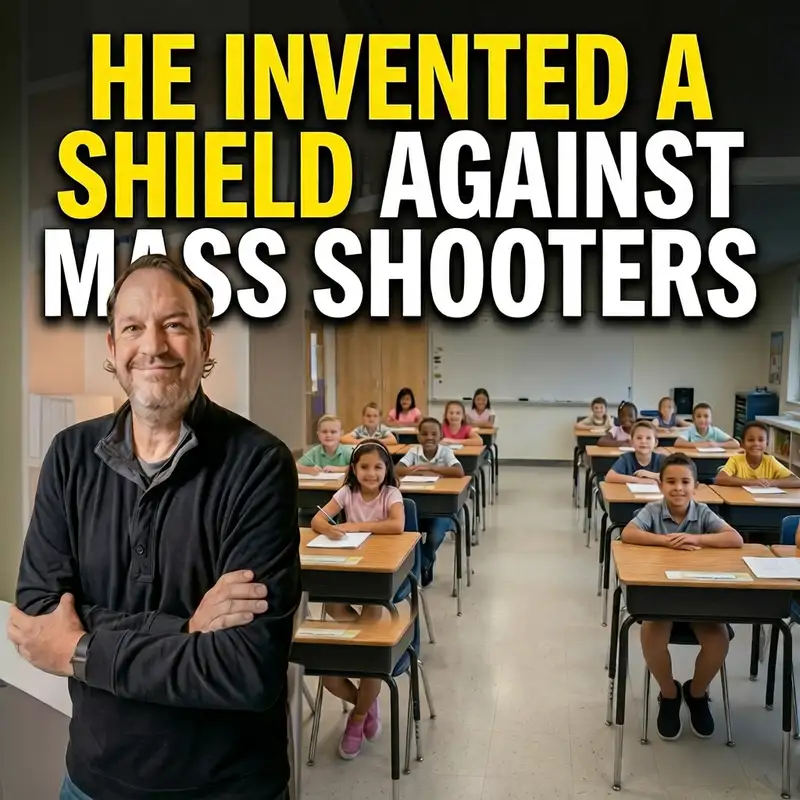
He Said No to Big Money to Protect Schools Instead | Scott Newman, Founder of Titan Armored Systems
Download MP3[00:00:00] I'll NEVER FORGET where I was, who I was talking to, and I was like, you know what? If I told you that I could manufacture a BULLETPROOF MOBILE GLASS BOARD, If the SHOOTER came into your school or administration building, would you be ready? This is a foolproof mobile dry erase. Five core SROs can use this as a Ford Operating Shield.
It also protects classrooms. Put this behind a door you could shelter in place in the event of an ACTIVE SHOOTER, protect you, your faculty, staff, and your students. We just pull that OUTTA THIN AIR. And so I just designed something that I thought would be really cool, there's one in every office. And I'm like, how great would that would've been if you could have positioned that behind the door and those kids and those teachers could have SHELTERED IN PLACE, quantifiably and potentially you have a dramatic loss of life.
Absolutely. And, and as a PARENT. To TWO YOUNG GIRLS. I'm like, think about those POOR KIDS that survived that ordeal that were TAUNTED BY THAT SHOOTER Today's guest is building on one of the high state markets. There is our children's safety. Scott Newman is the founder and CEO of [00:01:00] Titan Armored Systems, a company developing bullet resistant solutions primarily for schools, but also for workplaces, government environments, and other vulnerable spaces.
From bullet resistant glass to mobile protection systems. Titan is focused on creating smarter, more discrete ways to improve safety in the places people learn and work. Scott brings more than 25 years of experience building and scaling companies. And before launching Titan, he helped grow an armor vehicle business by doubling revenue, cutting costs, and expanding into international markets.
He's experienced both the hills and valleys of business and had to shut down one of his prior businesses during the pandemic, Scott brings a rare mix of entrepreneurial grit, operational discipline, and product vision to everything he builds.
What makes this conversation especially compelling is that it's not just theory. Scott has lived the pressure of building real companies, making hard pivots, learning from failures, and trying to scale a mission-driven business in a market where the stakes are very real.
In this episode, we talk about what it takes to grow and scale in a high pressure environment. What founder leadership really looks like behind the scenes
and why Scott believes [00:02:00] building the right product can literally save lives while setting himself up for a good exit.
[00:03:00] Scott, welcome to Wall Street. To Wall Street. Before we get into what you're doing with Titan Armored Systems and your entrepreneurial scaling up can you talk a little bit about. Your background growing up and what inspired you to be an entrepreneur and founder
yeah. I would say this, it started when I was 12. My sur first summer job was laying brick. So from the time, I started playing sports. I had a summer job. I worked, so I got up and had to grind every day. And that really taught me a lot more about work ethic. I'll never forget talking to my dad about it and he was like, look, I want you to understand what it's like to earn money.
And, that was just a foundation that I started. And that was a brutal summer, but the next summer. I did it again summer after that, I did it again and and laid brick all through high school and all through college. So that was really, that's where those foundations in those building blocks really started for me.
It's tough work. You learn a lot, you'll learn a lot about yourself internally working with your hands. Like 100%. Yeah. Especially while your friends are playing golf [00:04:00] and you're laying brick at the, on houses at the country club and your buddies are playing around at golf it's, but that, I think that's a really good, valuable lesson about, work ethic.
I think from an early LA early age, and I think it's no different in any business. You've gotta work hard to work smart. It's something that for me was just a great foundation. I've carried that with me into, my professional career and, and being an entrepreneur.
Talk about that. Talk about how after high school, what did you do? What's your progression? Outta high school, the progression was, so if you lay brick. And that's back when, you gotta get your four year degree. Isn't it crazy how far we've come as a society? And you look at now and you look at, laying brick and I use that example as, we were, you go to four year university, you get a degree and you go and join the Work FA workforce.
Now, you could take what you've learned at Laying Brick and become an entrepreneur Lane, Brett can probably make a lot of money right out of the gates. Absolutely. How times have changed and really, looking at what how valuable a degree is from university. After I graduated from school, I started building houses and worked for a [00:05:00] company that was at the time growing and scaling here in Dallas.
And they're one of the largest privately owned home building companies to this day. And that owner was just a complete maverick in the home building space and he was an entrepreneur, learned a lot from him. So that was a great next step out of college.
So you went from land, brick building houses. What was your first kind of, I'm going to be an entrepreneur? It's you just happen upon it really and truly. I progressed through, the corporate space and was an executive with one company running operations in Latin America.
And so I lived in Mexico City for seven years, which was a great experience. And then the opportunity to come in as an equity park or as a stakeholder and a, and an armored vehicle company. That's really why I got my hands really dirty as an entrepreneur and and building and skill in the company.
And they were wildly successful before, but we really took it to the next level. So over your 25 years, you've built a couple of companies. What kind of pattern recognition do you see that kind of draws you to a company? Is it the hands-on aspect of it, the manufacturing or [00:06:00] I think it's because, you control everything, and when you wake up in, in the morning and you're an entrepreneur and it's your business it's there.
There's something extremely gratifying to see that. I think too, that gives you the flexibility. I don't know. I think once you do something and it's your own, it's hard to go to work for somebody else. Especially back in the corporate space. Once that genie's out of the bottle, it's out.
And and then that's definitely the case for me. I after, after, the armored vehicle manufacturing company, for a hot minute, I got back in the corporate space and it was just, it, yeah. It was just. Say it was miserable. A hundred percent. Yeah. And the world's changed.
Yes. And everything's changed. And I, and I don't know, I, it just, I was like, okay, what are we gonna do next? So then, elevation Concepts was really my first foray, my first company that I started on my own. And, and it just so happens that founding, that company coincided with COVID, we manufacturing standing desks.
And I was a very high end. [00:07:00] It was a Gucci standing desk, but, and I was selling B2B . Okay. And then when COVID hit, it was just straight on B2C, so I had to pivot. But what happened was, is the market got flooded with people that were manufacturing standing desks, and, because there was all this work from home.
I, you probably would've been my demo for my desk 'cause you had the rideable glass surface and it was super nice, really amazing product. However, people just wanted something. They could stand up, work at home, and then they can go to IKEA for $200. Yeah. So as it was more of a consultative sell, building the product, the features and benefits of writing on your glass, the custom colors and all these things, at the end of the day, people just wanted a freaking standing desk.
And so did you learn from that though? A hundred percent. You should. You should have not gone Gucci, you should not have gone high end. Maybe go more mass market or, yeah, I think there's a lot of things that was B2C and you had to pivot really fast a lot of things.
Yeah. Things moved so incredibly fast and COVID and so I learned a lot. Don't get me wrong. And I think too that when you, oftentimes you fall in love with your company and you fall in love [00:08:00] with what you're doing. And when you fall in love with your company, you also don't look at some of the red flags.
Also learned what not to do. And so I think that, as a, as an entrepreneur and as a founder I always say there's no ego here. You can always learn. A lot of people are great to beat their chest and talk about best practices.
I've always been the one that talks about the worst practices. One thing that I will say that was, that, that was a benefit about COVID was I connected with a lot of entrepreneurs, a lot of people that, were in the same boat and, you learn a lot from people because an entrepreneur I like for me, I love to share things.
What not to do, how, things may be pitfalls to avoid when you're running a business because there's no rule book. There are, very few people out there that just have an idea. They launch it and it's just, it's a rocket ship right out of the gates, and it's going back to working hard to work smart.
Yeah. Yeah. Even the companies where, the press will tout a company every now and then as, oh, they just started it in their dorm room and it went up and it's no, you're really behind the scenes. It was band-aids and duct [00:09:00] tape and cobbling things together and it was hills and valleys and it could've collapsed at any time.
That's what you find out, right? It's never a hockey stick. No. I just thought we were talking about LinkedIn earlier. Everybody looks at, your social media or your LinkedIn oh my God, this guy's just striping it. But I always use this analogy is nobody ever goes back in the kitchen.
They don't know how the sausage is made. I love that. Yes, it's true. Yes. They don't, it's messy. A hundred percent. And they don't know what goes on behind the scenes, and another entrepreneur does because they know what it's like when you're sitting there and you're like, okay, you are looking at your p and l and you're like, okay, let's figure things out.
That's it's, there's a lot that goes on behind the scenes to get to that finished product. And Yeah, it's, if you have help along the way, or if it's a viral, viral social media poster or something like we were talking about earlier. Those things are great, but only a real entrepreneur knows about those things.
Everybody that has a corporate job, the other, what, 97%? Yeah. They call complainant about their boss or complainant. About their admin. Stop it already. And it's so true what you said about social media generally, especially LinkedIn. A AI has definitely made it worse. You see so much [00:10:00] content out there.
And I told my wife, I'm gonna start putting typos in my posts so people know that I actually wrote it. This is actually authentic. No dashes. Yeah. Yeah. No dash. She's oh. It's oh man, come on, this is chat. Or that's, Gemini. It's just so apparent and but the authenticity is key and you see so much out there.
About how, I'm an entrepreneur. I get up at 5:00 AM I was telling you this yesterday. I get up at 5:00 AM I do a hundred sits and my, my business is doing great. Sure. And it's no there's really a lot more to it, right? Let's hear the, let's hear the grit, let's hear the bad stuff.
You know what? Yeah. That sounds great on paper. And I love that, I do think that when you get up, how you get up in the morning is how you frame your day. I, it's true. You get to choose your mood. Like you get to choose if you're gonna go out there and have a great day.
And I do believe in that. I think it's really important to get up and to express that gratitude to to put your mind in a place to where you can go and be successful. Yeah. But then the first thing that goes off, then all of a sudden, you're off the tracks. Then you check your email. You're having your shake, but Oh, a hundred percent that email comes through and you're like, damnit. Yeah, I, I know. And then, but as, [00:11:00] but you've gotta be able to auto Correct. Yeah. And when you're an entrepreneur and and you have a small team, you have to be very careful because, you can't just start complaining, complaining and bitching and moaning and whatnot because nobody's there.
It's you gotta pick yourself back up. But you've gotta be able to auto correct super fast to keep things, going ahead. Going back to Elevation Concepts, what did you learn from that business? What were some of the things, 'cause you talked about you learned a lot of the good Yeah.
And best practices, but also a lot of the worst practices. Share a couple of those that you're applying now that you think are applicable just to generally business. I think, when you're starting a business, you've gotta have people around you that are experts at things that you're not. I could just say right out of the gates, when we started Titan Armored, the first thing that I did was found best accountant in the business.
And our, our CFO is just a stud. I think that was one thing that I learned be because that was a weakness of mine, and I'm okay to say that. So you build yourself around people that are smarter than you. Absolutely. That would be another one. And then also too it's okay to be passionate about your [00:12:00] product.
It's yours, it's your invention. It's something that you designed, but you gotta be careful about falling in love with it, and it's something that you just it's a business. Is it working or is it not working? And then being very quick. I think that if something's not working. That's the advantage of companies that are lean, is to be able to pivot, if you will, or do something super fast, because the faster you can pivot and you can move on.
The faster you're gonna grow and scale, especially thank you for that. That's very insightful. And I think, the number one way to do that is look at numbers. 'cause numbers don't lie. They know numbers are objective numbers don't care about feelings. They're going to tell you how healthy your business is.
And, but how do you know when it's time to pivot and when it's just another shiny object, right? So how do you differentiate between that? Because pivoting can get expensive. I'm a squirrel. That should be our mascot because, something catches my every 10 seconds and one thing that I draw on is,
before you start trying to launch a full online, do one thing and do it great. [00:13:00] Like for us, with Titan our flagship product, the tag mobile, which I'm sure we'll get to in a minute. Yes, we'll talk about that. But do one thing right. And make it great. Work the bugs out. Let that pull the sled and just be laser focused.
100%. Okay. 100%. And it's, look, a lot of this is therapeutic because you've learned the, you learned the hard way and then you just and row with that. So for Elevation Concepts, did you exit or did you just close it? Just close it. How did you know when the time was to do that and to move on to something else?
We weren't selling any, I mean we, we were selling some, but it was just like it was one of those things to when you're selling a standing desk that's that expensive online it's, people aren't gonna buy that online, was the price point.
Let's say 1500 and, just shy of $2,000. Wow, okay. Yeah. It was an expensive product. The value proposition is there, but when people are going online to purchase something, look you wanna maximize the CTRs.
I click through rates. When I want you on the website, I want you boom. And I want you checking out. I want your credit card immediately, and I want that purchase. That was tough. You know what I mean? [00:14:00] And so because you were getting the CTRs but you weren't getting the follow through. Yeah. 'cause people would see the price point and say, oh, let me see if there's something else out there.
Yeah. And then we tried to, we tried to pivot and as it was a slow drip going back to work. And, but and doing more like collaborative tables, like doing, height adjustable conference tables, which are great kind of in that, enticing people to go build more back to the B2B.
Look, when people are coming in, it's a hybrid office space. We'll let people kind of work at a shared space to bring that collaboration back. That didn't work coming out of COVID. Now it's not, maybe not so bad, but by then that ship had sailed. I was done. You know what I mean? I was like, okay, it's.
And also too, that, that's one thing back to standing desk, very one dimensional. And then you look at other companies like, you know what VE Desks did with their rebrand of Veri? And you look at what Jason's done. It's phenomenal how they are a turnkey full office suite, 28 days, boom.
That's a business model. Yeah. So it's okay to lose. Yeah. It's, it's okay. And, come on. I think with every loss though, so long as you learned [00:15:00] something, if you look at even like Amazon, Jeff Bezos, they put like $170 million into their phone that they did years ago.
I don't know if you remember that, the fire phone. And they pulled the plug in six months and they literally have dozens of lines of different products and everyone thinks, oh, they, they won. It's no, they have far more losses than wins, but they learn from each one. That's why your serial entrepreneurs, in my experience, your serial entrepreneurs are the ones who actually they shortcut.
Looking at this now, several years after the fact, it's like I should have, that runway for exit should have been a lot shorter. So you should have pulled the plug sooner. Hundred percent. Okay. Yeah. Yeah. And and then, and then for me, really and truly you just and again, I think that's all you learn. There, a lot of entrepreneurs I don't know what the statistic is, but they talk about how many companies they started and failed before one hits. Exactly. And when it hits big. Yeah. And you draw from that.
That's where it's like going back to that me. No, you've gotta really learn as you go because it makes you a better leader. It makes you a better founder, entrepreneur, every little thing along the [00:16:00] way. 100% total marathon. I saw a clip, I don't know if you follow Alex Ramzi, but he had this clip.
The other boy that I signed, he said, I started my first business. I lost everything. I started, my second business fell and he goes through nine times.
Yep. And then finally he did Gym Shark. And he, and it hit and. Look at him now, it looks like his overnight success, but it's not. It's no, this guy's s flogged through for years and he's willing to share it.
And a lot of people aren't willing to share that. And a lot of people don't have the stomach for it either. Yeah. Because, it, it comes with price, and because you have, your inner circle that's with you on the ride, you have your family and friends and, so yeah.
It's, your inner [00:17:00] circle gets small. It's lonely. Your inner circle remembers. They're like, oh, again, is this like that idea? And it's no, this is different. This one's gonna work. Yeah. Yeah. Good point. What's the biggest lie you think founders tell themselves when they say we're growing?
And I think, the big lies is they're their biggest cheerleader, and like you said, the numbers don't lie. In my experience that they're not looking at the right numbers. Yeah. Or they're not looking at numbers at all. That's right. A lot of times it's, I'm getting this great feedback on social media.
It's but what are sales doing? That's what are your margins? That's such a trap is oh my God, I've got a hundred do followers on, on Instagram or TikTok, and if you're not ringing the bell and you're not translating that into sales, that's a complete load of garbage.
And, and I think that goes back to having a really good person that's watching and managing, the business, the, the, on the accounting side, because they're the ones that are calling and saying, Hey, these are the numbers, you know what's going on. So we're gonna get into exactly what tight Norridge system Sure does, but.
You were in the armored space before with vehicles. And now you've [00:18:00] moved more into classroom type space. What made you transition and say, I need to get into this space and build this product? Alright. Every, everything does happen for a reason. I do believe that.
People ask me that all the time is, how did you go from armored vehicles? You're doing standing desks and then you've got this. Bulletproof product. Okay. Obviously we are armoring vehicles and and the thing about armoring vehicles is its discretion. So when you are in an armored, let's just say you're in an armored Range Rover, or you're armored suburban or Escalade, you don't want to tell the world that it's armored.
Chances are you the VIP or inside of it and you're in, you're a high value target. So it's discretion. Unless you're building like a, like a swat vehicle that everybody knows it's armored, send a message. So it, it's discretion number one. So from that, when I started Elevation Concepts, it wasn't by, branded chance, we were using an actuator motor that would raise and lower the ballistic glass on the cars.
That same technology is used in the actuator columns for the standing desks. Oh. So there's a little bit of armor in the [00:19:00] standing desk. I wanted to do something a little bit different on the standing desk, and so at the time. Somebody's office had been shot. And so I, just mentioned to a buddy, I was like, it'd be cool if there was a ballistic desk.
At least you could just, you could, tilt it over or you could shelter in place behind it. At least, at least, save you a couple of minutes. There really wasn't a thing. And then I came across a company that was manufactured the dry erase glass, and I was like, oh, this is really cool, so you could write on it.
And I thought that was neat, just how much paper we waste in offices, whatnot. So that was that. As we've already discussed about Elevation I could see the end of the road on that. And about that time they had the school shooting at Rob Elementary. In Uvalde. In Uvalde, yes. And I just, I don't know, I think that's really where, for me, the road forked and I just couldn't get over that, how you had, an active shooter that was identified outside the school.
Now you've got an active shooter that's in the school, then you have a barricaded shooter. You have, I think, 77 minutes that [00:20:00] transpired. Yeah. Almost 400, law enforcement that assembled outside the school. They go in and then he starts shooting, as a Barr GED shooter. He's shooting through the door, through the wall, so they have to leave and they've gotta go back in when they finally have rifle rated shields so they could breach the door, go in and neutralize the active shooter.
That really bothered me. And, and look, and, active shooters situations have been, since, Columbine in 1999. Think about that. And then, but I couldn't let that go. And so I'll never forget where I was, who I was talking to. And I was like, you know what, if I told you that I could manufacture a Bulletproof mobile glass board,
[00:21:00] and it was just pull that outta thin air and then that, I said earlier, when the gen outta the bottle and that was about three, a little over three years ago.
And so I just designed something that I thought would be really cool, and I look at, office furniture and things like that. And I look at, the mobile dry erase class. I'm sure you've, you, there's probably one here, there's one in every office. And I'm like, how great would that would've been if you could have positioned that behind the door and those kids and those teachers could have sheltered in place, quantifiably and, potentially you have a dramatic loss of life.
Absolutely. And, and as a parent to two young girls, I'm like, think about those poor kids that survived that ordeal that were taunted by that shooter for that amount of time. That's not right. Yeah. And that's where they were tortured. Hundred percent. They slaughtered or tortured, they're all slaughtered and so people don't talk about it.
They look at the victims and those poor families for what they have to live with for the rest of their life. [00:22:00] But the people and the students, faculty and staff and parents of the survivors. And what they have to live through. And the law enforcement, I've talked to a lot of people that were there.
Yeah. Communities are forever fractured. Yeah. You can tear down the school and you can rebuild it, but, it doesn't take away from that incident. And it's horrible that we're even having this conversation or that's how you develop a business model. But that's where, that's really where the progression was and yeah.
Here we are today. So talk to us about the product because and I'll share images and video of this. Yeah. Talk to us about what your current company Titan Armored Systems, your core product, and then, ancillary products, but the core product that you shared with me, which I think is what you're referring to.
Yeah. Yeah. So our, our flagship product, we call it the tag mobile. It's it's exactly you. What we say it is, it's a bulletproof mobile whiteboard. The idea behind this, and I don't wear a cape, I, I can [00:23:00] build great things and great products that I think are super applicable to the classroom setting.
I knew nothing about K through 12 specifically selling into education, so when I designed this, I thought, okay, I'm gonna start knocking on doors and getting into school districts and we're gonna save the world. It's a tough market to sell into. The educational market is tough to break into.
Sled market is tough. It's a relationships built industry and long tail. A hundred percent. Yeah. And I found out very quickly, that no relationships, that's a lot of door knocking. And so the first big break that we had so develop the tag mobile. So we filed for our patent, obviously.
And what it is it's, as I said, it's a dr, it's a Bulletproof mobile whiteboard. So ours is a lot different because we have the dry erase glass surface. And so it's a layered piece of glass. It actually has ballistic properties, so it looks like a dry erase piece of glass.
Super, super, super nice. The armored core is a mill spec armor. And then on the backside we have a nine millimeter acoustic panel. So going back to what I said [00:24:00] earlier about an armored vehicle, you want discretion. I don't think kids need to go to school Yeah. And know that there's a Bulletproof mobile whiteboard in their entry classroom, cafeteria, soft library.
So it's completely discreet, with our product, you would not know it was ballistic unless we shot it. It's that good. So the idea is inform the faculty and staff. That's right. Kids don't need to necessarily know. No, it's discreet. There's utility, it's not taking up space that's right.
Between a dry board. Anyway, it's an educational component. There you go. And and with that being said, school districts not only across Texas but across the country, are strapped with budget deficits. But meanwhile they're being compliant with new rules and regulations and whatnot.
And on the heels of Valdi, there were a lot of new laws the school districts had to comply by, et cetera, et cetera. So this product is great because it's an interactive learning tool. But I started to realize, when I started speaking to school districts that you're not gonna put one in every classroom and that's fine too.
[00:25:00] So as we, we started this, we, we got into several buying co-ops, so school districts can buy, via the co-op, they can purchase our product. We've been vetted, all the product has been third party tested. But the great thing about this is it's not one dimensional. So whereas a police shield on average is, let's say 24 by 36 inches a police shield to be stored effectively on a campus is gonna be either in a closet somewhere.
Or if there's a school resource office officer, they have their own independent office. But if a, an active shooter situation, happens or there's an emergency, where's that shield? Our product is four to eight inches by 74 inches salt. So it's full coverage and it's on wheels.
That's right. And it's very moving. So both hands are open. Barricade behind it. That's right. Very agile, very nimble. And so once we started, presenting to school districts, especially to the the police chiefs that they have an ISD in the school district and the directors of safety and Security, they're like, wait a second.
This is a tool that we could [00:26:00] use. And we could say, welcome to, Highland Park High. And it's parked off the vestibule and it's there. And in the event of an emergency, everybody knows where it's, A lot of districts will put multiples points of entry or long hallways. And so as I started talking to law enforcement officers, they have a nine millimeter, if somebody's gonna come on your campus, they're bringing a rifle, they're bringing something on an AR platform.
Yeah. In a hundred meter hallway. And they enter that hallway. You round the corner with your little nine millimeter, sorry. They own you. Yeah. And with your little, your little police shield, oftentimes those police shields aren't even rifle rated. They handgun protection. Wow.
I'm sorry. So it goes back to the design of our product to where it's full body coverage. We can put that in. And that could be a physical barrier in a hallway. So then you can shorten the playing field, and then you could engage, the threat. Or you could put that in a hallway, lock the casters, and if you needed to clear that hallway, you could evacuate.
I'm not [00:27:00] saying that it was all by design, a little bit of luck along the way, but right out of the gates, even from the time that we were designing this product, I feel like we checked everything off to where this was a tool that can be literally delivered into a campus and used in a variety of different ways.
Now, going back to budget deficits you now have something that is a police shield when it needs to be. You have something that can be used as an interactive learning tool every day. If it's in a classroom or maybe it's a breakout session or it's something for way finding if like maybe there's an SAT or a CT test or there's an event on campus.
And then the backside, of course is an acoustic panel. So you can decorate it and put whatever the next holiday is. You humanize it. Yeah. Put your, school colors investment, it's innocuous. No one knows what it is. And that's right. The likelihood of a shooter coming in and knowing that they can use that as a barrier is extremely low because again, it's innocuous.
It doesn't say I'm bulletproof. And no one's gonna think that they can hide behind that and be safe. Yeah. But the faculty and everyone else is informed and they know there's a tool there that they can use, God forbid if they need it. That's [00:28:00] right. We talked about it's tough to sell into the education market.
It's also tough to educate a market and say, Hey, I have this new Right. Even with Uvalde the high profile of it. How do you do that? Were other people already in this space? Are there other people now? Like how do you navigate that there? Yeah, there are, there, look, when I came with the idea, I didn't do any due diligence before.
I just okay, we're gonna do this now. There are, there's, we have some competition. There's people that, that make a similar product. It's. It's literally like an old school nineties whiteboard that's on a piece of armor plate and on casters. Nowhere near rudimentary. Yeah. And a lot of them look armored.
Not a lot of competition. Schools have budgets, schools are strapped, districts are strapped.
Are you offering financing to, to make it easier for them or, we've thought about that. We haven't gone down that road yet. The pricing for a similar product to ours is all over the map. Okay. For starters, our product is rifle rated. There's armoring standards, in that, in NIJ, national Institute of Justice, it's level [00:29:00] three plus ul 7 5 2, level seven and eight.
So it, it's rifle rated. Yeah. Now, other competitors or people that are out there might just have something that's handgun protection. Yeah. Okay. Whereas ours is 48 inches wide, some are only 24 inches wide. I'm sorry, that's not full coverage. Some might be 36. So where our price point is now is we are really a, we're the best value in the market.
And again, great question. I encourage people to do their homework. Okay. On what's the best value for you.
The actual emergency if it ever happens, and then I'll let everybody else make their decisions. So what I try not to do is I try not to sell. I try to educate because if it's not a fit, it's not a fit, especially when they're looking at their budgets. But more oftentimes when people see it. They're like, oh yeah, we want this on our campus.
When you launched Titan, was it harder to get the product right, or to educate the market like that a little bit of both. We've been evolving as [00:30:00] we've been out in the field if you think about it, you want something that's going to be agile and nimble if you need to move it's heavy. What's the weight of this product? About 300 pounds. So you need to have some serious industrial casters that are going to also still be able to roll easily, right?
That's right. Yeah. That, that, that's right. If you're gonna use it in an emergency, it's got to perform. So I think another thing too is again, we keep talking about that ego. If it's in a school and the person that's gonna use, it's have you thought about this?
Because if you take that feedback when it's in we did delivered what, three school districts yesterday, all over Texas. And, I had to race back here for this. But the product was just, it was incredible. Best we've ever delivered from. And and you can see these are the whiteboards. Yeah. You can see that when.
The superintendents are there with, the assistant superintendents, the principals on each campus the SROs that are gonna, potentially use it. The chief of police, all the admin that are there. That to me is most gratifying as we're like, okay, this is exactly when we invested in this.
'cause it is an investment for the districts when they invested in that product and [00:31:00] they love it. That to me is just it's a complete walk off. Yeah. It has to make you feel really good. Yeah. So selling desks is one thing, going back to selling this product. Yeah. So selling desk is one thing.
Selling armored cars is one thing. Yeah. Selling something like this is a completely different like ethical and emotional landscape. Oh yeah. Because there's, it's hey, you're, what? How did you get over that? You have to get pushback on that front. It, yeah, that, that goes back to, to our viral video that, that people, before we started the, the podcast was.
That background noise of people saying, you're capitalizing on murder and death and Okay, great, you, you wanna know the feedback, you wanna know what people are thinking. But that's just I don't know, I don't really buy into that because unfortunately, mass shooting school shootings, there's something that until we can really, we can get a cure for this and get around it, they're going to continue to happen.
And for me, I look at it very mission driven. I want a product [00:32:00] that's in a school. If it ever happens, it's gonna minimize the loss of life, period. Full stop. I was with a superintendent last week and they had an incident at their campus and he's look, since I've been in this district, I've, he goes, my job is academics and curriculum as a superintendent, but unfortunately our district, I am.
100% focus on safety and security. I have to delegate academics and curriculum to an assistant superintendent. He goes, that's my world. And he goes, and the parents want safety and security in this district. And that's pretty powerful considering that we're sending our kids to go to school to learn and to thrive and become better versions of ourselves and to go and contribute in society.
But yet from, the administrators, the parents we're worried about a potential active shooter without a, that, that's just the reality of where we live. And yeah, it's tough. And then another thing that's really, selling into school districts, it's, it is very challenging and it's very [00:33:00] unpredictable.
And, when I'm sending you the superintendent an email how many other people are trying to sell them anything? If it's, if it's bathroom cleaner or some commodity, or they're trying to sell 'em. X, Y, or Z widget, or they're trying to sell in safety and security. You've got a very short amount of time to capture their attention, get in front of them, and then when you get in front of 'em and they're excited about the product, then you gotta get the purchase.
And then you bring into, where's the money coming from? And, and it's a lot of people, your chief of police, director of safety and security, and then your school board. So a lot of people that see it, that get it, they're like, look, after, hearing you and what you do in your presentation, we could not imagine that if we didn't buy this product for our campuses there was an incident.
So there a lot of people think about it. So yeah, it's, you have to be very careful and I learned that from the get go. Look, I can sell anything. Okay, but. You have to learn not to be very [00:34:00] salesy and let the product speak for itself. That, I, again, I go back to just educating people on the product.
And I think also too, it's okay if it's not a fit for a certain district, that's okay. Because there'll be a fit someplace else. I feel as we're growing and we're scaling, we're still the best kept secret that nobody knows about. And I see it, it is definitely a problem.
And God willing we'll solve it. But even if we do, there's still the threat of terrorist, attacks and, not just in schools, hospitals, movie theaters, stadiums. There, there's different applications I think you would find, because it can be signage. It doesn't just have to be a dry erase board.
It could be signage promoting a movie or something like that. You touched on something that, given, the timing of this and where we are in current events, we look at a school shooting. And when you look at it through the lens of, your prototypical, troubled student, lone wolf, he gets he's on the dark web and then he comes to school, he has his manifesto.
He knows he's gonna go [00:35:00] in, he knows the teacher that's the bully. Or maybe it's some students that are bullies or whatever the circumstances are, the warning signs have been missed. He goes in, chances are he is not gonna come out. And that's the way we look at school Shooting specifically in the K through 12 space, you mentioned it now, where we are with geo current geopolitical climate, you look at, what happened at the mosque in Michigan and, I do believe that these are lone wolfs, but they self activated because their ideologue aligns with, the ISIS inspired al qa.
And they're self activated because of what's going on the news. And they, go drive a vehicle into a mosque or they go into a church and they open fire targeting individuals. Now you wanna take that a step further and the likelihood of sleeper cells that exist in the United States, which we know exist.
Then you start looking at multiple shooters and multiple teams. Is it a [00:36:00] two, three man team, times three of 'em, and then all of a sudden you look, we will go back to a school and then that school's a soft target and now you have three shooters on one campus. Yeah. That's a problem. That is a problem.
And and in Texas, we're a little bit different in Texas, but let's just say that there's one school resource officer on that campus, and these campuses are big. Now you have three shooters full of students, faculty, and staff. That's a problem. And I think that, self-awareness is really important, but we don't even want to go there. So yeah, you look at like our product that we design and 100%, you look at some of the incidents that happened in the fall with universities and a lot of swatting, I don't really know who was doing that, but it could it have been a bad actor looking to see the response testing the system?
That's right. Or if you look at, I was in a meeting last week, look at the mosque in Michigan, how many police cars showed up? To that one mosque well think about. Now all of a sudden they've got all the law enforcement drawn to one location, but there's a target over here that's not being or there [00:37:00] 35 minutes away.
There you go. So I think we have to be very careful and and I pray that does not happen. But when it goes back to that, back to our product if you need to shelter in place behind our product, you can do that. So you've talked about, selling into the educational market, tough long tail customer and you've talked about having to educate the market and make sure you're pushing the safety component, not so much the fear component.
Talk to me now, I think you have an added layer of complexity. Of, of manufacturing. Yeah. 'cause you manufacture the products I understand here in Texas, in your factory north of Dallas, correct? That's right. Talk to me about some of the challenges of that. Why not have it offshored? Why did you decide to manufacture in the US and what are some of the challenges you faced with that?
I. I'm very big on made in USA I'm very big in made in Texas. If we can't make it in Texas, let's at least make it in USA. I'm proud to say that, every component is manufacturing in the us. That's really important to me. The standards of [00:38:00] the component are very important to me because, look.
I tell this to everybody, I wanna sell you the best dry erase whiteboard you've ever purchased, and I hope that's all you ever use it for. But on the, in the event that it does need to be used in an emergency, I want the, I want it to be the best bullet resistant product on the market.
I can quantifiably tell you that we've achieved that, and we've and when you go back to manufacturing, I think it's important too that you listen to the people that are also, that are building it. What tweaks can we make to make it better? What ways can we make this thing, even better?
We're already working with some school districts that wanted to put a grab bar on it, and early on I was like, there you go again. Like ego gets in the way. No. We're not doing that. Then I'm like, wait a second, I'm listening to the experts and in this particular district, they're gonna use it with the grab bar.
We're putting freaking grab bar on it. And so we figured out a way to make it really look good to where it, it still looks nondescript, so I think you have to. You have [00:39:00] to, you check that ego again. You've gotta listen to the people that are manufacturing it, and also too you want something that you could build to where, it's like making cookies, you get that recipe to make the cookies and there's tweaks and whatnot, but once you get that, once you get the recipe down, you make a lot of cookies.
You have this experience of armor cars. You have this experience of the glass top desks, the Gucci desks. And then you're like, I'm gonna manufacture bullet resistant glass. Yeah. Dry erase boards. Do you buy a factory?
Do you go build it? Like how did you go about that? That's been a work in progress. What we do is, we're really good at how we get all the components. In one place to where we do the assembly. So you're sourcing the components and you're primarily focused on the fabrication.
They're putting everything together and the casters and the frame. It's an art. It's an art that I can't get too much in because of the IP component of that. But we're really we're adding a lot of elements that create one product. Yeah. And it goes back to the sausage.
I could tell you a whole lot off, off the [00:40:00] testing you're doing behind the scenes and getting it right to where it's scalable. You have to create a scalable company 100% for what's going. And you're also marrying products that aren't designed to be married. True. When you're looking at the, at the glass and then the ballistic material, so we've, I feel like we've we've got that all dialed in. We've got that secret sauce and you're taking something that, going back to the desk that, that looked like that bougie Gucci standing desk, but something that you could just mass produce and you could do it at scale, because as we grow, people wanna know that they can buy the product and get the product and we can crank it out, you know what I mean?
And I think that's something even going back to looking at last year we did a lot of things behind the scenes on the manufacturing side that. I had to take myself off the streets selling until we could really work out how we wanted to manufacture this to where, for it, there's no difference in if you're doing 10 or if you're doing a hundred at once.
That's very insightful. A lot of founders [00:41:00] will not take themselves off the streets, as you say, because sell, sell gets the cash in the door, which keeps a company life. But if your product is your process or your product is broken, you can sell, and you start scaling and then you've got junk out there, and then word gets out in your toast.
Well, a hundred percent Amy can't deliver. And that pay or you can't fulfill the orders. And we, look, we've been there and and I go in and I'm like, look, I'm the tip of the spear. And, and I have no problem being like, yo, look, I, it falls on me. This is my business, so I'm not gonna run and send somebody else over there to do that delivery.
I'll go myself, but I do fall back on, on this. We will only deliver a perfect product. I'm not going to put something out in the field that's not 100% to our standards. Period. End of story will not happen. And you know what I find? Because I believe in the greater good that when you show that humility to somebody, they're like, thank you for that.
Because look, I wanna be able to grow the business. Look, you're not gonna please everybody. You're not right. [00:42:00] But more often than not, you are going to be able to ask for a letter of recommendation or how can I help you? And and we find all the time that people go to a school, they see our districts or wherever they're deployed and they're like, oh my God this is in, this is incredible.
And we find that more often than not. But there's that fine line between just sell. But you gotta deliver. Yeah. No, you absolutely have to be able to deliver. Yeah. Every time. What is your biggest choke point to scaling this company? What's the biggest thing that would hold you back?
Being very intentional and thoughtful about how you spend the money, as as you, you, because, companies can either, they can be cash, cashflow rich and cashflow poor. And it's it's, first of all, it's delivering a good product. The more product we put out in the market, the more people see it, the more are gonna talk or superintendents go, or an assistant gets promoted and goes to a different school district kind of spiderweb approach.
So that's a great way to scale. And really you make your own look, you are only as good as your next call. And we have some things in the [00:43:00] works that would allow us to get a larger national footprint. And I think tapping into people that already have those relationships too, because you do have to cultivate those relationships.
And it does take time. Time, yeah. Time is a good multiplier. So you doubled revenue at, I think it was the armored car company over a short period of time. What principles from that, because that's the achievement doubling revenue. What principles from that company have you applied here or you think you should apply here in this space?
I think in the armored company, it was likability. Our customers loved us. I, how many people do you know, would go to Libya and camp out in Libya for three weeks waiting for a contract? True story. Huh? A hundred percent. Wow. Yeah. And, but we did that.
Okay. And we did that and, you earn trust and not a lot of, not a lot of other companies would be willing to go and do that. I would say. Yeah. And and Libya's not the same country now then a couple of years ago when we were there, pre Arab Spring, [00:44:00] another story for another day.
But I, I think that customers see that and, going that extra mile yeah. Great likability. Also too and somebody told me this there, and I think that a lot of founders and a lot of entrepreneurs, they have oh, what is it? I can't think of the word, but they don't want to, where I'm trying to get at is they don't want to put themselves out there, imposter syndrome, right?
Or Right. So they don't wanna put themselves out there and get in front of a camera or do that video or the demonstration. But when you become the face of the brand and your product and you embrace that people are buying from you because you are the brand. Yeah. And the, you have to have that authenticity.
And you've gotta check your ego, but also too, but when you have a product that you know, look, it's great. I know it's great, but is it really great? And I feel like we've checked the boxes on all three. And so yeah, when you put yourself out there, you're gonna get the haters. People are gonna have the [00:45:00] comments and they're gonna hit you on social media and say that you're trying to capitalize on murder and all that.
That that's. It's noise. It is, it's background noise. You have to, it's noise, right? Because if Yeah. Unfortunately in this business, yeah, there's gonna be, there's gonna be a loss of life if there's an active shooter, but how many lives can we save? Yeah. How can we keep that community in that school district as well intact as it was when, mom and dad dropped their kids off to school that day.
That's that's where I come from. And I think that's where, I've been very mission driven and leaned into my faith on this, and I think that trans translates to me being very authent authentic about the product. And this is mission driven. I know that, you talk about how many companies you've started or maybe crashed and burned along the way, but I really feel like I found that one thing that truly is my calling, I always felt that I would get in some way back into the armor space.
I knew it desks were temporary. But this is definitely that, that space and, and [00:46:00] going back to, building one great product and let that really, be the lead dog, really pull the sled, if you will. So many other opportunities have come about talking to the architecture and design community.
Look, they're the brilliant minds. They're the ones designing these schools and taking that collaborative approach to where, there's all these other applications. And, you mentioned it too. You look at healthcare, you look at universities, you look at go.
Buildings. You look at soft targets, look at the corporate space. You know what started in, in Columbine has really found its way into other spaces. And unfortunately in the world we live in, they're not coming in with a handgun. They're coming in with a, something along gun our rifle everywhere.
Mean there was the guy in Manhattan like a last year or the year before. Yep. And there's video of him walking right into this office building with an air at the NFL building or whatever. Yep. He had the brain issue and he's shooting up the place and it's it's everywhere. It's rural America.
It's early in America and everywhere in between. Yeah. So it one life, it's [00:47:00] worth 100%. And think about it, you mentioned rural America. Look, I've visited districts in very rural communities to where the average response time, now, let's just assume that on that one day, they might have, they, they outsource the sheriff's deputies and there might be seven sheriff's deputies for nine school districts in this one county.
Geez. Average response time, if you are lucky. Best case is 45 minutes. Oh, it's over by then. A hundred percent. Yeah. And or he's outta magazines. Yeah. Yeah. And we're it's horrible. Think about that. And maybe the first responder is a game warden. Yeah. Somebody that's not trained to go, but that's just the first enfor, law enforcement agency to arrive.
Yeah, you are right. It's over. It's over by then. And if it's not, how much help are they? Yeah. And no, no offense to any of those first responders, but you're right, they're not trained for that. I, going back to what you were saying you're spot on in my opinion, personal brand is absolutely important.
It's the people who get out [00:48:00] there in front of the camera, put themselves out there, take the hate, but also spread their message that end up being the winners and Yeah. They're buying from you because it's a great product, but it's backed by Scott. It's backed by Scott.
Yeah it is. And as you grow and you scale, Titan Armored is going to be Titan Armored stands on its own. That's right. You start that a hundred percent and and eventually it'll be Titan, and so Titan armored systems, it's a lot of armored systems, such as bull just in glass or different applications.
But when people, yeah, people as you're growing a business, they buy from Scott. Scott is Titan, but eventually as we grow and we scale, they'll be, as you said, they'll be buying from Titan. Scott's just got it to where it goes. And I think that's something that you draw on, is there's people along the way that get you to where you, you go and maybe, they helped get you there, but you outgrow them and you continue growing.
Yeah. And I hope that we get to that point because the more of our product that we can get into. Schools, [00:49:00] healthcares, universities houses of worship, places like that. The more I'm serving the people that need it the most, it's a numbers game. The more boards you have out there, the more lives you could potentially save.
That's right. What's most dangerous for a founder or more dangerous for a founder? Scaling to slowly and missing the market or scaling too fast and breaking the company? Gosh, that is such a great question because, it all goes back to money, right? Because, you might go out and you want to wanna raise money and I hear people all the time start, founders and you see a lot of it, and they're like throwing equity around, like it's just a card and a deck, right?
I'll give you equity for this and da. And it's just really? Once you do it for long enough, you're like, you realize how valuable your equity really is and what it's really worth. Or then you talk to some marketing person and they're like, yeah, I want 15% of your company and I can do this with marketing.
Oh, really? Yeah. After you've been in a, rent a car for, a couple months straight, that 15%. Yeah. But, first to market always [00:50:00] wins. But first to market, you gotta put yourself out there because, and if you don't scale and it's a fine line.
Yeah. And I don't know if I have a quantifiable answer that, really answers that question to your liking. But yeah, you've gotta get out as fast as you can. I think you gotta protect your IP worth money. Yeah. It's worth the money. Yeah. It's worth it if you have something that Yeah.
Get, protect your ip but get out there. And then also, yeah. People always say, okay, great. Look, I could see myself with this business for longevity because I believe in it. And I think it's obvious based on a lot of these questions that you've asked me. I do that. Am I building it to sell?
100%, probably one of the best books ever. And but am I looking to sell tomorrow? No, because we're not ready, so I think that's a great question. I think, and then also too, I think you also know when you need to look in and really have somebody to really inject that capital so that you could really take that next step.
We're not there, but it's certainly, I'm trying to do all the best practices [00:51:00] from some of the people that you mentioned before we started this, that are really successful entrepreneurs. But what I can tell you that is in our control is manufacturing and being lean. We don't have a lot of burn, which I think is super important.
Do you think that's something you learned from COVID and the market having forced you to pivot so much? You learned that and are applying it now, stay lean 'cause you never know when the market will shift. Yeah, I do. I think that it's easy, because, you fall prey to people that are trying to, look, I'm no different than the people that I'm trying to sell to.
I've got people, throwing the indecent proposal on LinkedIn about, fit, CEOs that have a great diet, help over 50 or someone trying to, are you interested in selling your business or insurance or all these other commodities? And I'm like, great I appreciate it, but I know that you did not email me that this morning.
You've got, you've obviously paid somebody to pre-program and find me. You have to be very careful with how you spend your money. 'cause it's easy to sit there and give your money away. But you have to be very protective of that [00:52:00] because it's what ROI are you going to get outta, it's like spending money on advertising.
Okay, great. That's awesome. If you're gonna spend your money on advertising, we have, but why would I do a branding campaign for Titan? I think you need to be laser focused on who exactly is your audience. Go after your audience and pinpoint your audience, and then outsmart everybody to get in front with people, and you also have to out hustle.
I could tell you the, I could tell you what parts of Texas where you could walk in without a cold call, but I think it also shows grit. Yeah. That when you are, you are out in West Texas or east Texas and it's, the end of the day they're tired. You're tired.
They've, but you just come in and, you knock on their door and you just wanna tell 'em about your product. I probably can, they'll probably open the door for you, but it's targeted like you said. You thought through, the customer base. Yeah. And you're selling a solution.
They may not necessarily know they need, but they know there's a problem. And and having the conversation, I think you, you mentioned that from the outset. I think that [00:53:00] going back to, we as Americans are, we're welcoming and that's just who we are in our DNA, we welcome people into our communities.
We, we believe in the greater good. We are definitely more, reactive than we are proactive. But, and it's just true. It's, I think that's what makes us endearing and that's why so many people wanna live here. It's who we are, but, sometimes you have to have the tough conversations with your customer, especially with who we're trying to sell to on that one.
F I'm not trying to sell a doom and gloom. We're not trying to do that. But we sponsor a lot of safety and security summits in the, there's 20 regions in Texas for all the school districts. And at every safety summit, there's always a speaker that was either the principal, superintendent, law enforcement for a mass shooting, and I've heard a lot of 'em.
Oh, wow. And it's just, it's so they have actual firsthand experience. Oh, yeah. I was with the principal from Columbine about a [00:54:00] month ago. And and I always say that after the last one, I'll never forget it, but that one was just, 27 years later, we're still talking about Columbine and everyone knows where they were when that happened.
It's it's really a nine 11 style event, and but I think that there's a way that you package that and you have that open and honest dialogue. And I think that people appreciate that. I do, it's, I don't know. That's just maybe goes back to consultative selling.
As opposed to being very transactional and selling on fear. That's I don't want to do that. That's not who we are, and the hat's off to you because it would be so easy to sell on fear that's the low hanging fruit. And, but you're selling from a safety perspective.
Yeah. Which I think is the high road. What's the, if not this company, any company you've been a part of, what's the loneliest decision you've had to make as CEO leader where people were like, that's absolutely not the way we should do it. But you stuck to it and it turned out to be right. Can you give an example of that?
That's a great question. I dunno, you tend to want to go, I, I don't know. That's a really good question. I think you gotta trust your [00:55:00] gut. You I go back to that. If it's something that kind of, your spidey senses pick up on it. Trust your gut, lean into your gut.
It doesn't feel right. It nine times outta 10, it's not right. As a parent, we say that to our kids, right? I just said that to my daughter yesterday. I said it to my daughter yesterday too. Same thing. I'm a total girl that I'm like, look, I'd say another one. Okay, so here we go.
Talking about, raising our daughters. Own your No. The power of, no. Yes. I think the power of No. Is so incredible. Very powerful. Yep. And so on your calendar is the, yeah. Setoff for us. It's on your calendar. Because, I've said this too in the corporate space, and they didn't get it.
You're an entrepreneur and I know, time is your most valuable commodity, is this time well spent? I think this conversation is phenomenal conversation. It's time. Very well spent. Trust your, no, and you, and you've gotta be, you've gotta be, non-negotiable about certain things.
I think that you do need to be self, you could sit here and do podcasts all day long, but if it's not turning the needle, is it really, is it really a value add? Yeah. I [00:56:00] think you have to trust your, trust, your senses and what you'll find and any and just keep your head down, I think the biggest thing that I've learned, I feel like a politician.
'cause I might have, answering on my own terms, but I think you just, you keep your head down and you grind and it's okay to, it's okay to grind. You're not desperate if you're grinding. I heard that once from, someone said that grinders were desperate people at the time. I wanted to give him the finger.
I did. But there was a little bit of truth in what he said because if you are just grinding, there's an era of desperation. But I do believe that you gotta, when I say my definition of grinding is knocking on doors, working hard to work smart. Yeah. So I like that. Yeah, that's good. But that kind of goes back, a full circle moment.
I heard that in, in a company that I worked for. You also wanna make sure too that, it's like working to be busy. Are you really being right? Is that you being productive at the same time? Spin wheels, just filling your calendar or productivity? Oh yeah. What you think is pro, just to fill up your calendar, so sometimes don't fill up that half day so you can recharge.
[00:57:00] So the other half day there, there's a lot to that as well have, God forbid. But have you had any instances and where the product has been in an instance? No, that hasn't happened yet. No, it early days. We're three years into this company,
We started the company officially it coming up on two years in May. Okay. But delivery of first product delivery of first product was little recent. Yeah. Yeah. A little over a year. So it's early days. Oh, very much haven't had an event yet.
They feel like dog years, but yeah. No, no event. The only events we've had is the video that I showed you of the border patrol actually testing units, which was. That was completely unexpected and that now that, we've done independent laboratory testing, we've shot it, you know when gun ranges, things like that.
So the independent third party testing, okay, great. Now you have your letter, you say what it is, but when the border patrol grabs it and huge, they're shooting it, that was beyond huge. 'cause you don't know what they're shooting it at. You don't know [00:58:00] what range they're shooting at now remember, they're what range are they shooting at?
I think the video that I shared with you now, this is when I knew, and this has been recent, when I got that video that's when I knew that we had the best product. They're out there using a high powered rifle and they're allowing it to get the velocity, I think a hundred percent.
They're not, yeah. They're when they're shooting at, with a 3, 3, 8 lapu at 300 grain round. Yeah, that's, it's heavy hitting round, big time. It is not. Rated to, to stop that round. But when it did and the reaction of the border patrol agents are like, holy cow. And this is after they've been shooting it with three oh eights after they shot it 30 out, six after they've shot it with, 10 rounds of buckshot, shotgun shows.
And these are all higher caliber rounds for people who are not shooters, then you're 2, 2, 3, 5, 5, 6. These are heavy hitting hunting rounds or battlefield rounds, right? Correct. When they're, yeah. When they're shooting it with a 3 0 3 8 round or a 7, 6 2 by five one round, those are the big boys.
Yeah. And that and then the reaction from them, and I didn't know they shot it and I got that video back and I was [00:59:00] like, wow. Now again, you're a gun enthusiast. And when you show that to anybody and that knows anything about weapons they're like, wow. Yeah. Okay. Alright. Y you talk about your credibility going through the roof, and that's not you guys out there testing it.
No. Kubota patrol completely independent. Yeah. Completely object. Yeah. Or the whole thing of, me going to a gunsmith and having a round dummy and, and saying, I'm gonna stand behind my product. Look, I will say this and and I don't say this lightly, if it's between, if you are a threat and our product is standing between you and me and my family, I'm behind my product 10 times outta 10 no questions asked.
So I can say that. Because you've gotta believe and you've gotta be willing to stand behind your product, period. End of store. Yeah. Literally in your case. Yeah. Last question. So what does success look like for you as a founder? When you wake up in the morning, like at what point are you like, I'm a successful founder?
I think, there's a lot of different ways to [01:00:00] answer. I feel like. To me, low hanging fruit of that answer is I really feel like we're already successful because we're already protecting lives in all the districts that we're already in. So to me, measuring success, a lot of you measure it in a lot of different ways.
I think an entrepreneur we hold ourselves to extremely high standards. I know I do. I look in the mirror and I've got a, I'm, I see a lot of self-reflection every single day. What could I have done better? But to know that we are already in so many districts and protecting those lives and making a difference even on the education in some of these rural communities that have invested in us.
And the teachers are like, oh my God, this is the best whiteboard ever. And they don't even have whiteboards on the wall. We're already successful. They're seeing it from the utility wow, this company makes really good whiteboards. Yeah. Little do they know. We're already successful.
I, I think it's just, yeah, and I think you gauge that but for me, yeah. We already are successful. I love that. Yeah. And I feel like, we're making a difference. And I think that's what, when success breeds success. So when [01:01:00] you're out there and you're, you're driving young.
Yesterday I was in a car for seven hours all over the state delivering, but when I drove home last night, thinking about, going home to see my family and I took a minute and I'm like, wow, that was a mic drop day. Best product we've ever delivered.
Everybody was just super happy when they received the product that, so if you're gonna ask me what success is, that's, that, that feels pretty good. That's awesome. I love that. Scott Newman, Titan Armored Systems. Thank you for this. Thank you. This was a great conversation. Yeah, absolutely.