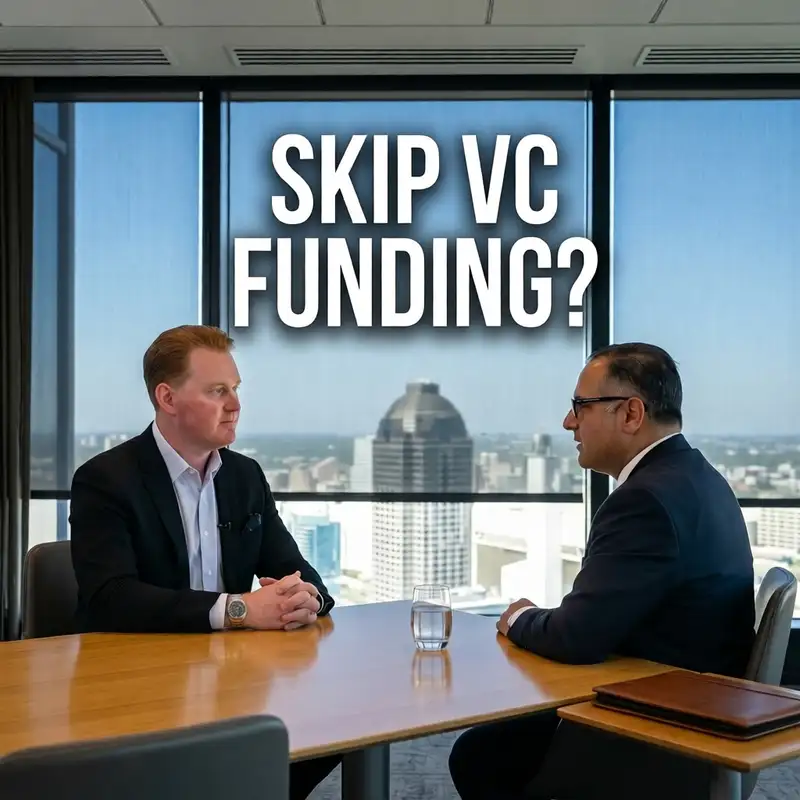
Why Smart Founders Skip VC Funding, And What They Do Instead | Erik Andersen, Toronto Stock Exchange
Download MP3[00:00:00] What's a misconception that kills a founder's interest when they hear the word go public? in the us, by far, I've been told by every advisor, we're too small and that is 100% true in the us. It is not true in Canada. You fit our sweet spot
as a founder, you hold onto more of your company. You flatten your cap table, now you answer to 50 bosses instead of maybe two VCs. Right? Okay. I have a hundred bosses, but they don't call me every day. So once you start answering the common shareholders, it's a lot easier to run your business.
It's a great stair step and I see this now. And you tailored it to the venture eligible world. Yep. And formed almost like a concierge program. Yep. Where you're holding your hand through the process and saying, Hey, look, here are your biggest risk exposures worth, this is an escrow and we're gonna walk you through this and that, and make introductions.
We have something called the growth accelerator, where you have in-house people with knowledge of what it's like being a public market company. Help you with your first reporting, other stuff that goes maybe you didn't think about as a first time C-E-O-C-F-O.
And it's these classes that you could take and help grow.
[00:01:00] Today's guest helps founders answer a question most are not even asking soon enough. What if venture capital is not your best move? Eric Anderson is the head of listings for the innovation sector in Texas and the Southern United States for the Toronto Stock Exchange and TSX Venture Exchange, where he helps grow stage companies, explore an alternative path to raising capital, accessing liquidity, and scaling through the public markets.
Before that, Eric built his career starting on Wall Street at Merrill Lynch during the mortgage boom, living through the financial crisis, and later working in institutional sales at Morgan Stanley and JP Morgan.
That gives him a rare lens on what founders think they need, what investors actually want, and where companies often misjudge their readiness for the next stage.
In this episode, we're talking about venture capital versus public capital. How smaller companies can go public earlier than most people think, and the hard truths founder CEOs need to hear when they start running into the real pressure of scaling.
And if you do here, I'm Joseph j Rader, a former Wall Street lawyer with more than 20 years of experience across a [00:02:00] hundred billion dollars in transactions. I'm also a former entrepreneur having launched two businesses. One I built and had a seven figure exit in less than three years. I rolled that into a national retail chain, lost it all during the pandemic, but I've rebuilt that.
I've generated tens of millions of dollars in both B2B and B2C sales. I've hit highs, had lows, and rebuilt from scratch. My law firm rates for PLLC focuses on mergers and acquisitions to buy and sell companies and assets as well as securities laws to raise capital. I'm licensed in both New York and Texas.
My podcast, wall Streett Wall Street is where we bring you real business lessons from seasoned operators, founders, funders, and executives who've actually lived and breathed businesses, ups and downs. I'm not giving legal advice here. Always consult your attorney about your situation. Enjoy the show.
. Eric, welcome to Wall Street. To Wall Street. I'm so grateful for you being here. I want to hear about what the Toronto Stock Exchange and TSX Venture Exchange is doing in good old Texas. Yeah, sure. Thank you very much. Thanks for having me. [00:03:00] It is a mouthful. TSX operates two exchanges. One is the senior board, the TSX, and then the TSXV.
It's for venture stage companies. So I am in charge of business development and capital formation for all Texas companies, all Florida companies, and anywhere in between. My goal is to educate them about what is possible as an approach, an alternative to venture capital, and what are the benefits to going public at an earlier stage are.
And that's generally what I do the majority of my day is talk to founders, entrepreneurs. Investors, what is possible by using this Canadian exchange and how does it fit into the overall ecosystem in North America? I can't imagine the conversations you've had going to these companies in the US and saying, Hey, have you ever thought about listing on the Toronto Stock Exchange?
Huge economy, huge exchange. I think you said they have 97% of the market, so completely makes sense, but I don't think something a lot of entrepreneurs even think is possible. But before we get into that, share with us a little bit of background about. what drove you to go into business, [00:04:00] kind of entrepreneurial Wall Street work and then talk to, walk us through your Wall Street experience.
Yeah, sure. So I grew up in New York City, grew up in Brooklyn had some exposure to it being in New York City. I think everybody's touched by Wall Street. Nine 11 happens. I'm in my freshman year of college and I'm. I want to, go help this country. And my dad pretty much who served in Vietnam, got drafted, said, no, you're going to college.
He was a firefighter among many of his jobs. He worked at the Metropolitan Opera House as well, a union guy, and he, he. He saw what the next generation of, young people maybe should aspire to, so that was my background. And then I switched in school to a business degree. I got very lucky. Timing is a lot oh five. When I graduated college, very good markets, very good time. We were in the midst of a housing bubble that no one, some people were calling it a housing bubble, but it wasn't broad scale yet.
It was still a boom. Yeah, it was. People were making money, realtors, people owned houses, people buying houses. Credit was easy, so the economy was. Was generally humming. And I went to work for Merri Lynch in 2005 as an analyst [00:05:00] on a fixed income training desk. I had no idea what that meant at the time.
But I learned very quickly how it progressed. And yeah, during that time I was also on Wall Street down in the world financial center and I was in asset backed securities. Wrapping those mortgages into MBS and RMBS. Securitized bonds and we were pumping out just on my team, five to 7 billion a month.
Yep. And it was just and if you remember back then they started doing these ninja loans. No income, no job, no assets. And it just started getting a little hairy. Yeah. Which you lived through that, that and so walk us through a little bit about that.
How did that progress with your career, Trent? It's really interesting. We probably walked past each other 'cause my first offices were two 50 BC Street, otherwise known one as four World Financial Center. I lived downtown, so I was a two. I was a two world. Yeah. That's great. Small I the dome small world.
Exactly. When I first started r and BS residential mortgage backed securities were very in vogue. They yielded more than treasuries, obviously, and they yielded more than a lot of corporate debt.
They also paid you monthly. So a lot of retirees love that. You could see that the risk was building up in [00:06:00] the system. Maybe not at my level. But there was an, it turns out there was endemic fraud at the top. But at the time in oh 5, 0 6, 0 7 things were going smoothly. The default rates were historically low and, wall Street did what it does best as it sells securities to retail and institutions and so times were really good bonuses were good.
We didn't really understand. I didn't understand why as a young person where I was, what I was doing, but I knew I was move this bond, sell this bond, close this deal, and move on to the next one. I wasn't a banker, but I was a fixed income trader, so that was my role at that time. And so moving from Merrill, where did you go after that?
I survived the great financial crisis. I like to tell the story that anybody who made any money. Or it was senior to me, either left or were fired. The economy rebounded so fast or the banking system rebounded. The economy didn't, but the bank system rebounded so fast, thanks to certain government policies that I worked my way up to actually fixing income trading.
And I had my own book of of bonds that I. Slang now, the world changed post Dodd-Frank. The ability of the bank to take the risk that it wants to decreased and [00:07:00] a lot of the risk went off bank. But I stayed until 2016 when I met a girl and decided that living in a small one bedroom co-op on the upper East side was too much for us and I certainly did not want to commute.
So we looked around and I said, where is, where's the next growth going to take place? And I had been to Dallas professionally and personally and they just had a huge, it's always known as a regional banking center. And in the eighties they got beat up a little bit, but it started coming back in terms of big wealth management books.
And I knew that how much money in terms of. Family offices were in Dallas. So I said Dallas, I'm gonna take a flyer. So we eventually ended up moving in late 2016. Sight on scene. My wife's actually Colombian, so I moved to Columbia for four months.
No, that's great. Chill. It was. It was amazing. . So happy to get out. So we moved to Columbia and then moved to Dallas, sight unseen.
Got a job working at Morgan Stanley and then JP Morgan doing institutional sales. So you moved to Dallas, you beat millions of New Yorkers and Californians, who are now having this exodus. Y'all street wasn't [00:08:00] even a thing. And now we have the Chicago Exchange is coming down, I think it is the nasdaq, and then we have obviously the TXSE. You were early, so you come down though, but you're a Morgan, right?
And and then JP Morgan, so Morgan Stanley, JP Morgan. At what point did you say I'm going to join the Canadian Stock Exchange? How did that it's a really interesting point. So the reason I got initiated with the Toronto Stock Exchange, my best friend and I, my golfing partner. Who I met at JP Morgan doing institutional sales, was actually a transplant Canadian from Vancouver.
His dad was the CFO of a fairly large TSX listed company. My boss happened to run into his boss in Vancouver. They like to talk, said, Hey, do you know anybody in equity capital markets? I'm a debt capital market guy. But that didn't stop my friend's father saying, yes, I do know somebody. So TSX was in 20 2020 looking to expand their geographic reach.
So historically, there's somebody in Chicago, somebody in la. We had somebody in New York and we wanted to expand to [00:09:00] the south. Obviously Texas was growing. TSX strategically looks for places that are not super heavy with venture. So we ignore Boston. We ignore San Francisco. They have their path and their path works for them.
But we want an alternative to venture. And so they started looking at where's the fastest growing part of the US 'cause it's a huge growth market for Canadians is the US And then they settled on Dallas. So the amount of money and people and operations in DFW. Yeah, made sense that it was home. Now, obviously it helps. I'm in Austin probably once every six weeks. I travel to Atlanta, Nashville Miami, Orlando places like that. But home is still DFW I think it's the third largest metroplex in the country. So it made sense from a strategic standpoint. For that. I tell everybody when you talked about one of the first people I met down here and who was a good old Texan, he said, don't bring your politics.
Down here. And I said, not only from New York's a liberal, not that's a bad thing, but it's just, it's okay. Yeah. And then once the California par people started moving in, no offense to the California [00:10:00] people, I was able to say, Hey, at least I'm not from California. Because they probably took it to a level that maybe some Texans were.
Yeah. Not comfortable with. I love that. That's good. No, but you've been here since 16, so two 16. Yeah. So I think it's in you now and you can get away from that. Although the New York accent never quite leaves. It never quite leaves. But what I was able, what I was able to do when I first got on the trading desks at JP Morgan, every person I'm speaking to they were like, can you please. Slow, slow down. So I got that after a while. It took me a while to, to, blend in a little as much as I can. Obviously it's the hardest thing, especially when you get inside and you love what you're doing. I just, and then you talk to someone in New York and it's oh, for the next week you're just fires back up going like that.
So what is. What is the process? So you, you reach out, you're reaching out to these companies, say a startup in Austin, and you go to them and say, Hey, have you you're talking to Venture right here. Have you thought about going this route? First of all, what size is the ideal customer [00:11:00] the ideal listing for your exchange?
Yeah. All great questions. So we'll tackle it first with what is ideal? What does ideal look like? And unfortunately there's not an answer to that. 'cause it changes what the market wants sometimes. Four years ago, the market wants burn at all costs. They wanna see you. If you're not growing at a hundred percent, I don't care what your bottom line looks like, but if your top line's not growing at a hundred percent, you're not ready for venture.
The market shifted a little bit in certain sectors. They're really looking at companies that have sustainable business models. Maybe some moats around them, but are still growing, right? So they don't need to see profitability. That's not an indicator anybody wants to see. Technically from a, a biotech standpoint, there doesn't necessarily need to be revenue.
'cause most biotech companies, even when they go public on a New York Stock Exchange, are pre-revenue. The investors wanna see, actually a good business that grow that could most importantly be helped by growth, equity, capital. It's great that you could raise $10 million. How is that gonna supercharge or turbocharge your growth and your path to profitability?
And those are the people I'm targeting where venture has always been. [00:12:00] The bastion of the elite in the sense it got democratized for a little bit. It didn't really work out when there was tons of venture splashing around the venture. People will tell you that what they do is important, but it's not for everybody.
And I would say the same thing for going public, but this sounds, what you're describing sounds like venture correct. But it sounds just like venture but it's democratized in the sense that it's public venture, the vast majority. Exactly. The vast majority of investors will be retail or small institutions.
Okay? Everybody will be a common shareholder. So from the entrepreneur who's listening to this, that means there's no liquidation preferences. That means there's no capital stacks, that there's all these rules that apply to later stage venture do not apply when you're a public company. Now you can have a dual class share structure.
Kind of like the Zuckerberg rule on our exchange as well, if the investors allow it. But I think that's the key differentiator between a Series B and a go public is everybody's a common shareholder on a go public. You could use your shares freely. You don't have this pressure to maybe move to the coast where your investors are.
You can't really get out flanked by your board. You can in certain [00:13:00] circumstances, but in the sense that. Okay kid. Thanks for taking us so far. Now we need a serious professional, CEO, and that can happen in venture land. And this kind of protects you against it. Oh yeah, absolutely. So basically to translate that for someone who may not understand, it's a better deal for the startup in most circumstances.
So nothing is free. The difference is now you have more disclosure, now you have more paperwork because you are publicly. Yeah. Now you have quarterly disclosures that you have to, get audited and reviewed. So there are more. Strings attached to the capitol, but formalities, yeah. On. We think at the end of the day, if you're an entrepreneur or a serial entrepreneur, is where we generally find the most uptake.
It's generally not the kid in the hoodie who has a great idea. They want venture, and venture is great, money's great. They want that venture stamp on them, and they don't understand maybe some of the pitfalls that go with venture as opposed to this public venture capital. So just on that note of.
Of quarterly reporting, there's talks to make it now to where it's on a six month basis to have kind of more long term, not such a myopic three month [00:14:00] outlook. Is there talk in Canada to do that? Yeah. There was actually, not to one up people, but there was actually talk beforehand, before the US administration wanted to talk about that.
We're actually in a pilot right now to do semi-annual reporting. There is pushback. A lot of people don't realize that London went to that. 10 years ago. Most people still report quarterly 'cause it's what their investors want. We don't think let me just say, this is my opinion, not opinion of TSX is if you are a smaller junior company and you're burning cash.
I think the investors are gonna wanna see quarterly reports. I don't think they're gonna wanna wait around six months. Apple could report once a year and everybody would be okay with that. They're not, there's not gonna be a going concern. I, overall it's good to have options that it's not mandated and imposed.
And if you ask why are there quarterly reporting? Nobody really seems to know. It just popped up in the seventies in terms of government structure. But I like that the markets are evolving and I don't think it's gonna be one reason not to go public would be too extra. Quarterly reports. I think [00:15:00] there are some other issues that are hampering.
There's a lot of pressure on the exchanges because there's a, there's obviously a lot of competition now amongst the exchanges. But also there's just a lot of companies that are just like, we're not going public or we're delisting it.
There, I think they're at a record low for the number of companies that are listed. That's correct. And do you think that's competition or just that there's more options for pools of capital or what is that? Yeah, certainly both. Both are true. At the same time, Canada's not immune. We have less, we have more listed issuers than the New York Stock Exchange, but if you look at an overall chart, it is decreasing.
There are more companies staying private for longer. I think the markets have evolved somewhat in terms of. Not only do you have a very large venture capital sector where people are able to raise enormous sums of money that were generally possible 10, 15 years ago. But you also have the secondary markets where people are actually getting liquidity.
In a nice, not so huge of a haircut. So you have both when you go private, you don't have the pressures of reporting quarterly. You don't have to explain your business to [00:16:00] anybody except your initial investors. The downside to that is you limit the pool of your investors. You have, you limit maybe the price of your shares.
Because generally when you're public, there's a premium to being public. 'cause the optionality, there's liquidity on the optionality. There's liquidity. Yeah, absolutely. So there's no one size fits all. I know Teche, one of the reasons the tech stock exchange is coming into view is to try to get more companies to go public at an earlier stage to get more of the wealth broadly distributed by investing in early stage companies.
And I think that's one of the main missions of hopefully launching the tech stock exchange. Yeah, I think the more. Exchanges there are, you don't want like an ungodly number of them, but it I think it helps. I think, I think it helps because it brings awareness that option is there.
And then you also, you have this rise of family offices and so much money concentrated there that they're putting to work. You sent me materials on the parameters and whatnot and there, there's a lot there. Can you just speak generally, like to a company that's out there, how long do they have to have [00:17:00] audited financials?
What kind of revenue or what kind of balance sheet did they have to have? Talk about some of the Sure. High level. Listing requirements. Yeah, sure. So we have something called generally, yeah, we have something called the minimum moisture requirements. There's two different standards for TSX, which is our bigger, more mature people.
But let's just talk about the TSXV, the V standing for Venture Exchange. And that's primarily the companies that I'm targeting, venture style companies. So the minimum moisture requirements you would need to be in business for at least two years. When you go public, you will need two years of audited financial statements.
They will be needed to convert it to IFRS, which is the international system. The US uses gap. That's not a big deal. 'cause generally if you're a private company, you don't have gap audited financials already. You're starting from scratch. Exactly. So a minimum risk requirement, you really need to be in business for at least two years.
So you can't be a startup with a great idea and expect to go public. In terms of working capital, the good news is we had a carve out for that. We like to see 18 months of runway. The majority of that could come from the raise. So if you can't raise any money, there's no reason to have a working capital [00:18:00] deficiency.
And then there a pers depending on how you go public, either there's a prospectus drawn or there's an offering statement drawn, or you do something called the reverse takeover. All that really means is. Depending on what legal formation you would have to, you obviously you're aware you back the company.
Yeah, exactly. And that's the simplest way. Now, in terms of, again, we talked about this briefly, the market is dictating what they want to see right now. Obviously. There's no minimum requirement. I would say if you're raising less than 3 million us, it becomes cost prohibitive to really Oh, wow.
Go through the whole thing. So about 3 million is where it makes sense. That's like the minimum, the average raise. The average raise on our exchange for a go public is about 6 million Canadian at a $40 million Canadian valuation. So if you wanna back those numbers up, let's just say. Started my Canadian friends, four and a half million US and probably a $30 million.
So very early stage. Yes, I talk to a lot of angel groups and I say, we're closer to you than you actually think. And there is a path to liquidity. 'cause a lot of people are stuck in funds right [00:19:00] now that are not paying any DPI, they're not paying any anything out, marking them like, oh, we have a three x return, but they're actually paying things out in there.
Those companies are even further away in the US and that's why we come in and we say, Hey. Listen you're gonna use the Toronto Stock Exchange and the Venture Exchange as a stepping stone to get to New York, to get to Nazi, to get to taxi. And that's the US person's message is use this for three to five years.
Grow your top and bottom line, pay your employees with shares. Roll up strategy are very popular, where you use your shares as currency to acquire competitors and you grow strategically through the business. Anybody who's been a public market CEO or CFO, the half the reason to be public is.
Liquidity and the other half is using your shares as currency. Yeah, absolutely. You're essentially your own treasurer. You minted your own shares and now you could go use them and maintain your precious cash on your balance sheet. And the same reason would apply to A-T-S-X-V company. It's even more important for them to maintain their cash levels as you have a company.
Absolutely. 'cause they're accountable more so than [00:20:00] before. I. When does the company know that it's ready to go that route? Yeah, it's a great question. The most successful companies we see, 'cause we see successes and we see failures. Going public does not mean you're guaranteed to succeed. Generally not to dissuade anybody, but generally we see it's either their second or their third company.
They've been through the vc, they know how to built and scale, they can multitask. I think a company's ready to go public when. They realize that they need to raise a certain amount of money and the strings attached will be too great for the founder's vision or the company's vision. And what I say by that is it's great to raise $20 million unless there's severe complications or handcuffs attached to that capital.
And that's becoming more and more frequent in venture land for all but the top of the top, I think people see venture capital raised more money in 2025 than it did 2024. The vast majority of that is going to the top 10 companies. So the outliers. The outliers, yeah. They're doing tremendously well.
[00:21:00] Valuation's a different story, but they're able to raise capital. And at the end of the day, that's almost more important than what valuation is. What's a misconception that kills a founder's interest when they hear the word go public? Yeah, sure. That I would say in the US by far I've been told by every advisor, we're too small at 10 million run rate.
We're too small, and that is 100% true in the us. It is not true in Canada. You fit our sweet spot for all the reasons we discussed. As a founder, you hold onto more of your company, you flatten your cap table, you answer, now you answer to 50 bosses instead of maybe two VCs, right? The same. The same in the wealth management model.
Okay, I don't actually have a boss for my financial advisor except I have a hundred bosses. But they don't call me every day. So once you start answering the common shareholders, it's a lot easier to run your business. Now there are, there is pressure from quarterly reporting. It's easier up and counter on the TSXV.
'cause again, there's specific rules that carve out. They understand you are a junior company and that you need. More help than say a fully built out finance team. The second biggest one is it's too much, right? It's too hard. It too [00:22:00] much time is taken away from the core business. Yes, there is time.
Devoted to being a public market, CEO in terms of investor relations quarterly reporting, getting on calls which there are services that help you with all of these things. Abso, there's a whole ecosystem for that, but even still, if you try to do a lot of it in-house, it is still manageable, especially if you run a fairly simple business, right?
People think of these giant businesses where they have. Floors and floors are built out, finance people. But if you're running a $10 million business, it's a great business. You've already done something that a lot of people have never done, will never do. And maybe instead of, going to the later on VC where they could have preferred shares, maybe you kick the tires.
So I tell everybody to dual track it. There's not one right answer. There are the perfect public company again, as we discussed, will. Their growth will benefit tremendously from that growth equity check. They raise the hockey stick growth that everybody talks about, the ability to go to the market, to finance again and again.
That's another good business. If you're growing, [00:23:00] if you're getting one check and scaling your business to sell it. You're not a public market business. There's nothing wrong with that, but you're just not a public market business. No, that's a good point. Because if you need a second round or third round, you don't have to go through the whole pitching process again.
You're already listed and you're like, Hey, we're gonna, float some more liquidity here. And I tell everybody the I in IPO stands for initial. Yeah. That it's your first round, then you're gonna do your second round, third round. Hopefully you, if you grow business, you'll get to debt one day where you don't have to, keep, but that's not possible in the venture capital world.
For right now. Yeah. No. Interesting. So talk a little bit, how long does it take generally, say, a $5 million raise? It's a smaller raise. Yeah. You're going to, and you're gonna raise 5 million generally how much work month wise, behind the scenes? And if you can share generally how much are the listing fees and whatnot?
Yeah, sure. So everything's public. Everything's in financial statements. Once you if a company does get to the final line and does go public, you could go up on C or Edgar look at their prospectus and they'll detail exactly all their costs. I would say this. Because it's venture firms and you can't go the traditional [00:24:00] IPO route.
And what I mean by that is in the US you would go to a banker and you're a much larger company, so you're doing $200 million run rate and you're like, Hey, I really need this growth equity check. I could get to a billion dollars run rate, right? And you go to a banker at an unnamed firm and. You got it.
Sexy business. I'm gonna raise you a billion dollars. Don't worry about it. We're gonna do it at X percent. You sign an exclusivity agreement with him, for the most part, they have six months. As soon as you sign that agreement, it feels like they forget about you and they move on to their next thing.
But the interim, what the company in the US has to do and it does happen in Canada, but not for venture companies. They have to, do audited financial statements. So they're coming out of pocket millions of dollars. For the us they're getting their prospectus drawn out and they're coming out hundreds of thousand dollars the line.
And at the end of the day, there could be no money there 'cause the banker couldn't raise it or couldn't raise at the valuation. In Canada, things are reversed. We understand that you're venture companies and you need the money secured first. So part of my job is to get people interested, understand their business, connect them with bankers and capital providers.
So you guys do this? That's all I do. Okay. [00:25:00] I both sides of the street. Wow. And I say, and not just network in Canada, people here as well. 'cause the majority of the raises that we're seeing now are 50 50. 50% comes from Canada, and the other 50% comes from either my network year or the founder's network as well.
People wanna see skin in the game, but the money is secured first. So what the company and the founder does is they go through the pitch contest, the road show, if there's no money to be raised or they're not right, or they can't raise at the valuation they want. There's no cost out of pocket.
There's some time, generally it's by Skype or Zoom. But the money in a perfect transaction, they go to raise $5 million. They build their syndicate. That money will go into escrow and sit there. Wow. And then they come out of pocket with audit of financial statements. You need two years, as we discussed, knowing the money's there.
That's it. They can get these statements and everything done and the perspective's drawn out. And then once that all comes together, try par amalgamation a nice fancy lawyer term. Basically, the money's released for general corporate purposes. That's the key ball game. I am not telling you to pay professional service fees when there's [00:26:00] no money at the end of the rainbow.
You are gonna use my network. Your network, the capital's gonna be secured. If it is secured, it's not guaranteed obviously. But once it's secured, it sits in escrow and then you come out of pocket for the various expenses. And that's the only way it really could work. 'cause a venture company can't spend.
So you talked about cost, right? This is just an average. I don't want to make any lawyer lawyers. There are expensive lawyers and then there are budget friendly lawyers, although they're. Few and far in between. But a go public we generally like to say is about 500,000 us. You could do it for cheaper.
You could do it for more, but that's all in, that's the cost fee, audited financial statements, your marketing expenses, your your lawyer fees, where they drop drift or perspectives from an offering statement, and then the fee of the exchange. And the fee of the exchange is all public. It's based on a sliding scale about how many shares you issue and your market cap.
At the time it's capped at 70,000 Canadian, so that's about 45,000 us. Okay, so we're talking about. Fractions of the cost of the us. Again, extremely reasonable. The only way the system works right is [00:27:00] because the money sit in escrow first rather than coming outta pocket. 'cause they're venture companies.
And then once you list the professional service firms and costs are dramatically lower up in Canada, then they are in the US And then we have our version of the SEC. There's different provincial ones and they're much less combative. And I think the biggest difference that doesn't get talked about a lot unless you're on a public board or.
CFO or CEO is directors and office insurance. I know tech is trying to do something about that with their business courts in Texas where they're limiting some. Liability for board and officers. It's still not there yet, but in Canada they have a different legal system in terms of it's a loser pay lawsuit, so there's not these frivolous shakedown lawsuits.
So a major cost of being public in the US is d and o insured. That doesn't exist at this scale. That it does in Canada in a good way so that there are immense benefits. And it's well thought out. The key part is raising the capital. Can you raise capital? Interesting. Do they have to form like a Canadian SPV or anything like that?
[00:28:00] So no. SPV, there's no legal requirement to form a Canadian C Corp, their version of the Canadian C Corp. Sometimes it does help to put a Topco up in. For reporting purposes, but it's not necessary. They don't have to open an office. They don't have to do anything. No you don't need people operations.
You don't pay taxes up there unless obviously you have revenue up there. So it really is just utilizing the Toronto Stock Exchange in a way. That you would utilize any other business in any other state or country. There's a lot of people that are listed on the New York Stock Exchange that don't have operations.
I shouldn't say a lot. There are some companies that obviously don't have operations in the US that are listed on the New York Stock Exchange. Yeah. The vast majority of their operations are in Europe, but they still realize that pool of capital is where they need to be. Yeah. Same thing with the London Stock Exchange.
So we're just another. Avenue for founders, entrepreneurs to raise capital, to get liquidity to grow their company, and then when they're ready and relevant, everybody wants to, whether they're a Canadian born firm or a US born firm, if they're building a public market company. They wanna be listed on a US exchange and you tailored it.
It's a great stair step. And I see [00:29:00] this now and you tailored it to the venture world or the venture eligible world. Yep. And formed almost like a concierge program where you are holding their hand through their process and saying, Hey, look here, your biggest risk exposures worth, this is an escrow and we're gonna walk you through this and that and make introductions and when they go public not to.
Tap ourselves in the back, but we have something called the growth accelerator, where you have in-house people with knowledge of what it's like being a public market company. Help you with your first reporting, help you with wow. Other stuff that goes, maybe you didn't think about as a first time C-E-O-C-F-O, and it's these classes that you could take and help grow.
And then we have additional advertisements that we do. We can't really. Specifically advertised for stock, and I have to be like, conflict issues. It's, I have to be especially careful. They exchange, right? So we have to play fair, but we will say, Hey look, who just listed, here, find out more about them here.
And we do that for free for them and, but the same kind of boilerplate. Correct ment and the same thing me. So I had to give up my licenses, my FINRA licenses to get this job. And I have to be very careful [00:30:00] because I wanna stay in good standing with finra. I have to be very careful when I speak about I'm not promoting a specific stock.
'cause then I would be. Off guards of what I'm supposed to do, right? So my role is just, Hey, did Brandon Ambassador, did you know about this exchange? Did you know what's possible? Do you know? Who's listed there? Do you know these US based firms that are listed there? So we have about a hundred US firms that are currently listed, especially including tenant techs.
That's amazing. So what's the success rate going to the number of listings? Is it that 50% get listed to try it? Is it 80%? Is it a higher ratio? Yeah, it's very low. It's a low, it's a low volume game. The vast majority of people, if they're able to raise capital, they generally go forward with the listing.
It's the raising the capital part. And just like venture is extremely selective. Oh yeah. The capital providers up, there're all looking for the best in show. And so it is a low volume game. Obviously if a big game gets behind you, they could push you over the edge by either cutting a larger check.
But it's a, I would say the vast majority of people that I send up north are [00:31:00] great companies, but they're, they either can't raise the capital or they're not at the right place at the right time. Could just be bad timing. It could be where the market is exactly where the company is of the cycle.
Right now, AI's in vogue and if you try to raise for a SaaS business Yeah. SA was just hot. Yeah. Six months ago, but now it's not in vogue right now. So yeah it's, we build a big pipeline. We have a, as you listened to our CEO talk about, we have about 3000 names in our pipeline. I think really it's more like a hundred, I would say if we did a.
From the us. If we did 20 listings a year from the us that would be a nice year. It would be close to a high watermark. So the selection, right? This, everything here matches up with vc. It's just vc. But there's an exchange and. Yeah, it's correct. It's not easier than vc. It's not, it may be slightly easier to raise in vc, but it's still has its own host of challenge.
These are sophisticated investors Yeah. That are looking for VC like returns. They're just more comfortable doing it in a liquid format, right? Yeah. Regulated than liquid. So talk about once success happens for those. The do list, how many have you guys seen off board to NASDAQ and NYSE? [00:32:00] Yeah, so that's certainly the pitch for the US companies, right?
The pitch is to grow. Either be acquired at a higher premium 'cause you're a public market company and they can pick up your shares or transition to New York Stock Exchange or nasdaq. And now obviously we talk about taxi, we had about 220 over the last 10 or so years, 12 years now that have transitioned and and have done that move.
Now that's all in, that's either Canadian companies or US companies split out who come. One of our recent successes, and we were not. Again, this is not a solicitation to buy. It was real brokerage. Real brokerage was a Chicago based firm. Did online brokerages. They right place, right time. The housing bubble this time, this lady's housing bubble and I think it was 2017, they went public.
They raised a million and a half dollars. They executed on the business. They were on Nasdaq within two years. Wow. At almost a billion dollar company. Now they've come off a little bit. Obviously there's. The housing market has come off especially, yeah. But they're one of our best success stories.
Wow. The Israeli founder very bullish on what was possible, praises us for saying, couldn't be there. But I would say, within one year [00:33:00] there's something called MJDS, which is a legal term, which says basically if you are listed on the exchange, meaning the Canadian Exchange, it's a seamless process to list on the US Exchange.
It's following S one. Cheaper, easier. So that will be the fastest somebody could do it. Generally it's about three to five years when they, if they reach the scale to absorb all the costs to being a public market company in the us. That's all fascinating. And. I love what you're doing.
I love that you're bringing essentially a quasi VC stock exchange amalgamation available, and holding hands where in the sore points where it's necessary. Let's go back to the capital raising part and talk about how, just generally, whether it's VC or getting on TSXV what is the fastest way a founder destroys their leverage in a capital raise?
Yeah. It's a really good question. And VCs are notoriously private for why they turn your way or they don't turn your way. I think what's happening now is a lot of group think who's else is in on it. If they're in it, I [00:34:00] wanna be on it, right? And I know there's a, I fall some of it. There's a whole VC community that is going away from the mega rounds and the big rounds.
I would say if you can't clearly annunciate not what the capital's gonna do for your business, but what the capital is gonna do for their. LPs then I think that's a small distinction, but it is a big one. So a lot, I think a lot of people get bogged down in saying, you are gonna gimme, I'm gonna raise $5 million.
I'm gonna hire X, Y, Z, engineer, X, Y, Z sales person. Okay, how does this return my, 'cause everybody's looking to return their fund, right? And VC borrow. So I think if you speak more to what is this and clearly show them, don't just make it up, obviously, clearly show them how you give me this capital. It's gonna be a fund returner for you.
And I think that's what the VCs want to hear. I would say in the public market it's a little different. You wanna be more prudent with the money than just swinging for the fences. But I would say getting caught up on the minutia of the business where the. I think a lot of the investors say if I wanted to run a business, I [00:35:00] would, I'm an investor.
Tell me what, I give you X money, what do I get back? And y So I think that's the best way to do it, obviously within reason. We hear some people talk about total addressable markets. Some people tell you they're nonsense. Okay, great. Like how? I don't want to hear that. What are you gonna do with the cash I give you to generate?
At the end of the day, they're just looking for more cash back. And I think that's, I think if more people talk to VCs and inve, this is just my two sons more VCs and investors like that, and I get it their day-to-day life, they probably spend more time with the business than they do with their wife and their kids.
And they're excited about the business. They want to talk about the business. I think most VCs and investors don't necessarily wanna hear about the business per se, but about what the business can do for their capital invested their return on capital. That, that's my 2 cents. Obviously, talking about the business is good.
Having a defensible business is great. It's getting harder and harder with AI to say, okay, I have a mode around my business unless you sell McDonald's. But that would, I say the biggest pitfalls when I see pitches to myself and listening on pitches to [00:36:00] backers. So focus on what it's going to do for them.
If you're gonna talk about the team, you're gonna be bailed out. Translate that to how that's gonna impact ROI and not just make your life easier or something like that. And, use of proceeds is key, but Sure. But it has to translate. Yeah. But I think most, I think most VCs will hear the same pitch.
And I, everybody thinks their business is special and different, but most of the businesses are pretty similar. You are gonna hire a sales person or you're gonna hire a data scientist. They get that, I think they want to see, okay, how is this person gonna be a better steward of my money than person B?
Because that really, when you're com, when you are talking to a VC or an investment banker you're not competing with them. You're competing with the company that just came in before you, or the company that comes in just after you. So true. 'cause these, they're seeing, at least in VC land, they're seeing multiple pictures a week.
Sure. And so they hear the same story. They can really read, they can drill down. They know within the first, and I guess every VC is different, if you're early stage, you bet more on the. Founder and the people and their background, if you're a later stage, okay, is this defensible or which [00:37:00] strategic buyer's gonna come in and buy it and get my money back?
So we had a big exit in not us, but Brex was a FinTech business out in San Francisco. They raised money at a 12 million valuation. They ended up getting sold for a 6 billion valuation. So you, at first, you. These later stage series D and E rounds who came in with significant capital they have liquidation preferences.
So they, they almost have the private equity model where they're getting their initial capital back one way or the other. Unless the business completely fails and anything else is gravy on the upside, right? So every VC, would not be created equal. A later round VC is looking at completely different stuff than say a seed or a series A vc.
So I think that's another way to look at, consider your audience. But I, again, I generally focus on. C series A, and maybe it used to be B, but now the numbers are getting so large that B'S kind of our hour realm already. If you're raising a hundred million dollars, you are not a good fit for the TSXV.
So the VC lens you were just talking about, does that apply also to the investors on TSX? Somewhat. But it's [00:38:00] different. 'cause in this case. You are pitching the gp, we'll say the investment banker, we'll call them the GP who are then pitching their book. You're never pitching the LPs. And so you really need to convince the gp that this is a good raise to do.
And I think it's closer to closer, you're closer to the LPs than you are in the VC world. 'cause in a perfect VC world, they've already raised their capital and they're like, I trust you. And when a banker does a raise. He is, this is new, this is fresh. I just talked to him. So I think you have an easier shot at raising from a banker, which sounds crazy than you do a vc, but I think numbers would prove me out on that.
If you go through this process and say you get capital locked up in escrow, it's not guaranteed. And then you go through this process, do you come back again a year, three years later? Do you see people doing that in terms of a new company or tapping the market?
A new company trying to get listed on TSXV. You get money locked up. There's a low success rate, right? I don't know what the percentage is, but it's [00:39:00] low. Just like general vc. Yeah. Do they come back later? Do you see them coming back years later or, yeah, sure. Even a year later. Sales. The sales cycle's very wrong.
Generally, once the money's in escrow though, there're a go. Okay. If the money sits in escrow, yeah, if the money's in escrow, there're a go. Okay. Something would have to materially be deficient and there are the financial statements, or God forbid there's. A problem with a founder. But once the money's in escrow, you're generally a go, right?
You're, you've had the initial vetting. You've been vetted initially full steam. Yeah. Then, the financial statements and background checks begin, and then there could be some hiccups, right? But generally once the money's in escrow, the valuations agreed upon and the amount you're raising is agreed upon.
So now it's just on the company to, in a timely manner to produce their other financial statements. And obviously the auditors can say, Mr. Investor, there's a giant hole here. Generally that does not happen, but there isn't that. Massive level of diligence. So in terms of companies that can't raise, we'll, say we, our sales cycles along we, we have bankers that say, hit X, y, Z benchmark and come back to us in 12 months.
Kind of, so there's feedback and, okay, so there's [00:40:00] more feedback than the VC world, let's just say that. There's more we love you, but No, and they don't. Sometimes some VCs don't wanna lump everybody together. But yes, our sales cycles along, we take multiple runs of multiple companies during their lifestyle their, life cycle.
I would say, and so we've seen repeat bosses up in Canada have it a little better than me where they see Canadian cos over decades, maybe not a decade, maybe a decade. Initial not ready, courting not ready. Okay. Market's really hot, let's go. In the US it's a little different. We generally get a hotter prospect who's ready to either dual track it, they're either raising that A or they're going public.
And if we don't come through, the Canadian investors don't come through, then they're raising that A generally what happens, and there's no rule, but generally once you're into your series A or B and you have institutional people with preferred shares on your cap table, they effectively have a veto over whether you want, where do you go next?
Not a foolproof Vito, but when. If, say, let's say there's a technology company that raised a hundred million dollars in a series B and [00:41:00] they have, liquidation preferences and they have preferred shares on their cap table from institutional VCs, those VCs will lose their preferred shares when they go public.
So they will generally fight that as you would as well, right? You wouldn't wanna lose, you invested in the money, you invest in the company and you have these preferred chairs as security. They would veto you. So I would say if you are a company that does not have institutional capital, you're still a great fit for us.
You're in that sweet spot. You are right in the sweet spot of where I operate. Yep. Which is the capital raising from five to a hundred million. Yep. That's that's my security side of my law firm is in that sweet spot. What are some of the. Biggest objections you get because I, I see the clarity here.
I see the benefit, and I see the processes established. What are some of the biggest objections you get from people when you, 'cause I can't imagine you're going to these companies in Texas saying, Hey, go up north. Yeah. What do they say? So a lot of it is, I've never heard of it. And they're right off the bat, wary, of to do.
And we could show them, here's our track record, here's [00:42:00] companies. Here's success stories. Here's failure stories. The second one is, I don't want to deal, I'm building out this business. I don't have time to be a public market, CEO, right? So they think the lift is much heavier than it actually is.
And the third one is, like. Why Canada? I don't get it. And that's really my role is to really come in and say, you're not choosing Canada, you're choosing a Canadian exchange that's gonna allow you to do X, Y, z kind of what I talked about. Don't show me what it's gonna do. Show me how it's gonna affect your company in terms of dollars.
And that's really the message we get across
we wanna do business. I wanna finish with how, if someone is interested in getting listed, where do they go?
How do they get a hold of you? Yeah, sure. So I'm sure we'll include a link at the bottom of this but us.tsx.com, they can email me directly. We'll include that in the link as well. I am the rep for Texas all the way to Florida, so anywhere in between. If you are listening to this and you're not in Texas or Florida, we have somebody in California.
We have somebody in Chicago. We cover the states pretty wide. And then I'm gonna do a shameless plug. I'm doing an event in Austin. It's [00:43:00] one of our big events. We call it the flagship events, where this time we bring the lawyers, the bankers, and the capital providers down to Texas. They meet one-on-one with select group of private companies to understand what a capital raise looks like.
Understand the intricacies of going public. How do we get more customers in Canada, if that's what they want. How do I sell to a strategic. In Canada. And that's the genesis of the event and that's May 12th in Austin, Texas, May 12th, 26, Austin, Texas. I'm looking forward to that. I am going to that.
I'm looking forward to that. And if someone needs to get a hold of a different area, they can reach out to you and I'm sure you can put them in touch. Eric Anderson, this was very informative, awesome. And opened up the whole, the world to a different area that I didn't even know existed. Thank you for this.
This was great. Appreciate, I appreciate it. Thank you very much for having me. Thank you.